




Barrier Film Materials for Vacuum Packaging: Performance Factors That Matter
Barrier film materials vacuum packaging choices shape far more than package appearance. They influence oxygen exposure, moisture control, seal reliability, line stability, and the usable life of products moving through food, medical, and industrial supply chains.
That is why material selection has become a practical evaluation task rather than a routine conversion step. In many applications, the film must protect the product, survive handling, and still run efficiently on forming, filling, and sealing equipment.
For companies comparing specialty films, APIM often frames the question in material terms first: what barrier is needed, what process window exists, and what failure mode is least acceptable.
What barrier film means in vacuum packaging
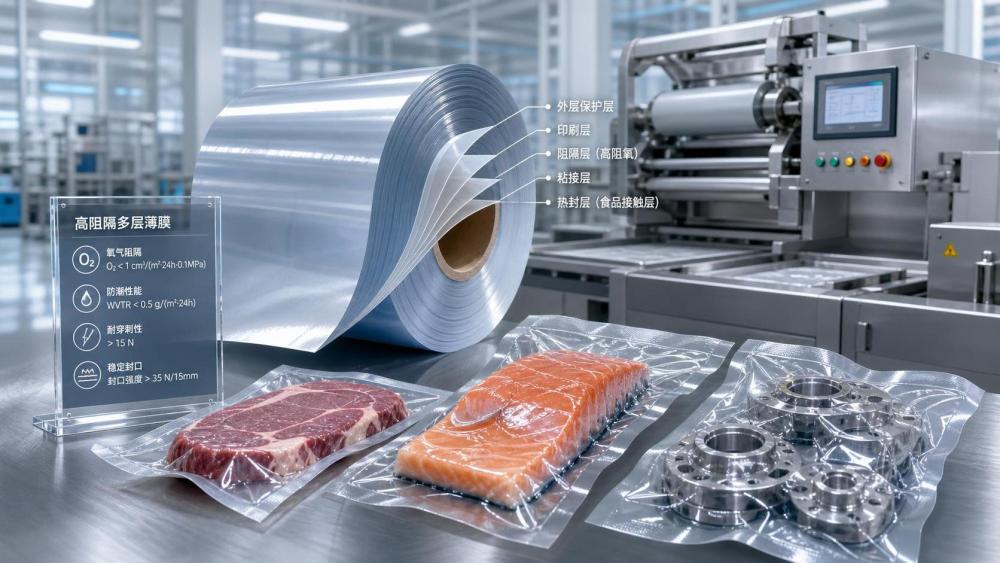
In simple terms, barrier film materials vacuum packaging systems use polymer layers that slow the transmission of gases, water vapor, aroma compounds, and sometimes light.
Vacuum packaging removes air from the pack. The film then becomes the main defense against oxygen re-entry, moisture shift, contamination risk, and mechanical damage during storage and transport.
A basic monolayer film may seal well, yet fail on shelf life. A high-barrier structure may protect the product, yet create forming or sealing problems if the structure is poorly matched to the application.
That balance explains why barrier film materials vacuum packaging evaluation usually focuses on structure, not just resin family. Layer order, tie layers, thickness distribution, and orientation often matter as much as nominal material type.
Why the topic matters now
Performance pressure has increased across multiple sectors. Food processors want longer distribution cycles. Medical packaging needs consistency and compliance. Industrial products need cleaner protection against corrosion, moisture, and contamination.
At the same time, converters face thinner gauges, cost pressure, sustainability targets, and tighter tolerance expectations. A film that looked acceptable in a lab trial may perform poorly on a faster commercial line.
This is also where broader material intelligence becomes useful. APIM’s coverage of extrusion technologies, specialty films, modified polymers, and process control reflects how barrier performance is built across the full manufacturing chain.
The real issue is not whether a film is called high barrier. The issue is whether its measured properties remain stable under the actual package design, product chemistry, storage climate, and machine conditions.
The performance factors that usually decide outcomes
When teams compare barrier film materials vacuum packaging options, a few technical factors consistently carry the most weight.
Oxygen barrier and moisture barrier
Oxygen transmission rate and water vapor transmission rate are usually the starting points. They determine how quickly a package loses protective performance after sealing.
EVOH is often selected for strong oxygen barrier. Polyamide can improve toughness. Polyethylene supports sealability and moisture resistance. PET may add stiffness, clarity, and dimensional stability.
The right combination depends on the product. Dry goods, processed meat, cheese, pharmaceuticals, and corrosion-sensitive components do not require the same barrier balance.
Puncture resistance and flex durability
Barrier performance is irrelevant if the film cracks, pinholes, or tears. Bone-in meat, sharp-edged parts, and irregular products can quickly expose weak structures.
Flex cracking is especially important in multilayer films. Repeated bending can damage fragile barrier layers, especially where low temperature, tight folds, or distribution vibration are involved.
Seal integrity and hot tack behavior
A package with excellent barrier still fails if the seal channel leaks. Seal layer selection, contamination tolerance, seal initiation temperature, and hot tack strength all influence closure reliability.
In vacuum packaging, film collapse around the product can create stress points at the seal. That makes seal design a functional performance issue, not a secondary packaging detail.
Thermal resistance and process window
Some applications involve hot filling, pasteurization, retort exposure, or post-pack handling under elevated temperature. Others require freezer resistance and low-temperature impact strength.
A film may test well at room temperature and still fail during thermal cycling. Material compatibility with the full temperature profile should be checked early.
How multilayer structures change the decision
Most high-performance barrier film materials vacuum packaging formats are multilayer because no single polymer delivers every required property.
The structure normally combines barrier, mechanical strength, sealing, and sometimes print or thermoforming functions. Tie layers and co-extrusion quality are critical because weak interfaces can reduce reliability.
For technical review, the question is not just what materials are present. It is how those materials interact under draw ratio, sealing pressure, cooling rate, and storage exposure.
Application context changes the priority list
Barrier film materials vacuum packaging requirements vary widely by use case. A film selected for fresh meat may not fit electronic assemblies or medical devices.
- Food packaging often prioritizes oxygen barrier, puncture resistance, seal contamination tolerance, and visual presentation.
- Medical and pharmaceutical packaging often adds sterilization stability, cleanliness, traceability, and consistent seal performance.
- Industrial packaging may focus on corrosion prevention, abrasion resistance, and transport durability.
- High-value components may require anti-static, low-outgassing, or specialized chemical resistance beyond standard barrier needs.
That is why direct substitution is risky. Two films can show similar barrier data on a datasheet while behaving very differently after thermoforming or vacuum drawdown.
What to verify beyond the datasheet
Datasheets remain useful, but they rarely capture the whole decision. Practical evaluation should connect measured properties with line conditions and downstream handling.
Check test conditions carefully
Barrier values depend on humidity, temperature, and sample conditioning. Comparing two films without matching test conditions can lead to false conclusions.
Review thickness tolerance and uniformity
Thin spots can create weak areas in barrier and puncture performance. Gauge consistency also affects forming behavior and sealing repeatability.
Link film design to equipment capability
Film structure should match the actual process. Co-extruded and laminated films may respond differently to draw depth, dwell time, and sealing jaw temperature.
Consider supply consistency
For ongoing production, batch variation, resin sourcing, and process stability matter. APIM’s broader supply chain perspective is relevant because packaging reliability often depends on upstream material discipline.
Sustainability adds a second layer of evaluation
Sustainability goals are influencing barrier film materials vacuum packaging development, but performance tradeoffs remain real. Recyclability targets often favor simpler structures, while high barrier usually pushes designs toward complexity.
The practical question is whether a downgauged, mono-material, or recycled-content option can maintain barrier, machinability, and product protection at commercial scale.
In many cases, the best route is staged evaluation. Start with product sensitivity, then map barrier needs, then test whether a lower-impact structure still protects against actual failure modes.
A useful next step for material comparison
A sound review process usually begins with five questions: what must be blocked, what mechanical loads occur, what thermal exposure is expected, what machine limits exist, and what compliance or sustainability targets apply.
From there, barrier film materials vacuum packaging options can be screened more clearly. Shortlist structures by application risk, not just cost per kilogram or nominal barrier rating.
Where the decision is complex, it helps to compare film chemistry, multilayer design, extrusion quality, and converting performance together. That approach usually produces fewer surprises than evaluating each variable in isolation.
The strongest results come from treating barrier film selection as a material systems decision. Once the required protection profile is defined, testing and supplier discussions become much more precise.
Have questions about this sector analysis, or seeking best practices specific to your niche? Drop us a line below and let the senior consultants at APIM assist you.
We respect your privacy. Your information is strictly confidential.
Related News
- 00
0000-00
How does washing affect contamination in post-consumer recycled PP resins? - 00
0000-00
How does feedstock affect depolymerization equipment selection? - 00
0000-00
US Sets 213.44% Preliminary Antidumping Deposit on Chinese PTMEG - 00
0000-00
When should epoxy be used as a thermal interface material for semiconductors? - 00
0000-00
US Midterm Results Unlikely to Quickly Shift Recycled Plastics Market or Legislation