




Are EVOH Barrier Films Worth the Extra Cost for Food Packaging?
Are EVOH Barrier Films Worth the Extra Cost for Food Packaging?
For packaging buyers and food manufacturers, a higher film price only makes sense when it delivers measurable value. EVOH barrier films can justify their premium when oxygen exposure limits product quality or shelf life. They are harder to justify when moisture loss, seal failure, microbial growth, or slow stock rotation is the real problem.
The decision is not simply “high barrier versus ordinary film.” It is whether a particular multilayer structure protects a particular food throughout processing, distribution, and storage—at an acceptable total cost. Humidity, forming depth, sealing conditions, and recycling requirements can change the answer considerably.
What does EVOH actually add to a food package?
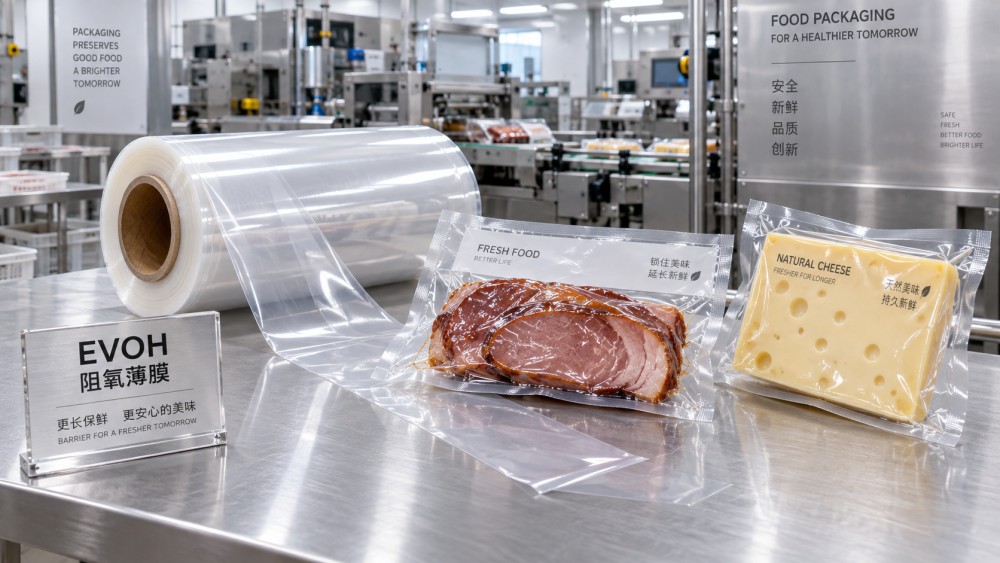
Ethylene vinyl alcohol, or EVOH, is primarily used for its strong oxygen barrier. In food packaging, it normally appears as a thin functional layer within a coextruded or laminated structure, rather than as the entire film. Other layers provide moisture resistance, toughness, printability, and heat sealing.
A representative coextruded construction is PE/tie/EVOH/tie/PE. The tie layers help bond polymers that would otherwise adhere poorly. More demanding applications may include polyamide for puncture resistance or use polypropylene-based structures where the processing conditions require it. The correct construction depends on the application, not simply on whether EVOH is present.
EVOH can slow oxygen ingress and help retain certain aromas. It does not remove oxygen already trapped in the headspace or dissolved in the food. A poorly controlled gas-flushing process can therefore undermine an otherwise excellent barrier film before the package leaves the line.
It also does not automatically provide a strong water-vapor barrier. That function typically comes from other layers. Treating “barrier” as one universal property is a common specification mistake: oxygen transmission and water-vapor transmission need separate targets.
Which foods are most likely to justify the premium?
The strongest candidates are foods whose commercial life is meaningfully constrained by oxidation or oxygen-related quality changes. Examples include processed meats, some cheeses, nuts, fatty snacks, and selected prepared foods. The mechanism matters: protecting fats against rancidity is a different task from controlling discoloration or preserving a modified atmosphere.
Consider sliced cooked meat distributed through a refrigerated supply chain. If the pack must maintain a low-oxygen atmosphere over a relatively long selling period, oxygen ingress through the film may become important. However, the benefit still depends on residual oxygen, seal integrity, hygiene, and temperature control. EVOH supports the packaging system; it does not replace those controls.
For nuts, the question may be whether oxygen exposure causes unacceptable flavor changes before the intended best-before date. A barrier upgrade can be sensible, but only if the existing package is the limiting factor. Light exposure, storage temperature, and the initial condition of the nuts can also influence oxidation.
Fresh produce requires a different approach. Respiring products often need a carefully balanced exchange of oxygen and carbon dioxide. An extremely low-permeability film can be inappropriate unless the package incorporates a validated gas-management design, such as suitable perforation. More barrier is not always better packaging.
How much extra shelf life should buyers expect?
There is no reliable universal answer. A supplier’s oxygen transmission rate, or OTR, describes barrier performance under specified test conditions. It does not directly predict how many additional days a food will remain acceptable.
Shelf life ends when the first relevant limit is reached. That might be sensory deterioration, microbial growth, moisture change, texture loss, or a safety criterion. If microbial spoilage occurs before oxidation becomes noticeable, improving oxygen barrier alone may add little usable life.
Ask for OTR results with the temperature, relative humidity, test method, and film thickness clearly stated. ASTM D3985 and ISO 15105-2 are examples of methods used for gas-transmission measurements. Figures should not be treated as interchangeable unless the measurement conditions and reporting basis match.
Then validate the finished package with the actual food. Include realistic storage and distribution conditions, rather than only ideal refrigeration. Reduced-oxygen packaging can introduce food-safety considerations, so longer shelf-life claims need appropriate microbiological assessment as well as sensory testing. A better OTR result is evidence of improved barrier—not proof of a safe extension.
Does humidity weaken EVOH enough to make it unsuitable?
Humidity is a genuine design consideration, not an automatic reason to reject EVOH. The polymer absorbs moisture, and its oxygen-barrier performance can deteriorate as moisture exposure increases. This is particularly relevant when comparing dry-condition data with a package containing a moist food.
Protective layers such as PE or PP help manage moisture exposure, but they do not make the EVOH layer permanently immune to humidity. Layer thickness, storage duration, temperature, and moisture conditions on both sides of the package affect performance. Resin grade matters too; EVOH grades differ in their balance of barrier properties and processing behavior.
Hot filling, pasteurization, and retort processing deserve separate scrutiny. Moisture and heat can temporarily change barrier performance, and recovery afterward depends on the structure and conditioning environment. Do not assume that a film suitable for chilled cheese is suitable for a heat-processed meal.
For these applications, request data after the intended thermal cycle and under relevant storage conditions. A room-temperature datasheet alone is not enough to qualify the package.
What costs are hidden behind the film quotation?
The premium includes more than the EVOH resin. Tie layers, coextrusion complexity, layer-gauge control, production scrap, and qualification work can all affect the converter’s selling price. Specialized structures may also bring higher minimum order quantities or longer replenishment times.
On the packing line, a new structure may behave differently during forming, cutting, sealing, and winding. Changes in stiffness, friction, or seal-window behavior can affect output and reject rates. Those effects belong in the business case, even when the quoted film price looks attractive.
Compare cost per usable package, not only cost per kilogram. Film density, total gauge, package dimensions, and scrap influence how many saleable packs a roll produces. A lower price per kilogram can still result in a higher packaging cost per unit.
The practical break-even question is whether avoided write-offs, returns, or other verified commercial benefits exceed the additional packaging and operating costs. Longer shelf life has little financial value if inventory already sells comfortably within the current window. Conversely, a modest extension may matter when distribution lead times routinely consume most of that window.
Can seals and thermoforming cancel out the barrier benefit?
Yes. Oxygen can enter through leaks rather than through the film itself. Product contamination in the seal, wrinkles, punctures, and poorly matched lidding materials can make an expensive barrier layer largely irrelevant.
Thermoforming introduces another issue: the original sheet thickness is not the thickness everywhere in the finished tray. Deep corners and highly stretched areas can become much thinner. Because barrier-layer continuity and thickness matter, flat-sheet OTR alone may not represent the formed package.
Evaluate the tray, lid, and seals together. Where suitable, whole-package oxygen-ingress testing gives a more useful picture than testing an unformed film sample alone. Line trials should also check seal integrity, puncture resistance, handling damage, and performance at normal production speeds—not just during a carefully supervised short run.
Does adding EVOH make packaging unrecyclable?
Not necessarily, but neither does a predominantly PE or PP structure automatically qualify as recyclable. Compatibility depends on the complete construction, including the EVOH proportion, tie-layer chemistry, other polymers, inks, adhesives, and the recycling stream being assessed.
Some design-for-recycling frameworks allow limited EVOH content in specified polyolefin structures under defined conditions. Those conditions vary by framework and market, so a supplier’s general statement should be checked against the applicable guidance. Technical compatibility also does not guarantee that flexible packaging is collected and sorted locally.
There is a real trade-off here: reducing packaging complexity may improve recycling compatibility, while removing useful barrier can increase food loss. Neither outcome should be assumed. Compare validated food protection with verified end-of-life options, and avoid making environmental claims from the material name alone.
What should a supplier comparison include?
A useful comparison starts with the required package performance, not a request for “an EVOH film.” APIM’s materials-selection perspective connects resin properties with conversion, application conditions, and procurement risk. For barrier packaging, that means asking suppliers to address the same operating conditions and acceptance criteria.
- Specify the food, target shelf life, filling atmosphere, storage temperature, and any thermal treatment.
- Request the full layer structure, total gauge, barrier-layer specification, tolerances, and relevant OTR and moisture-transmission data.
- Confirm seal compatibility, forming requirements, food-contact documentation for the intended market, and change-control procedures.
- Compare delivered cost per pack, minimum order quantity, lead time, trial requirements, and supply continuity.
- Ask what evidence supports any recyclability claim for the complete package in its destination market.
Keep the current film as the control during trials. Without that baseline, it is difficult to separate the effect of the barrier upgrade from changes in filling, sanitation, or storage.
When is a simpler film the better investment?
A simpler structure may be preferable for rapid-turnover products, applications dominated by moisture control, or packs where the current film already meets the validated shelf-life requirement. It can also be the better choice when the proposed barrier upgrade creates unacceptable converting problems or supply constraints.
Before changing materials, check whether better seal control, lower residual oxygen, improved light protection, or tighter cold-chain management would address the actual failure more directly. Buying additional oxygen barrier to compensate for a leaking seal is an expensive distraction.
So, are EVOH barrier films worth the extra cost for food packaging? They are when oxygen ingress is a demonstrated constraint and the finished package delivers a commercially useful improvement. Define that constraint, test the proposed structure under realistic conditions, and calculate the value per saleable pack. If the trial cannot show a meaningful benefit, the premium has not yet earned its place.
Have questions about this sector analysis, or seeking best practices specific to your niche? Drop us a line below and let the senior consultants at APIM assist you.
We respect your privacy. Your information is strictly confidential.
Related News
- 00
0000-00
Do polyolefin hot melt adhesives bond well to polyethylene? - 00
0000-00
Korean Study Finds PLA Barely Degrades in Landfill After 320 Days - 00
0000-00
How to assess batch consistency from a thermal potting compounds supplier - 00
0000-00
How much weight can carbon fiber reinforced plastics save in cars? - 00
0000-00
Switching from PS to ABS Sheet Extrusion: Equipment Checks