




Why High Temp Polymer Compounds Degrade During Extrusion—and How to Prevent It
Discoloration, black specks, unstable melt flow, or weaker downstream parts can appear even when every barrel zone is at its approved setpoint. A high temp polymer compound can withstand demanding service conditions yet still degrade during extrusion: local shear heating, excessive residence time, moisture, oxygen, or unstable additives can damage it inside the processing window. The consequences include rejected pellets, interrupted production, and material that looks acceptable but no longer meets mechanical requirements.
Start by checking actual melt temperature, feed moisture, and recent changes in throughput or downtime—not by lowering every barrel setting. These checks help distinguish overheating from hydrolysis, stagnant material, and formulation problems. Then adjust one factor at a time within the grade supplier’s processing limits. A cooler barrel does not necessarily mean a cooler melt, and lower screw speed does not always reduce degradation.
Use the defect pattern to narrow the search
Record when the problem starts, whether it is continuous or intermittent, and whether it follows a feed interruption, screen change, restart, or material change. Compare affected pellets or extrudate with a retained sample from stable production. Appearance provides clues, but no single visual symptom proves degradation.
A pressure increase is not automatically chemical degradation. A loaded screen can create the restriction first, increasing mechanical energy input and heat exposure afterward. Likewise, black particles may be foreign contamination rather than charred resin. Preserve samples before changing the process so laboratory checks remain possible.
Barrel temperature is only part of the heat balance
Barrel thermocouples generally indicate temperatures near the barrel wall, not the complete temperature distribution in the melt. Kneading blocks, restrictive mixing sections, narrow die passages, and loaded screens convert mechanical work into heat. The compound can therefore leave the screw hotter than the displayed settings suggest.
Use an approved melt-temperature measurement point and a suitable instrument. Follow the equipment procedure for installation and sampling; do not open a pressurized melt connection to obtain a reading. Compare measurements at equivalent operating conditions because probe position and measurement method can affect the result.
When lowering the setpoint makes matters worse
An overly cool melting section can leave material partially unmelted and increase viscosity. The screw then works harder, raising torque and potentially generating more shear heat farther downstream. A low-temperature adjustment may also worsen filler dispersion or create pressure instability.
Build the temperature profile around complete melting followed by controlled mixing and delivery. Use the resin grade’s recommendations as the starting point, then account for reinforcement, flame retardants, lubricants, and other ingredients. The base resin’s processing range is not automatically suitable for every compound made from it.
Check heater and cooling response as well as setpoints. A failed cooling valve, poorly responding thermocouple, or overshooting control zone can cause localized overheating that disappears in an averaged trend display.
Residence time explains problems that appear after interruptions
Temperature and exposure time act together. Material that tolerates a brief processing cycle may deteriorate during a feed interruption, slow production, or an extended hot hold. Average residence time also hides a long-residence fraction: small amounts trapped around adapters, seals, mixing elements, or die cavities can remain hot much longer than the main flow.
Look for a connection between defects and reduced output. Running a large extruder at very low throughput may expose each unit of material to more heat than normal production. A rough melt-inventory-to-throughput calculation can indicate the direction of change, but it cannot identify stagnant pockets or the full residence-time distribution.
Do not treat screw speed independently from feed rate. Reducing speed can lower shear heating, but it may also increase fill, change mixing, or lengthen exposure. Increasing throughput can shorten residence time, yet may exceed melting, torque, or pressure limits. Evaluate screw speed, output, torque, melt temperature, and pressure together.
Repeated specks after otherwise successful process adjustments justify inspecting the flow path. During a planned, safely isolated maintenance stop, examine adapters, screen changer cavities, die passages, and worn components for deposits or poorly swept spaces. Temperature changes alone will not reliably correct a persistent dead zone.
Drying must be verified at the feed point
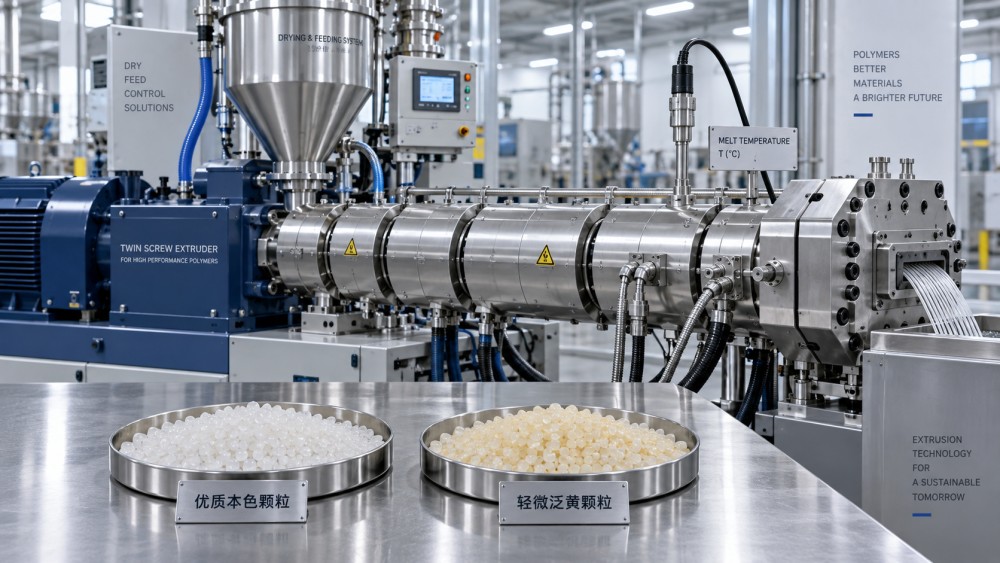
Moisture can break molecular chains in hydrolysis-sensitive materials during melt processing. High-temperature polyamides and polyester-based compounds are particularly relevant examples. The result may be reduced melt viscosity and strength without severe discoloration, so apparently clean pellets are not proof that drying was adequate.
PEEK and PPS have different moisture sensitivities from polyamides and polyesters. Nevertheless, residual moisture can still contribute to bubbles or surface defects, and their compounds may contain moisture-sensitive ingredients. Follow grade-specific instructions rather than assuming all high-temperature polymers need the same drying treatment.
- Confirm the drying specification. Check drying temperature, duration, and allowable residual moisture for the exact compound, including any restrictions on repeated drying.
- Verify actual dryer operation. Review air temperature, airflow, desiccant condition, and dew point where applicable. A dryer display alone does not establish pellet moisture.
- Measure a representative sample. Use a validated method suitable for the polymer and additives. Some weight-loss methods may count other volatiles as moisture.
- Check transfer and hopper exposure. Open containers, humid conveying air, and long waits can allow dried pellets to reabsorb moisture before entering the extruder.
Vacuum venting supports removal of moisture and other volatiles, but it should not replace required predrying. Hydrolysis may already occur before the melt reaches the vent. More drying is not always better either: excessive drying temperature or exposure can affect certain additives or the compound itself.
The resin name does not define the whole processing window
A high temp polymer compound contains more than its main polymer. Glass or carbon fibers change flow behavior and energy demand. Mineral fillers can carry moisture. Flame retardants, pigments, impact modifiers, and processing aids may have thermal limits below those of the base resin.
This matters when a process that runs cleanly with an unfilled grade becomes unstable with a reinforced or flame-retardant version. Raising temperature to reduce viscosity may expose a sensitive ingredient to excessive heat. Ask the supplier for the finished compound’s recommended melt temperature, drying requirements, and guidance on interruptions—not just the neat resin data sheet.
- PEEK: Its high processing temperatures demand temperature-capable equipment and careful removal of incompatible residues from earlier runs.
- PPS: Oxygen exposure and heat history can alter viscosity and contribute to discoloration; do not assume degradation must make the melt thinner.
- High-temperature polyamides: Drying, sealed handling, and moisture measurement are central to diagnosing viscosity loss.
- PEI and sulfone polymers: Drying remains important for preventing processing defects, while prolonged thermal exposure still needs control.
Regrind introduces another heat history. Record its source, proportion, drying condition, and contamination risk. When symptoms coincide with a regrind change, compare against an approved feed without that change before redesigning the extrusion settings.
Check vents and oxygen exposure without creating another fault
A blocked vent, weak vacuum, leaking connection, or overloaded condenser can prevent volatile removal. Inspect the vacuum system using the equipment’s operating procedure, and compare vacuum readings with the line’s stable baseline. A reading at the pump may not describe conditions at the extruder if the connecting line is restricted.
Material rising into the vent may indicate excessive fill, unsuitable screw configuration, or a downstream restriction. Simply increasing vacuum can pull out more polymer rather than solve the cause. Review feed rate, vent-zone configuration, and downstream pressure before making that adjustment.
Oxygen can contribute to degradation at high melt temperatures, especially during prolonged exposure. Where the process uses inert-gas blanketing, verify the approved arrangement and its operation. Improvised nitrogen use is inappropriate: it creates an oxygen-deficiency hazard and may interfere with ventilation or process controls.
Run corrective trials that produce interpretable results
Before adjusting the line, capture a baseline: material lot, regrind fraction, drying records, throughput, screw speed, zone settings, measured melt temperature, torque, pressure, and vacuum. Mark affected production for quality review. Changing several settings simultaneously may improve appearance while hiding the cause.
Choose the trial from the strongest evidence:
- Excessive measured melt temperature: Check cooling response and restrictions, then evaluate shear input and the temperature profile within approved limits.
- Viscosity loss with excessive feed moisture: Restore drying and closed handling before making broader process changes.
- Specks concentrated after pauses: Review hot-hold limits, restart procedures, and stagnant areas.
- Instability following a material change: Verify grade identity, additive compatibility, residual contamination, and regrind history.
Allow the previous material to clear and the process to stabilize before judging a trial. Record both the response and any trade-off: less discoloration is not an improvement if dispersion, pressure stability, or pellet quality becomes unacceptable.
Protect the line during shutdown—and verify recovery
Shutdown procedures should specify permitted hot-hold conditions, clearing steps, temperature reduction, and restart criteria for the material and equipment. Avoid leaving a degradation-sensitive compound stationary at processing temperature longer than permitted. Select purge materials for compatibility and temperature capability; a general-purpose purge can itself degrade at high-temperature operating conditions.
Smoke, unusual fumes, rapid pressure escalation, or uncontrolled temperature rise require the site’s safe-stop procedure, not continued adjustment. Never loosen a die, screen changer, or other melt-containing connection under pressure. Cleaning and inspection require isolation, cooling, and lockout according to the machine procedure.
Recovery needs more than a clean appearance. Compare representative output with approved material using the relevant quality tests: controlled melt-flow or rheology measurements, color assessment, particle inspection, and mechanical testing where required. Test preparation matters because moisture and conditioning can distort comparisons.
Material produced during the upset should remain segregated until it meets the release criteria. If color recovers but viscosity or strength does not, escalate with samples and process records to the material supplier or process engineering team. That mismatch indicates the underlying damage may persist even after the visible defect disappears.
Have questions about this sector analysis, or seeking best practices specific to your niche? Drop us a line below and let the senior consultants at APIM assist you.
We respect your privacy. Your information is strictly confidential.
Related News
- 00
0000-00
NAPCOR Report: US PET Bottle Recycling Rate Fell to 29% in 2025 - 00
0000-00
How does washing affect contamination in post-consumer recycled PP resins? - 00
0000-00
How does feedstock affect depolymerization equipment selection? - 00
0000-00
US Sets 213.44% Preliminary Antidumping Deposit on Chinese PTMEG - 00
0000-00
When should epoxy be used as a thermal interface material for semiconductors?