




Which Fillers Increase Compound Stiffness Without Causing Brittleness?
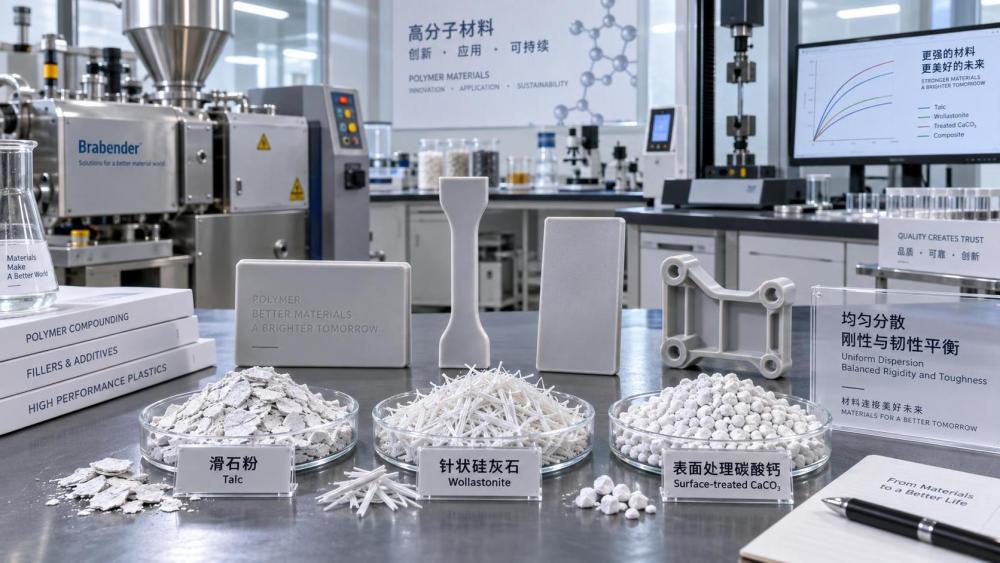
Fillers that raise stiffness without creating a brittle compound usually combine a moderate reinforcing effect with good adhesion to the polymer matrix. Fine mineral fillers with controlled particle shape, treated calcium carbonate, talc, wollastonite, mica, short glass fiber at restrained loading, and selected elastomer-modified reinforcement systems are often stronger starting points than simply adding the hardest available filler. The right choice depends on whether the part needs flexural rigidity, dimensional stability, impact retention, low warpage, surface quality, or resistance to repeated loading.
Brittleness develops when the filler acts as a crack initiator, weakens continuity in the polymer phase, or produces excessive stress concentration at the filler-polymer interface. A compound can show a higher flexural modulus on a data sheet while failing more easily in a dropped part, a snap-fit, a thin weld line, or a cold-temperature assembly. Stiffness must therefore be evaluated alongside impact behavior, elongation at break, weld-line strength, fatigue response, and the fracture appearance of molded specimens.
Start with the stiffness mechanism
A filler increases stiffness by restricting molecular movement in the polymer or by carrying part of the load itself. Shape matters as much as intrinsic hardness. Plate-like particles such as talc and mica resist bending effectively along their orientation direction. Needle-like wollastonite can improve rigidity with less severe embrittlement than a high loading of irregular mineral particles. Fibers deliver a larger modulus increase, but their effectiveness and their tendency to reduce impact strength are strongly tied to fiber length, orientation, and interfacial bonding.
The filler should not be considered independently from the base resin. A ductile polypropylene, an impact-modified polyamide, and a polycarbonate blend do not respond in the same way to the same mineral. Crystalline polymers may gain stiffness through both the filler contribution and changes in crystallization behavior. Amorphous resins often show a more direct trade-off between rigidity and impact resistance. Materials that absorb moisture, such as many polyamides, also require conditioned testing because dry and equilibrated parts can lead to very different conclusions.
Fillers that commonly give a balanced result
Talc: efficient stiffness with a manageable toughness penalty
Talc is widely used where flexural stiffness, heat resistance, and dimensional control matter. Its plate-like structure is effective in polypropylene, polyethylene, TPO compounds, ABS, and some engineering-plastic formulations. Fine, well-dispersed talc generally produces a more balanced result than coarse grades because large particles are more likely to initiate cracks under impact.
Particle size alone is not enough to specify talc. Aspect ratio, particle-size distribution, surface chemistry, moisture level, and contamination all affect the result. A high-aspect-ratio talc often improves stiffness more efficiently, allowing a lower loading than a less effective grade. That lower loading can preserve more ductility. Excessively high talc addition, especially in thin or highly oriented sections, can still create a sharp loss in impact resistance and weld-line integrity.
Wollastonite: a useful middle ground
Wollastonite has an acicular, or needle-like, particle form. It can improve flexural modulus and reduce shrinkage while retaining more toughness than a formulation built around a heavily loaded platy mineral. It is particularly useful when dimensional stability is required but glass fiber would cause too much anisotropy, surface roughness, or warpage.
Its benefits depend on preserving particle geometry through compounding. Aggressive screw elements, long residence time, or excessive shear can shorten the particles and reduce their reinforcing contribution. Surface treatment also matters. A compatible treatment improves wetting and load transfer; poor bonding leaves debonded interfaces that become voids during fracture. The same compound may therefore appear stiff in a slow tensile test yet fracture prematurely under impact or cyclic loading.
Surface-treated calcium carbonate: moderate reinforcement with process advantages
Calcium carbonate is often associated with cost reduction, but fine and properly surface-treated grades can also provide useful stiffness increases without the severe embrittlement associated with coarse, untreated particles. Treated grades disperse more readily in nonpolar matrices such as polypropylene and polyethylene, reducing agglomerates that otherwise become fracture sites.
Calcium carbonate is usually best when the required stiffness increase is moderate and processability, color, surface finish, or density control also matter. It is less suitable when a major structural modulus increase is needed from a compact wall thickness. Higher loading can quickly reduce elongation and low-temperature impact performance, particularly in unmodified polyolefins. Pairing it with an appropriate impact modifier is often more effective than increasing mineral content beyond the point where the polymer phase loses continuity.
Mica: high rigidity where directional behavior is acceptable
Mica can provide substantial stiffness and heat-deflection improvement because of its plate-like structure. It is useful in parts that benefit from resistance to bending in a preferred direction, but orientation must be treated as a design variable rather than a processing side effect. During injection molding, mica aligns with flow. A plaque can therefore appear very stiff in the flow direction and considerably less stiff across it.
This orientation can also contribute to differential shrinkage and warpage. In an uncomplicated flat part, that may be manageable. In a long housing, cover, or precision component with changing wall thickness, it can create distortion that is incorrectly blamed on the mold or cooling system. Mica is a strong candidate where flatness and in-plane stiffness are needed, provided gate location, flow pattern, and shrinkage behavior are reviewed early.
Short glass fiber: high stiffness, but only with deliberate toughening
Short glass fiber is among the most efficient reinforcements for raising compound stiffness. It also improves creep resistance and mechanical performance at elevated temperature. However, untreated use of glass fiber as a simple stiffness lever can make a resin noticeably more notch-sensitive, especially at weld lines or in sections where fiber orientation changes abruptly.
A balanced glass-fiber compound needs attention to fiber length after processing, coupling chemistry, resin stabilization, and impact-modifier selection. Fiber sizing must match the matrix. Strong adhesion improves load transfer, but an overly rigid interface can sometimes reduce energy absorption during fracture. In toughened engineering plastics, the formulation must balance fiber-matrix bonding with the presence and dispersion of the impact-modifier phase.
Glass fiber also changes mold behavior. It raises anisotropic shrinkage, wears gates and screws, and creates a surface texture that may not suit visible components. A stiffness target that can be reached with wollastonite or talc at a lower penalty to appearance and warpage should be assessed before specifying glass fiber.
Use hybrid filler systems when one filler creates the wrong trade-off
A hybrid formulation can separate the jobs of stiffness, impact retention, and dimensional control. For example, a moderate amount of glass fiber combined with a mineral filler can reduce the fiber level needed for the target modulus. A talc-and-elastomer system can provide a more controlled balance in polypropylene than talc alone. Mineral-filled compounds may also use a compatibilizer to improve interfacial adhesion without relying on excessive filler loading.
The effect is not automatically additive. Combining two fillers may increase viscosity beyond expectations, change crystallization, or complicate dispersion. It can also create conflicting orientation behavior: fibers tend to align along flow, while platelets align differently through the thickness. The resulting warpage should be measured on the real part geometry rather than inferred from a standard test bar.
Particle size and interface quality often explain failed trials
A compound may become brittle even at a filler level that should have been acceptable because the actual filler state differs from the nominal specification. Agglomerates behave like much larger particles. They concentrate stress and often leave visible fracture origins in broken parts. Moisture, poor feeding accuracy, inadequate distributive mixing, or a poorly selected feeder location can all contribute to agglomeration or inconsistent dispersion.
Interfacial adhesion needs a measured approach. With almost no adhesion, particles pull out of the matrix and leave cavities. With suitable adhesion, stress transfers from polymer to filler and stiffness improves efficiently. Yet maximum adhesion is not always the route to highest impact strength. A toughened polymer needs controlled local deformation around fillers. If the interface is too rigid and the matrix has limited ability to yield, a crack can travel rapidly from one particle to the next.
Coupling agents and compatibilizers should therefore be evaluated using both mechanical data and fracture evidence. A cleaner, more fibrillated or ductile fracture surface often indicates that the matrix is dissipating energy. Smooth, bright fracture regions around clusters or fibers point toward brittle crack propagation. Microscopy is useful, but even careful visual inspection of broken test specimens can reveal whether the issue is dispersion, filler pull-out, fiber breakage, or a fundamentally overfilled formulation.
Match the filler to the part rather than a single test value
Flexural modulus is commonly used to screen stiffness, but it does not describe the full risk profile. A cover that must resist sagging under heat, a clip that must flex during assembly, and a housing that must survive a drop load require different balances. A rigid mineral-filled resin may work well in a broad panel but fail in a snap-fit root. A glass-fiber material may provide excellent structural support but perform poorly in a cosmetic surface or a thin flow-front weld line.
- For broad, relatively uniform sections, talc or mica can provide efficient rigidity when flow orientation and warpage are controlled.
- Where shrinkage control matters but a highly fiber-reinforced surface is undesirable, wollastonite is often worth screening.
- For moderate stiffness improvement in polyolefins, fine treated calcium carbonate offers a practical starting point, especially when impact modification is already part of the system.
- For load-bearing engineering-plastic parts exposed to heat or creep, short glass fiber remains a strong option, provided the design avoids sharp notches and weak weld-line locations.
Temperature changes the answer. Many compounds remain acceptably tough at room temperature but become brittle near their low-temperature service limit. Chemical exposure can also alter the matrix and reduce its ability to yield around particles. For long-term service, test aged material as well as freshly molded material, particularly where hydrolysis, heat aging, plasticizer migration, or repeated stress may change the polymer phase.
Run formulation trials in a sequence that reveals the real trade-off
Begin with the unfilled or current compound as a control. Establish the stiffness target in a part-relevant direction, then screen one filler family at modest loading before escalating content. Record melt flow, pressure, torque, mold filling, shrinkage, surface appearance, and moisture condition along with mechanical results. A stiffness increase that requires unstable processing or produces large lot-to-lot variation is rarely a sound formulation outcome.
When impact strength falls, do not assume the filler itself is the only cause. Compare dry and conditioned samples where relevant; inspect weld-line specimens; check actual filler dispersion; and verify that test bars were molded under representative conditions. A change in melt temperature, screw speed, venting, or cooling can alter fiber length, crystallinity, and residual stress enough to obscure the filler effect.
The most reliable route to a stiff but durable compound is often a lower filler loading of a better-shaped, better-dispersed grade combined with compatible interfacial chemistry and enough matrix toughness for the part geometry. That approach usually produces a more useful balance than pursuing the highest possible modulus from a heavily filled formulation.
Have questions about this sector analysis, or seeking best practices specific to your niche? Drop us a line below and let the senior consultants at APIM assist you.
We respect your privacy. Your information is strictly confidential.
Related News
- 00
0000-00
How does washing affect contamination in post-consumer recycled PP resins? - 00
0000-00
How does feedstock affect depolymerization equipment selection? - 00
0000-00
US Sets 213.44% Preliminary Antidumping Deposit on Chinese PTMEG - 00
0000-00
When should epoxy be used as a thermal interface material for semiconductors? - 00
0000-00
US Midterm Results Unlikely to Quickly Shift Recycled Plastics Market or Legislation