




When is underwater pelletizing suitable for engineering plastics?
Underwater pelletizing for engineering plastics can be a practical choice when consistent pellet geometry, high throughput, and automated handling are priorities. Its suitability, however, depends on more than production capacity.
Melt viscosity, crystallization behavior, filler content, water sensitivity, and downstream drying requirements all affect process stability and pellet quality. These constraints determine whether an underwater system offers advantages over strand or other pelletizing methods.
When Is Underwater Pelletizing a Good Fit?
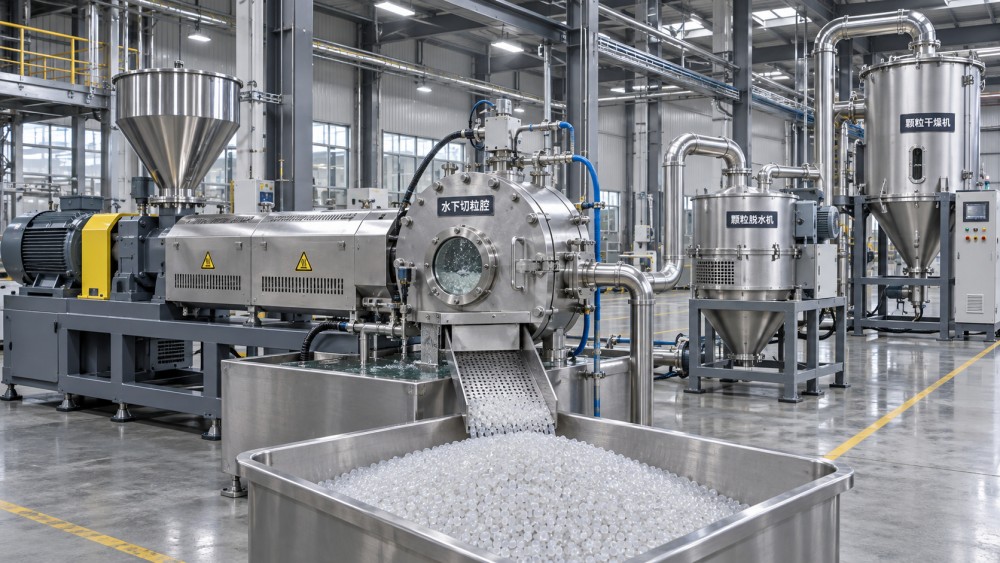
Underwater pelletizing is a strong candidate when a formulation can pass reliably through a heated die, be cut cleanly at the die face, and withstand controlled water contact.
It is especially attractive for continuous production where operators need consistent pellet shape, automated conveying, and fewer exposed strands between the extruder and pellet collection system.
The process cuts molten polymer as it exits the die into a circulating water chamber. Water carries the pellets to a separator and dryer before downstream handling.
Engineering plastics may benefit, but suitability must be demonstrated for the specific grade and formulation. A successful installation for one polyamide or polyester compound does not guarantee equivalent results for another.
The strongest case combines stable melt delivery, a manageable die-pressure requirement, acceptable pellet temperature after drying, and a production volume that justifies the equipment and utilities.
Conversely, frequent formulation changes, difficult die freezing, abrasive fillers, or demanding moisture specifications may reduce the advantage. These factors should be tested before comparing equipment on throughput alone.
Which Material Properties Determine Suitability?
Technical evaluators should begin with the melt behavior and finished-pellet specification, then work backward to the die, water system, cutting equipment, and drying capacity.
Melt Viscosity and Die Pressure
The melt must flow through the available die holes at a pressure the extruder, screen changer, and other upstream components can sustain throughout the production run.
High-viscosity melts, high filler loadings, and small holes can increase pressure. Temperature may improve flow, but excessive heat or residence time can degrade sensitive polymers and additives.
Review pressure at target throughput with clean and progressively loaded screens. A trial that succeeds only at reduced output or unusually high melt temperature is not conclusive.
Crystallization and Cooling Behavior
Semi-crystalline polymers, including many PA, PBT, PET, and PPS grades, can solidify rapidly at the die. Insufficient die-face heating may cause blocked holes or unstable cutting.
Cooling also influences pellet crystallinity and residual heat. Pellets that remain too soft can stick together, while overly aggressive cooling may complicate later thermal treatment or drying.
Water temperature, die heating, flow, and pellet residence time must therefore be selected together. The appropriate settings depend on the formulation and pellet size, not polymer family alone.
Water Sensitivity and Drying
Many engineering polymers require low moisture before downstream melt processing. Underwater cutting introduces water contact, so separation and drying must be evaluated against the customer's actual specification.
Surface water removal is not necessarily sufficient for hygroscopic materials such as PA, PET, and PBT. These grades may need additional conditioning or desiccant drying before processing.
Measure moisture using a method appropriate to the polymer and expected concentration. Specify sampling points after pelletizing, after storage, and, where relevant, immediately before downstream processing.
For hydrolytically sensitive polymers, also check whether moisture and thermal history contribute to molecular-weight loss during subsequent melting. Compare intrinsic viscosity, melt viscosity, or another validated indicator.
Fillers and Reinforcement
Glass fiber, minerals, and other abrasive ingredients can accelerate wear on knives, die surfaces, and conveying components. Replacement intervals and material selection directly affect operating cost.
Fiber-reinforced compounds also require attention to reinforcement length and final properties. Pelletizing is only one potential source of fiber damage, so evaluate the complete compounding process.
Highly filled formulations may behave differently from unfilled base resin at the die. Check pressure stability, cut quality, fines generation, and downstream feeding with the actual recipe.
How Do Common Engineering Plastics Compare?
Polyamide compounds can be candidates when throughput and handling consistency matter, including reinforced grades. Confirm die stability, abrasive wear, pellet moisture, and the drying required before molding.
PET and PBT compounds require particular attention to moisture control and thermal history. Assess pellet drying alongside molecular-weight retention, crystallization behavior, and any subsequent solid-state treatment requirements.
Polycarbonate and ABS grades may be suitable when melt delivery and pellet quality are stable. For appearance-sensitive applications, investigate fines, contamination, discoloration, and degradation during trials.
TPU and other softer compounds can benefit from rapid cooling, but tackiness and agglomeration remain important risks. Evaluate pellet temperature, water conditions, and handling after separation.
High-temperature polymers such as PPS and PEEK require equipment capable of maintaining suitable melt and die temperatures. Confirm supplier experience, thermal control, and component compatibility with the exact grade.
These examples are screening guidance, not material approvals. Flame retardants, pigments, recycled content, lubricants, and reinforcement can change behavior enough to require a separate process evaluation.
How Does It Compare With Strand Pelletizing?
Strand pelletizing forms continuous strands that are cooled and pulled into a cutter. It is a familiar option for many engineering compounds and can offer straightforward visual monitoring.
Underwater systems eliminate the need to maintain exposed strands between the die and cutter. This can be useful when strand handling is unstable or continuous automation is important.
However, underwater systems add a cutting chamber, water circulation, separation, and drying equipment. Their complexity, cleaning requirements, and utility demand must be included in the comparison.
Strand systems also involve cooling and often water contact, so neither method automatically eliminates moisture concerns. Compare the measured moisture and drying burden of each complete line.
For short campaigns or frequent color changes, evaluate cleaning time and scrap for both alternatives. The preferred method depends on the equipment design and actual changeover procedure.
Compare usable output rather than nameplate capacity: include startup losses, blocked die holes, strand breaks, maintenance, pellet rejection, labor, and the time needed to reach specification.
What Should a Production Trial Measure?
A representative trial is the most useful step before purchase. Use the intended formulation, feedstock condition, target throughput, pellet dimensions, and downstream quality limits whenever possible.
Agree on acceptance criteria before running. Record melt temperature, die pressure, water temperature and flow, knife settings, production rate, dryer settings, and any operator interventions.
Run long enough to observe thermal stability and wear-related behavior where practical. A short demonstration may identify immediate problems but cannot establish maintenance intervals or long-term reliability.
Collect samples after startup and during stable production. Measure pellet size distribution, shape, fines, agglomerates, contamination, residual moisture, and any mechanical or thermal properties relevant to the application.
For reinforced or sensitive compounds, compare the finished pellets with an agreed reference using appropriate tests. Include downstream molding or extrusion trials when pellet behavior affects part quality.
Document rejected material and the reasons for intervention. Also test shutdown, restart, and cleaning procedures if campaign length or changeover frequency is important to the business case.
Where water quality or additives may affect the product, agree on contamination limits and monitoring methods. Confirm filtration, water replacement, and wastewater handling requirements with the supplier.
What Should Evaluators Ask Equipment Suppliers?
Request a process proposal for the specific formulation and output range, including die design, heating capacity, allowable pressure, water circuit, dryer configuration, and expected operating window.
Ask which components contact the compound and how they address abrasion, corrosion, and temperature. Obtain inspection schedules, spare-parts recommendations, and evidence supporting expected wear life.
Clarify which performance claims are guaranteed, which depend on customer-supplied materials, and how acceptance will be measured. Include pellet quality, moisture, throughput, and operating stability where applicable.
Finally, compare total cost using consistent assumptions: equipment, installation, utilities, labor, maintenance, consumables, drying, downtime, scrap, and expected production volume over the evaluation period.
Conclusion: Make the Decision Around the Complete Process
Underwater pelletizing for engineering plastics is most suitable when the formulation cuts reliably at the die, water contact is manageable, and consistent automated production delivers measurable value.
It is less compelling when die freezing, wear, drying, changeovers, or operating complexity outweigh those benefits. A representative trial and a complete cost comparison provide the strongest basis for selection.
Have questions about this sector analysis, or seeking best practices specific to your niche? Drop us a line below and let the senior consultants at APIM assist you.
We respect your privacy. Your information is strictly confidential.
Related News
- 00
0000-00
How does washing affect contamination in post-consumer recycled PP resins? - 00
0000-00
How does feedstock affect depolymerization equipment selection? - 00
0000-00
US Sets 213.44% Preliminary Antidumping Deposit on Chinese PTMEG - 00
0000-00
When should epoxy be used as a thermal interface material for semiconductors? - 00
0000-00
US Midterm Results Unlikely to Quickly Shift Recycled Plastics Market or Legislation