




When conductive plastics for automation prevent sensor signal loss
When Conductive Plastics for Automation Prevent Sensor Signal Loss
In automated production environments, unreliable sensor signals can lead to inaccurate detection, unexpected downtime, and costly quality risks. Conductive plastics for automation provide a practical material solution by combining controlled electrical conductivity with the lightweight, durable, and process-friendly benefits of engineered polymers. For engineering teams evaluating housings, fixtures, conveyor components, and electronic protection parts, the key question is not simply whether a polymer is conductive. It is whether its conductivity, mechanical behavior, geometry, and grounding strategy will reduce a known signal risk without creating a new one.
That distinction matters. A missed photoelectric sensor reading, unstable proximity-switch output, or intermittent encoder signal may be blamed on the sensor itself, but the root cause can sit elsewhere: electrostatic charge accumulating on moving polymer surfaces, electromagnetic interference near drives, inconsistent grounding, dust attraction, or a housing material that does not control the local electrical environment. Conductive compounds can be part of the answer, especially where standard insulating plastics allow charge to build up repeatedly during operation.
Signal loss rarely has a single material cause
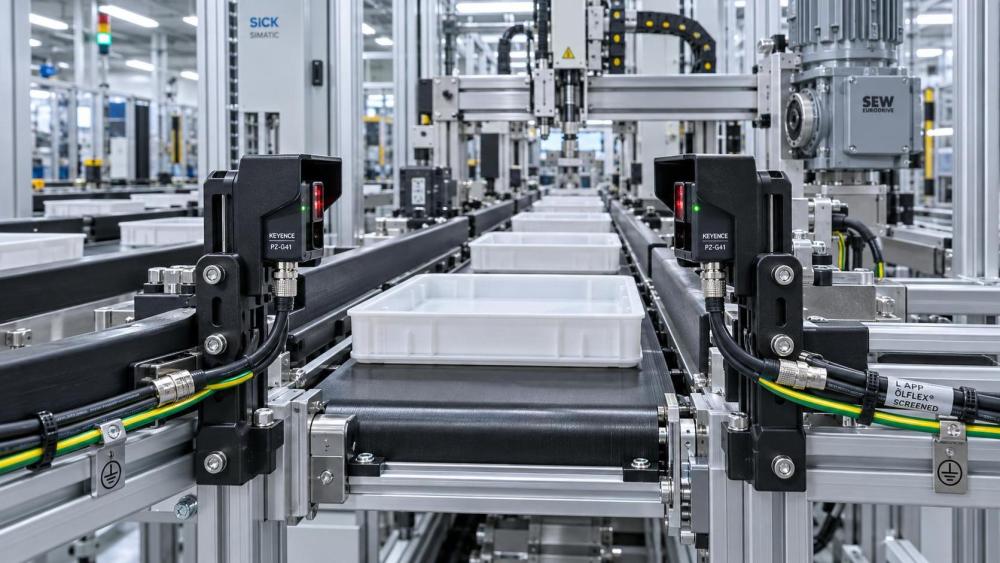
Automation systems combine sensors, cables, actuators, variable-frequency drives, robot cells, conveyors, machine frames, power supplies, and communication modules in a limited space. The result is an environment where electrical noise and static discharge can affect low-level signals. Plastic parts are often selected for weight reduction, corrosion resistance, low friction, moldability, or lower assembly complexity. Yet an ordinary polymer surface is electrically insulating, which can be a weakness when the part moves against film, paper, powder, trays, belts, or other plastic components.
Frictional contact can generate electrostatic charge. In some applications, that charge attracts dust to an optical sensor window, interferes with lightweight web handling, causes material to cling to guides, or creates an electrostatic discharge event near sensitive electronics. None of these problems automatically means that conductive plastic is required. Cable shielding, sensor placement, grounding continuity, cleaning procedures, humidity conditions, and machine control settings may all need review. But where the polymer component itself is a recurring source or reservoir of charge, changing the material can be more durable than repeatedly treating the symptom.
A useful first step is to separate three problems that are often discussed as if they were identical: static charge accumulation, electrostatic discharge protection, and electromagnetic shielding. A material suitable for one may not be suitable for all three.
Why conductive polymers can be more practical than metal parts
Metal enclosures and grounded steel machine structures remain effective in many industrial settings. They are not obsolete. However, a metal replacement is not always desirable for sensor brackets, protective covers, material guides, pick-and-place fixtures, conveyor accessories, robot end-effectors, or compact electrical enclosures. A conductive polymer can reduce weight, avoid corrosion concerns, simplify complex molded geometry, and combine electrical functionality with features such as snap fits, ribs, integrated cable routing, or wear surfaces.
The practical advantage is design integration. A molded part may consolidate several separate components, but it should not be assumed that it behaves electrically like a metal part. Conductive plastics usually depend on a network of conductive fillers distributed through a polymer matrix. Their performance can vary with filler type, filler loading, flow direction during molding, wall thickness, weld lines, moisture uptake, surface finish, and the way the part is connected to ground.
This is why a material data sheet alone is not a complete answer. A nominal volume resistivity value can help narrow the selection, but the finished component must be assessed in its actual shape and operating environment. A thin molded hinge, a large flat cover, and a heavily ribbed enclosure may not show identical electrical behavior even when made from the same grade.
Conductive, static-dissipative, and shielding grades are not interchangeable
The language used around functional polymers can obscure an important design decision. “Antistatic” may describe a surface treatment, a migratory additive, or a permanent dissipative compound. “Conductive” may refer to a compound intended to carry charge away, but it does not automatically confirm electromagnetic compatibility performance. “EMI shielding” is a system-level result influenced by enclosure layout and grounding, not simply a label attached to a resin.
For moving automation components, a static-dissipative formulation may be sufficient when the aim is to prevent charge accumulation and reduce dust attraction. For a component that needs a reliable path to ground, a more conductive grade may be considered. For housings surrounding sensitive electronics, the evaluation becomes more demanding: seam design, gasket interfaces, cable-entry openings, fastener locations, and connection to the machine ground can determine whether the enclosure provides meaningful shielding.
Carbon black, carbon fiber, graphite-based materials, stainless-steel fibers, and other conductive fillers may be used in different compound designs. Each comes with trade-offs. Carbon-filled materials are commonly dark in color and may affect surface appearance. Carbon fiber can improve stiffness but may introduce anisotropy, making flow orientation relevant. Higher filler loading can affect impact resistance, elongation, shrinkage behavior, tool wear, and melt flow. These are not reasons to avoid conductive plastics for automation; they are reasons to define the required function before choosing a base resin and filler system.
Start with the failure mechanism, not the resin family
A disciplined evaluation begins at the point where the signal problem occurs. Does the fault appear only when a conveyor is running? Does it coincide with dry ambient conditions, film unwinding, fast robotic motion, powder transfer, or repeated loading of plastic trays? Is the sensor affected by dust on the lens, by a transient event, by electrical noise, or by a mechanical alignment change? These observations help determine whether the polymer part is actually contributing to the problem.
The next task is to map the electrical path. A conductive housing that is isolated from ground may still reduce surface charge under some conditions, but it cannot be assumed to provide a controlled discharge route. Conversely, a grounded conductive component located too close to an unprotected signal conductor may alter the local electrical arrangement in ways that require validation. The right approach is to consider the material, component design, mounting method, and electrical architecture together.
For sensor-adjacent parts, teams should also ask whether the selected compound could affect the sensing principle. Inductive, capacitive, optical, ultrasonic, and magnetic sensors respond differently to nearby materials and geometry. A conductive polymer may be appropriate around one sensor type but require careful spacing or calibration around another. Supplier guidance and physical testing are usually more reliable than broad assumptions based on the word “conductive.”
Processing can change the performance engineers expect
Compounding quality determines whether conductive filler is dispersed consistently, but molding conditions also influence the finished part. In injection molding, flow can orient fibers or elongated filler structures. Weld lines, sharp changes in wall thickness, excessive shear, inadequate packing, and variable cooling may affect both mechanical integrity and electrical continuity. In extrusion, feeding accuracy, screw configuration, residence time, filtration, and melt stability can influence consistency along the profile or sheet.
This creates a common procurement risk: qualifying a material from a plaque result and then assuming the production component will behave the same way. A better specification identifies the relevant test method, test direction where applicable, sample conditioning, target locations on the finished part, and acceptable batch variation. If conductivity is essential to equipment reliability, it should be treated as a controlled part characteristic rather than an informal expectation.
The base polymer remains equally important. Polyamide may be considered where toughness and wear resistance are needed, while PBT, PC, ABS, PPS, PEEK, or other engineering polymers may be evaluated according to temperature, chemical exposure, dimensional tolerance, flame behavior, mechanical load, and process requirements. No resin family is universally correct. The conductive function has to coexist with the application’s ordinary demands.
A practical specification conversation
Before requesting samples or comparing grades, it is useful to prepare a short application brief that is more specific than “conductive plastic required.” It should describe the component’s location, the suspected signal-loss mechanism, contact with moving materials, operating temperature, chemicals or cleaners, mechanical stresses, color restrictions, production method, grounding approach, and any testing or documentation expectations. This gives compounders and molders enough context to identify conflicts early.
Questions worth raising include whether the required property is surface resistivity, volume resistivity, charge-decay behavior, or shielding effectiveness; whether the part will remain grounded throughout use; whether regrind is permitted; and whether a change in wall thickness could alter electrical performance. Teams should also clarify how the part will be inspected after molding. Electrical testing may need to be combined with dimensional checks, visual inspection, mechanical validation, and assembly-level signal testing.
This broader view is central to APIM’s coverage of modified polymers and industrial material applications. Material selection is not only a resin-price decision. It is a link between formulation design, compounding consistency, mold behavior, machine conditions, component geometry, and the reliability expected from the finished automation system.
The material should support the system, not replace engineering judgment
Conductive plastics can help prevent sensor signal loss when static accumulation, uncontrolled discharge, or enclosure-related electrical conditions are genuinely part of the failure chain. They are particularly relevant in automated handling of films, packaging materials, powders, lightweight molded parts, and other surfaces where repeated friction creates charge. Their value lies in offering functional electrical behavior without abandoning the manufacturing advantages of engineered polymers.
Still, the strongest projects do not treat conductivity as a stand-alone feature. They verify the sensor technology, define the electrical objective, examine grounding and cable routes, review the molded-part design, and validate performance under representative operating conditions. That process may reveal that a dissipative grade is enough, that a more conductive compound is needed, or that the material change should be paired with a different enclosure or grounding detail. The right conclusion comes from the application—not from the most aggressive conductivity claim on a data sheet.
Have questions about this sector analysis, or seeking best practices specific to your niche? Drop us a line below and let the senior consultants at APIM assist you.
We respect your privacy. Your information is strictly confidential.
Related News
- 00
0000-00
Do polyolefin hot melt adhesives bond well to polyethylene? - 00
0000-00
Korean Study Finds PLA Barely Degrades in Landfill After 320 Days - 00
0000-00
How to assess batch consistency from a thermal potting compounds supplier - 00
0000-00
How much weight can carbon fiber reinforced plastics save in cars? - 00
0000-00
Switching from PS to ABS Sheet Extrusion: Equipment Checks