




What to verify before choosing a reinforced polymer compounds supplier
What to Verify Before Choosing a Reinforced Polymer Compounds Supplier
Choosing a reinforced polymer compounds supplier is not a routine purchasing exercise. The material may be specified as glass-fiber reinforced PA66, mineral-filled PP, carbon-fiber reinforced PEEK, or a flame-retardant reinforced PBT, but the grade name alone does not determine how it will behave in production or service. Differences in reinforcement quality, formulation control, moisture handling, dispersion, and lot consistency can surface later as warpage, brittle parts, unstable molding cycles, cosmetic defects, failed testing, or difficult customer claims.
For procurement teams, the practical question is not simply whether a supplier can quote the requested compound. It is whether that supplier can repeatedly provide a material that fits the part, the process, the documentation requirements, and the supply plan. A lower resin price can quickly lose its advantage if it increases scrap, drying time, tool maintenance, qualification work, or the risk of an unplanned material change.
A disciplined evaluation should therefore connect commercial due diligence with engineering evidence. Before selecting a reinforced polymer compounds supplier, verify the points below in the context of the actual application rather than relying only on a brochure or a single technical data sheet.
Start with the part requirement, not the resin family
“Reinforced polymer” covers a wide range of materials. A 30% glass-fiber reinforced polyamide intended for an under-hood bracket is not interchangeable with a similarly filled grade used in an electrical housing, appliance component, fluid-handling fitting, or industrial gear enclosure. The base resin, fiber type, fiber loading, coupling chemistry, impact modifiers, stabilizers, pigments, and flame-retardant package all influence final performance.
Before approaching suppliers, turn the application into a short technical brief. It should identify the conversion process, expected service temperature, loading direction, chemical contact, electrical or flammability requirements where relevant, appearance expectations, environmental exposure, and anticipated annual volume. Part geometry deserves attention too. Long flow paths, thin walls, weld lines, inserts, sharp corners, and uneven wall thickness can expose weaknesses that standard tensile figures do not reveal.
This brief prevents a common sourcing mistake: comparing suppliers by a headline property such as tensile strength while overlooking the properties that govern the real part. For a precision component, shrinkage and dimensional stability may matter more. For a snap-fit housing, impact retention and weld-line behavior may be decisive. For a component facing heat and moisture, aged performance may be more meaningful than dry-as-molded test values.
Verify what the formulation actually contains
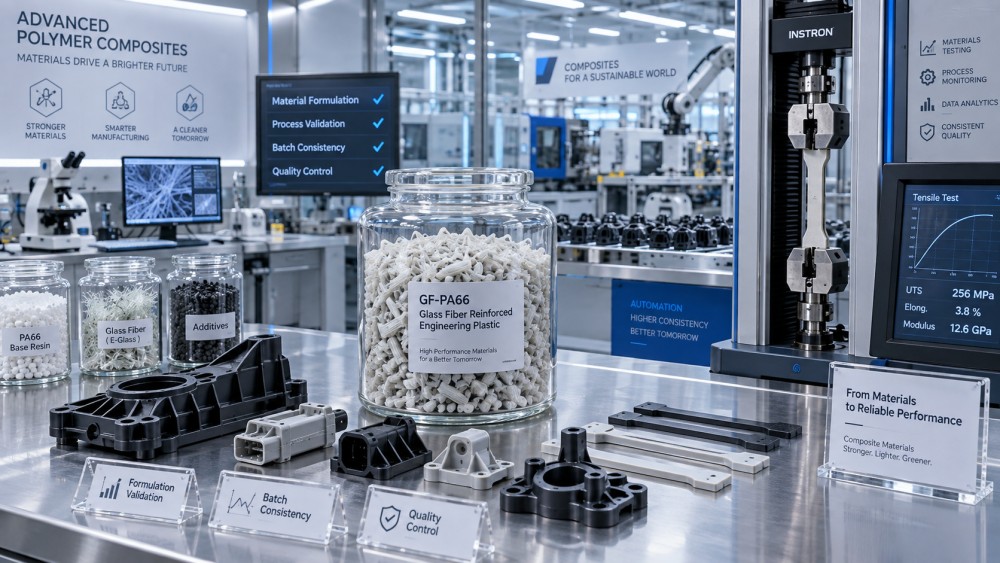
The stated reinforcement percentage is useful, but it is not a complete description of a compound. Buyers should clarify whether the percentage is nominal or controlled to a defined tolerance, whether the reinforcement is glass fiber, carbon fiber, mineral filler, or a hybrid system, and whether the number is expressed by weight. Fiber length distribution and fiber condition after compounding are also relevant, especially when stiffness, impact behavior, surface quality, or anisotropic shrinkage affects the design.
Ask how the supplier defines the grade and manages formulation changes. A supplier may need to substitute a pigment, additive, raw resin source, fiber treatment, or stabilizer for valid operational reasons. That does not automatically make the material unsuitable, but a controlled notification process matters. The buyer should know which changes trigger notice, re-testing, sample approval, or requalification. “Equivalent raw material” is not a sufficient technical definition for every project.
For colored or appearance-sensitive parts, assess color-control practices separately. Reinforced compounds can show batch-to-batch variation caused by base resin shade, fiber visibility, pigment dispersion, and processing conditions. A supplier’s ability to reproduce a laboratory color chip does not necessarily prove stable appearance in a production molding environment.
Where recycled or bio-based content is requested, the discussion needs even more precision. Confirm the claimed content, the type of feedstock, traceability available, expected processing implications, and whether the requested performance is maintained across the approved range. Sustainability claims should be reviewed alongside mechanical, thermal, and consistency requirements—not treated as a separate box to tick.
Read technical data sheets as a starting point, not proof
A technical data sheet is essential, but it is usually generated from standardized test specimens under stated conditions. It is not a guarantee that a finished part will achieve the same values. Test direction, specimen preparation, conditioning, moisture state, and test method can materially affect reported results. Reinforced polymers are particularly sensitive to fiber orientation, so a value measured parallel to flow may not represent performance across a complex molded component.
Compare data sheets carefully rather than comparing one number in isolation. Check the test methods and conditioning notes for tensile and flexural properties, impact performance, heat resistance, mold shrinkage, density, melt flow behavior, and electrical values where applicable. If the project calls for flame retardancy, chemical resistance, tracking resistance, food-contact suitability, medical documentation, or automotive requirements, verify the relevant evidence for the exact grade and color, not merely for a related resin family.
It is also reasonable to ask for lot-level documentation appropriate to the project. A certificate of analysis may show whether key release tests are being monitored, but its value depends on what is actually included and how the limits are set. Procurement should align with engineering and quality teams on the critical-to-function properties that need review at incoming inspection or during supplier qualification.
Examine compounding capability and process discipline
Compounds are made through process control as much as formulation design. A competent reinforced polymer compounds supplier should be able to explain, at an appropriate level, how it controls feeding, melt mixing, dispersion, devolatilization, filtration, pelletizing, cooling, and packing. The purpose is not to audit every screw element on a twin-screw extruder. It is to establish whether the supplier understands which process variables affect the material being purchased.
For example, inaccurate feeding can shift reinforcement or additive levels. Poor dispersion may create local property variation. Inadequate drying or volatile removal can contribute to surface defects and processing instability. Excessive thermal history may damage a heat-sensitive base polymer or additive package. Contamination control is equally important when a supplier runs multiple colors, resin families, recycled materials, or flame-retardant formulations on shared equipment.
A site visit, remote technical review, or structured supplier questionnaire can be useful during qualification. Focus on practical controls: raw-material identification, batch segregation, cleaning procedures, retention samples, nonconformance handling, calibration of measuring equipment, and material release criteria. Strong process discipline does not eliminate variation, but it makes variation more visible and more manageable.
Confirm performance in your own process
A material should be sampled under conditions that reflect production as closely as possible. Laboratory plaques and standard bars are helpful for screening, but mold trials or extrusion trials on representative equipment reveal more. Record drying conditions, melt temperature, mold temperature, injection pressure, cycle time, screw recovery, regrind policy, and any adjustments required to obtain acceptable parts.
During trials, look beyond whether the machine can make a part. Compare flow behavior, fill balance, warpage, sink, gate appearance, fiber read-through, weld-line quality, demolding, tool wear concerns, and dimensional repeatability. If the part will see elevated temperature, fluids, UV exposure, repeated stress, or humidity, the validation plan should reflect those conditions. The level of testing depends on the application and customer requirements, but the logic should remain consistent: validate the failure mode that would be costly in the field.
Suppliers that provide processing guidance can shorten this work. Useful support includes recommended drying windows, temperature ranges, mold design considerations, expected shrinkage direction, and cautions about residence time or regrind. Still, recommendations should be treated as starting parameters. They cannot replace trials on the buyer’s tooling and production equipment.
Assess traceability, documentation, and change control
Traceability becomes critical when a component is used in regulated, safety-sensitive, high-value, or long-life applications. Verify how the supplier links finished pellets to production date, manufacturing line, formulation version, and incoming raw-material lots. Ask how long samples and records are retained, how complaints are investigated, and how affected shipments can be identified if a problem is discovered later.
Documentation should be proportionate to risk. A general industrial application may need a reliable data sheet, safety information, lot identification, and agreed quality documentation. More demanding programs may require declarations, test reports, restricted-substance information, process-change notification, or customer-specific documents. Requirements vary by market and end use, so they should be confirmed early rather than added after commercial terms have been negotiated.
One revealing question is what happens when a batch falls outside an internal target but remains within a broad published specification. The answer shows whether the supplier sees quality only as a pass/fail certificate or as a commitment to stable downstream processing.
Look at supply resilience, not only quoted lead time
A supplier’s available capacity should be assessed against the actual grade, not just total plant output. Specialty reinforced compounds may depend on particular extruders, qualified raw-material sources, color lines, or testing resources. Confirm normal lead time, minimum order quantity, packaging options, inventory arrangements, production scheduling constraints, and the supplier’s approach to urgent demand changes.
Raw-material dependency deserves the same attention. If a compound relies on a specific fiber, base resin, flame-retardant system, or imported additive, ask whether alternate sources are qualified and how changes would be managed. Dual sourcing can reduce risk, but only if both sources are technically validated. Switching suppliers after a disruption is rarely quick when tooling performance and customer approvals are involved.
Commercial terms should account for total cost rather than pellet price alone. Include freight, packaging losses, storage conditions, drying burden, yield, cycle impact, reject rates, testing effort, and the cost of carrying safety stock. A compound that runs consistently may be economically preferable even when its purchase price is not the lowest.
Measure the quality of technical support before a problem occurs
Responsive technical support matters most when the material is not behaving as expected. Procurement teams should evaluate whether the supplier can involve a material engineer, processing specialist, or quality representative who understands the grade and can work with evidence. A useful response is not simply “increase the temperature” or “dry longer.” It considers resin moisture, machine settings, mold venting, shear history, fiber orientation, lot history, and the difference between a material issue and a conversion issue.
It is worth establishing escalation routes before production approval. Clarify who owns a technical complaint, what information the supplier will request, whether retained samples can be examined, and how corrective actions are communicated. Slow or vague support can be a larger operational risk than a modest price difference.
This is where structured material intelligence is useful. APIM examines advanced polymers, modified compounds, compounding technologies, processing factors, and application requirements in a way that helps teams frame better supplier discussions. For buyers comparing reinforced grades, the most valuable outcome is often not a generic shortlist, but a clearer understanding of which material variables must be controlled for a particular part and process.
Make the decision with a cross-functional evidence trail
The final choice should bring procurement, engineering, quality, operations, and supply-chain perspectives together. A practical decision record can compare each candidate on application fit, trial results, specification clarity, lot consistency, documentation, change control, capacity, logistics, commercial exposure, and technical response. Weighting will differ by project. A non-critical industrial housing may prioritize cost and availability; an electrical component, medical device, mobility part, or long-life machine component may justify deeper validation.
The strongest supplier is not necessarily the one with the largest catalogue or the lowest opening quote. It is the one whose compound, controls, records, and support can be verified against the conditions your part will actually face. Define those conditions early, test them honestly, and document the assumptions behind approval. That approach gives procurement a defensible basis for selecting a reinforced polymer compounds supplier—and reduces the chance that a material decision becomes a manufacturing problem later.
Have questions about this sector analysis, or seeking best practices specific to your niche? Drop us a line below and let the senior consultants at APIM assist you.
We respect your privacy. Your information is strictly confidential.
Related News
- 00
0000-00
Do polyolefin hot melt adhesives bond well to polyethylene? - 00
0000-00
Korean Study Finds PLA Barely Degrades in Landfill After 320 Days - 00
0000-00
How to assess batch consistency from a thermal potting compounds supplier - 00
0000-00
How much weight can carbon fiber reinforced plastics save in cars? - 00
0000-00
Switching from PS to ABS Sheet Extrusion: Equipment Checks