




What to Check Before Choosing an Impact Modified Plastics Manufacturer
What to Check Before Choosing an Impact Modified Plastics Manufacturer
Choosing the right impact modified plastics manufacturer can directly affect product durability, processing consistency, cost control, and long-term supply reliability.
For procurement decisions, price matters, but it is rarely the full story.
A lower-cost compound can create molding waste, unstable quality, and expensive line interruptions.
That is why supplier evaluation should begin with performance, process fit, and supply capability.
Start with the Real Performance Requirement
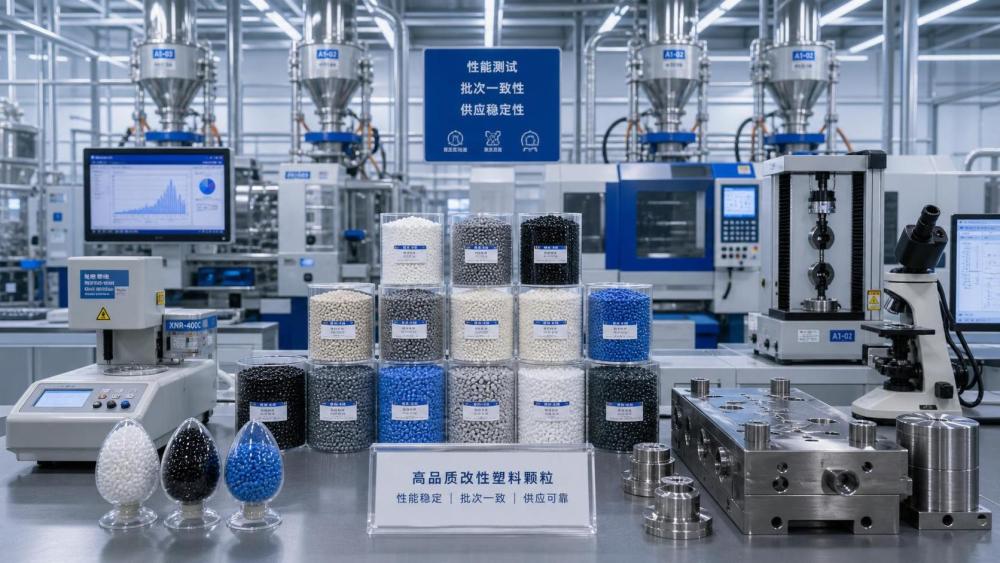
Before comparing any impact modified plastics manufacturer, define what the part must actually do.
Impact strength alone is not enough.
In practical sourcing, impact resistance interacts with stiffness, heat resistance, shrinkage, color, and surface finish.
A capable impact modified plastics manufacturer should ask about the end-use environment before quoting.
That includes drop conditions, low-temperature use, UV exposure, chemicals, and long-term loading.
If the supplier only shares a generic data sheet, that is a warning sign.
Ask for application-relevant test data, not just headline numbers.
- Izod or Charpy impact values at different temperatures
- Tensile and flexural properties after modification
- Heat deflection temperature under expected load
- Dimensional stability and warpage performance
- Aging results after humidity, heat, or UV exposure
This step helps filter out suppliers that can sell resin, but cannot support final product performance.
Review Formulation Stability and Batch Consistency
An experienced impact modified plastics manufacturer should provide more than a sample that performs well once.
The real question is whether every batch behaves the same in production.
Impact-modified compounds depend heavily on additive dispersion, base resin control, and compounding discipline.
Small variation in modifier loading can change toughness, flow, and appearance.
From a cost standpoint, inconsistent material often becomes hidden scrap.
More obvious signals include unstable cycle time, black specks, gloss variation, and unpredictable shrinkage.
Ask the impact modified plastics manufacturer how they control:
- Raw material qualification and incoming inspection
- Feeding accuracy for modifiers and fillers
- Melt temperature and residence time
- Pellet uniformity and moisture control
- Batch traceability and retention samples
Request recent certificate samples and compare batch ranges, not just target values.
Check Processing Compatibility with Your Factory
A strong impact modified plastics manufacturer should understand how the material runs on actual equipment.
This matters because good lab data does not always translate into stable molding or extrusion.
In real production, flow behavior can affect fill balance, weld line strength, and demolding.
If the compound needs a narrow process window, operating cost usually rises.
Ask for guidance on drying conditions, melt temperature, mold temperature, and recommended screw design.
A reliable impact modified plastics manufacturer should also discuss regrind limits and common processing defects.
That conversation often reveals whether the supplier understands plant-level realities.
Audit Quality Systems and Compliance Documents
A qualified impact modified plastics manufacturer should have a disciplined quality system behind the material.
This is especially important in automotive, electronics, industrial equipment, and regulated packaging.
Procurement reviews should cover documents, testing routines, and issue response speed.
Basic certificates are useful, but they are only the starting point.
A better signal is how the impact modified plastics manufacturer handles deviations and customer complaints.
- ISO 9001 or sector-specific quality certification
- COA format with critical property ranges
- RoHS, REACH, UL, FDA, or application-specific compliance
- Change notification procedure for formulation or sourcing
- Corrective action reports and response time expectations
If documents arrive slowly or answers are vague, future problem-solving will likely be slow too.
Measure Technical Support, Not Just Sales Support
A useful impact modified plastics manufacturer should support qualification, scale-up, and troubleshooting.
This becomes more valuable when a product launch is tight or application demands are changing.
For example, a part may pass impact testing but fail at weld lines.
In that case, technical support can save weeks of trial-and-error.
Ask whether the impact modified plastics manufacturer can offer formulation adjustment, mold trial input, and failure analysis support.
Also confirm who will answer technical questions after the first purchase order.
In many supplier reviews, the commercial team looks strong, but engineering backup is limited.
That gap usually appears during validation or production disruption.
Evaluate Supply Reliability and Total Cost
A competitive quote from an impact modified plastics manufacturer is useful only if supply remains stable.
This is where sourcing decisions often become more strategic.
Lead time, safety stock, plant location, and raw material dependence can all shape risk.
Recent supply chain shifts have made this much more visible.
Ask the impact modified plastics manufacturer about capacity, backup production, and key upstream resin sources.
Then compare total cost, not only resin price per kilogram.
A slightly higher-priced material can still reduce overall cost through better yield and lower downtime.
- Freight and local inventory availability
- Minimum order quantity and packaging format
- Forecast flexibility during demand changes
- On-time delivery history
- Claims handling and replacement timing
This gives a more realistic picture of procurement risk and cost exposure.
Use a Simple Supplier Shortlist Framework
To compare suppliers fairly, build a shortlist scorecard before final negotiation.
This keeps the decision from being driven by price alone.
A practical scorecard for an impact modified plastics manufacturer can include:
- Material performance fit for the target application
- Batch consistency and compounding control
- Processing compatibility with current equipment
- Quality system strength and compliance readiness
- Technical service depth and response speed
- Supply continuity and total delivered cost
This structure also helps internal teams align faster during approval.
Final Takeaway
Choosing an impact modified plastics manufacturer is a performance and risk decision as much as a cost decision.
The best supplier is usually the one that combines stable formulation, process fit, reliable service, and dependable delivery.
In actual procurement work, early technical verification often prevents expensive downstream problems.
Use samples, documents, trial data, and supplier discussions to validate each claim.
When the evaluation is structured, choosing the right impact modified plastics manufacturer becomes much clearer and far more defensible.
Have questions about this sector analysis, or seeking best practices specific to your niche? Drop us a line below and let the senior consultants at APIM assist you.
We respect your privacy. Your information is strictly confidential.
Related News
- 00
0000-00
How does washing affect contamination in post-consumer recycled PP resins? - 00
0000-00
How does feedstock affect depolymerization equipment selection? - 00
0000-00
US Sets 213.44% Preliminary Antidumping Deposit on Chinese PTMEG - 00
0000-00
When should epoxy be used as a thermal interface material for semiconductors? - 00
0000-00
US Midterm Results Unlikely to Quickly Shift Recycled Plastics Market or Legislation