




What should you check before choosing a carbon reinforced thermoplastics manufacturer?
What should you check before choosing a carbon reinforced thermoplastics manufacturer?
Choosing a carbon reinforced thermoplastics manufacturer requires more than comparing price and lead time. Technical evaluators should check material formulation, fiber dispersion, mechanical performance, thermal stability, processing consistency, certification support, and the supplier’s ability to meet application-specific requirements. For industries seeking lighter, stronger, and more reliable components, the right carbon reinforced thermoplastics manufacturer can directly affect part quality, production efficiency, and long-term product performance.
That sounds straightforward, but in practice the real challenge is not finding a supplier who says they can make a carbon-filled compound. It is finding one whose material behaves the same way in your process, your tooling, and your end use. A formulation that looks good on a datasheet may still create warpage, uneven surface appearance, weld-line weakness, or unstable dimensions once it enters a real production line. That is why the evaluation has to go beyond basic resin selection.
Start with the formulation, not the sales pitch
The first thing to check is what “carbon reinforced” actually means in that supplier’s process. Carbon reinforcement can refer to short carbon fiber compounds, long fiber thermoplastics, or tailor-made blends designed for stiffness, conductivity, wear resistance, or dimensional stability. Those are not interchangeable. A manufacturer with strong compounding control will be able to explain not just the base polymer, but also fiber length retention, loading range, additive package, and any trade-offs in impact strength or surface finish.
For technical buyers, this matters because carbon reinforcement changes the processing window. Some parts need higher stiffness but cannot tolerate brittle behavior. Others need better thermal performance but must still be weldable or paintable. If the supplier cannot clearly explain how its formulation balances these requirements, that is usually a sign to dig deeper.
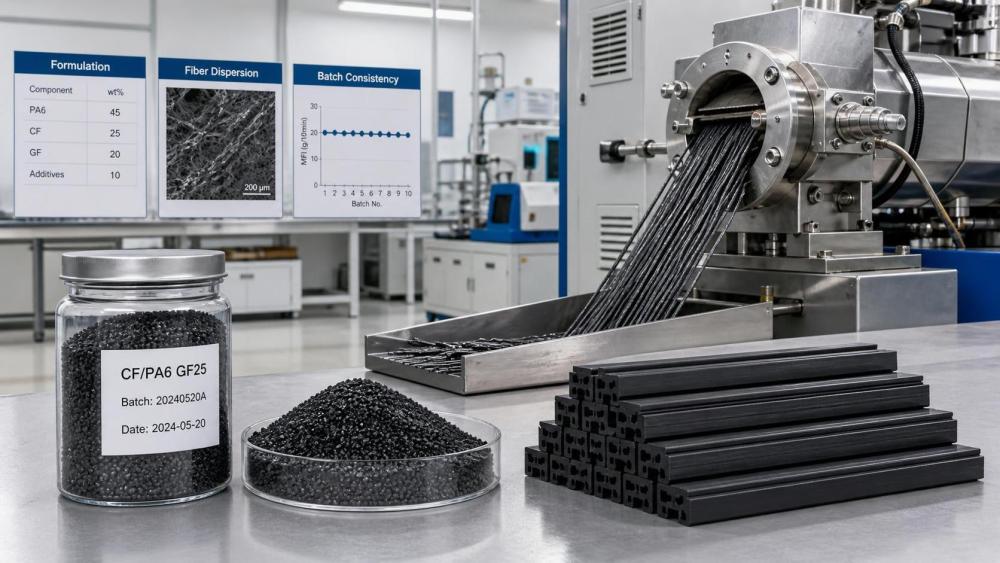
Fiber dispersion and compounding consistency are not secondary issues
Many performance problems start long before the part reaches molding or extrusion. Poor fiber dispersion, inconsistent feed control, or unstable melt filtration can create material variation from batch to batch. In carbon reinforced thermoplastics, that often shows up as uneven shrinkage, cosmetic streaking, inconsistent stiffness, or unexpected breakage in thin sections.
This is where manufacturing capability matters as much as material chemistry. A supplier using well-controlled twin-screw compounding, accurate gravimetric feeding, and stable pelletizing usually has a better chance of delivering repeatable lots. You do not need every technical detail on day one, but you do need enough information to judge whether the company understands dispersion quality as a process variable, not just a product claim.
Check whether the material fits your processing method
A carbon reinforced thermoplastics manufacturer should understand how the compound behaves in injection molding, extrusion, or other downstream processes. This is especially important for parts with thin walls, complex ribs, or tight dimensional tolerances. Some compounds run well in one process but create feeding or surface issues in another. If your application depends on stable flow, low warpage, and predictable shrinkage, the supplier should be able to discuss melt behavior in practical terms.
For example, when carbon reinforcement is used in electrical housings, automotive brackets, or industrial covers, technical teams usually care about dimensional stability and heat resistance first. In structural components, stiffness-to-weight ratio may matter more. In conductive or dissipative applications, electrical behavior becomes part of the decision. A good manufacturer will not force one “best grade” onto every project; it will ask enough questions to narrow the material around your process and load profile.
Mechanical data matters, but only when it is relevant to your part
Datasheets are useful, but they are not the whole story. Tensile strength, flexural modulus, impact resistance, heat deflection temperature, and creep behavior all matter, yet they do not matter equally in every design. A component that carries static load needs different evidence from one exposed to repeated vibration or thermal cycling. If the supplier only provides headline values without context, you may end up over-specifying the resin or missing a real weak point.
This is where application logic becomes more important than generic performance claims. Ask how the compound behaves after processing, not just on paper. Ask whether the property profile changes with fiber length, molding orientation, or moisture conditioning. If the answer is vague, the manufacturer may be selling a broad commodity story rather than a controlled engineering material.
Thermal stability and chemical exposure should be checked early
Carbon reinforced thermoplastics are often selected because they can handle heat better than unfilled grades, but that does not mean every compound is suitable for every thermal environment. Continuous service temperature, short-term peak temperature, and exposure to oils, coolants, cleaning agents, or process chemicals all need to be considered. In some industrial and automotive settings, the surrounding environment is harsher than the mechanical load itself.
Manufacturers with real experience in advanced polymer materials usually know that thermal stability and chemical resistance can shift depending on base resin choice, reinforcement level, and additive package. That is especially relevant when the application sits near motors, electronic modules, or fluid-handling systems. If the supplier cannot help you think through those operating conditions, then the material selection is still too early.
Documentation and certification support can save a project later
Many teams focus heavily on sample performance and forget about the paperwork until the approval stage. That is usually too late. A reliable carbon reinforced thermoplastics manufacturer should be able to support material traceability, batch consistency records, test reports, and application-relevant documentation. Depending on the market, you may also need compliance support tied to automotive, electronics, industrial, or packaging requirements.
The key point is not to ask for every document up front. It is to confirm that the supplier has a routine way of handling them. If certification support is ad hoc, or if test language changes from one shipment to another, approval work can become messy very quickly. Technical evaluators usually notice this only after the sample phase, when change control becomes expensive.
Look at process control, not just material naming
In advanced polymer supply, stable process control is often the difference between a good first order and a dependable long-term source. This is one area where APIM’s coverage of extrusion and compounding technologies becomes especially relevant. Screw design, melt filtration, residence time, cooling conditions, and pelletizing method all influence the final compound. If those variables are not controlled, the name of the resin matters less than people think.
A manufacturer that can discuss its production setup clearly usually has a better grip on repeatability. You do not need to become a process engineer to evaluate that. You only need to ask a few practical questions: how they manage dispersion, how they handle incoming fiber quality, how they reduce contamination risk, and how they deal with batch variation. The answers often tell you more than the brochure.
Commercial terms matter, but they should come after technical fit
Price, lead time, and minimum order quantity are still important, of course. But if a carbon reinforced thermoplastics manufacturer cannot meet the basic technical demands of your project, a lower unit cost will not help. What often happens in real procurement work is that teams compare quotes before they have fully defined warpage tolerance, surface requirements, or load conditions. That usually leads to re-sampling, schedule pressure, and extra qualification cycles.
A better sequence is simple: confirm the application window, verify the compound’s behavior, review the supplier’s process control, then compare commercial terms. That approach is slower at the front end, but it tends to reduce risk later. For technical evaluators, that trade-off is usually worth it.
A short checklist before you sign off
Before choosing a carbon reinforced thermoplastics manufacturer, make sure you can answer these questions with confidence:
Does the supplier clearly define the reinforcement type and formulation logic?
Can it explain fiber dispersion, batch stability, and processing control?
Does the material fit your molding or extrusion process without forcing major adjustments?
Are the mechanical, thermal, and chemical properties relevant to the actual service environment?
Can the manufacturer support documentation, traceability, and project-specific review?
If the answer to any of these is unclear, pause before moving to commercial negotiation. In carbon reinforced thermoplastics, the cheapest option is rarely the safest one, and the most polished sales presentation is not the same thing as a stable manufacturing partner.
For teams evaluating advanced polymer materials, the real goal is not simply to buy a reinforced resin. It is to choose a manufacturer that can supply consistent material behavior, practical technical support, and enough process discipline to make the compound work in your product—not just in a datasheet.
Have questions about this sector analysis, or seeking best practices specific to your niche? Drop us a line below and let the senior consultants at APIM assist you.
We respect your privacy. Your information is strictly confidential.
Related News
- 00
0000-00
NAPCOR Report: US PET Bottle Recycling Rate Fell to 29% in 2025 - 00
0000-00
How does washing affect contamination in post-consumer recycled PP resins? - 00
0000-00
How does feedstock affect depolymerization equipment selection? - 00
0000-00
US Sets 213.44% Preliminary Antidumping Deposit on Chinese PTMEG - 00
0000-00
When should epoxy be used as a thermal interface material for semiconductors?