




What matters most when selecting plastic compounding equipment for mineral filled compounds
Selecting plastic compounding equipment for mineral filled compounds is rarely a simple capacity decision. Technical evaluators are usually trying to answer a more practical question: can this line produce a stable, commercially usable compound at the target filler loading without creating avoidable problems in wear, feeding, dispersion, pellet quality, or downstream molding performance? That is the real selection challenge, and it is why equipment comparisons based only on screw diameter, motor power, or nameplate throughput often lead to poor decisions.
Mineral filled compounds sit in a difficult middle ground. They are often chosen to reduce formulation cost, increase stiffness, improve dimensional stability, raise heat resistance in some systems, or tune surface and processing behavior. But once calcium carbonate, talc, wollastonite, barium sulfate, mica, or other mineral systems are introduced at meaningful loading levels, the compounding process changes materially. Bulk density shifts, flowability changes, abrasive wear rises, melt viscosity can move in either direction depending on resin-filler interaction, and dispersion quality becomes much more sensitive to feeding and screw design. A line that performs well for unfilled polymers or even glass-fiber formulations may still be a poor fit for mineral-heavy compounds.
That is why the most useful way to evaluate equipment is not to start with the machine brochure. Start with the compound window the business actually needs to run: resin family, filler type, target loading, additive package, moisture sensitivity, color requirements, output range, grade change frequency, and the downstream process that will consume the pellets. Equipment should be selected against that operating reality, not against an abstract “high-performance compounding” claim.
The first decision is about formulation behavior, not hardware branding
Mineral filled compounds vary more than many buyers initially expect. A PP/talc line for automotive interior parts behaves differently from a PA/calcium carbonate compound for dimensional stability, and both differ again from highly loaded PVC-free specialty compounds using plate-like or needle-like fillers. The filler’s particle size distribution, hardness, surface treatment, oil absorption, and tendency to agglomerate all influence the demands placed on the line.
For technical evaluation, four formulation questions matter early:
- What filler loading range must the line handle consistently, not just in trial conditions?
- How difficult is the filler to disperse and wet out in the selected polymer?
- How abrasive is the mineral system over long production campaigns?
- How sensitive is final performance to filler distribution, orientation, and fines generation?
These questions quickly separate cosmetic throughput claims from usable process capability. A system that can physically push material through the barrel is not necessarily capable of producing stable torque behavior, uniform pellet composition, acceptable ash variation, and repeatable mechanical performance in molded parts.
Feeding stability usually decides whether the line will actually work
In mineral filled compounding, feeding is often the earliest point of failure. Many line evaluations focus heavily on the extruder core, but poor feeder behavior can undermine the entire process before melt mixing even begins. Fillers differ sharply in bulk density and flowability. Some flow cleanly through loss-in-weight systems; others bridge, rat-hole, compact, or pulse-feed, especially under humid conditions or when fine particle fractions are high.
For this reason, feeder configuration deserves more attention than it often receives in commercial discussions. Technical teams should look at hopper design, agitation requirements, screw geometry in the feeder, refill control, venting, and the ability to maintain accuracy across the expected throughput range. A line tuned for narrow operating windows may perform acceptably during a factory acceptance test yet become unstable when production shifts between 20% and 50% filler grades or when bulk material properties change by lot.
Where filler loading is high, side feeding versus main feeding also needs a case-by-case assessment. Side feeding can reduce premature barrel overfilling and may help preserve usable melt volume, but it introduces its own risks if filler intake is not synchronized with polymer melting behavior. If mineral enters too early or too late relative to melt development, dispersion quality and torque behavior can both suffer. There is no universal rule here; the right answer depends on resin viscosity, filler loading, screw design, and desired output.
A practical evaluation question is simple: under real production variation, will the line continue to meter resin, mineral, and additives within a narrow enough band to protect formulation integrity? If the answer is unclear, the machine is not yet properly evaluated.
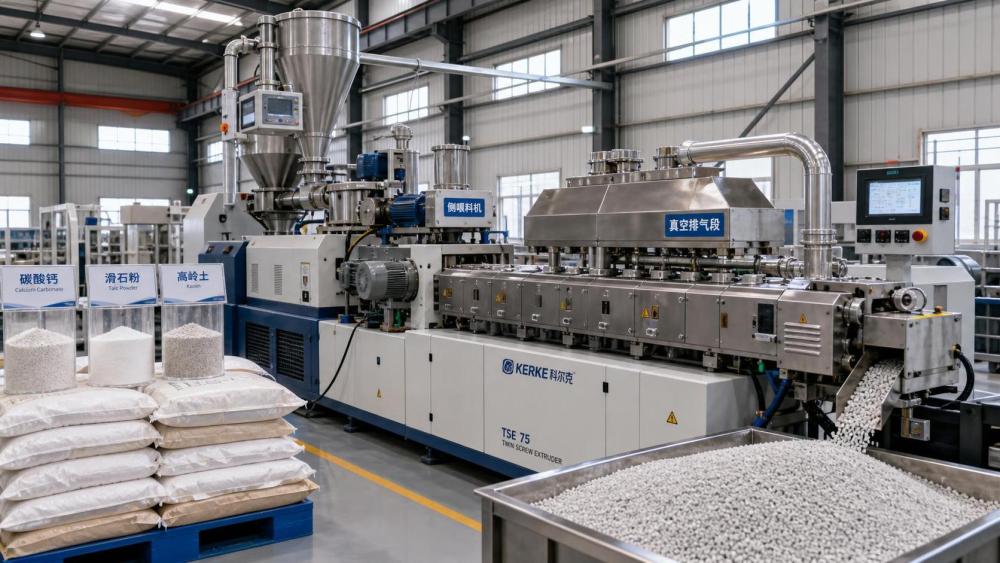
Screw design matters more than nominal output
When buyers compare plastic compounding equipment for mineral filled compounds, they often receive broad statements about “optimized screw configuration” or “excellent dispersion.” These phrases are not useful unless they are tied to the actual filler system and resin family. Mineral filled compounds require a careful balance. Too little distributive and dispersive mixing can leave agglomerates, poor surface appearance, unstable mechanical properties, or inconsistent shrinkage. Too much aggressive mixing can raise melt temperature, degrade polymer, increase fines, and accelerate wear without creating better product.
The key issue is whether the screw design creates controlled filler incorporation, sufficient wetting, and stable pressure without excessive thermal or mechanical stress. Technical evaluators should pay attention to:
- Available barrel length-to-diameter ratio and whether it suits the intended loading range
- The placement and intensity of kneading or mixing elements
- Free volume management after filler addition
- Residence time distribution and its effect on thermal history
- Flexibility to reconfigure screws for future grade changes
For businesses planning to run several mineral systems or both filled and unfilled grades on the same line, screw modularity has strategic value. It does not eliminate the need for process development, but it reduces the risk that a line becomes over-specialized and commercially rigid. That matters in markets where customer mix changes faster than capital equipment cycles.
Torque capacity and drive reserve are more important than headline horsepower
Mineral loading raises the mechanical demands on the extruder, but high motor power alone does not guarantee robust operation. What matters is whether the machine can maintain stable torque utilization across the actual grade mix, startup conditions, and production disturbances that occur in day-to-day use. Lines that operate too close to their torque ceiling may still hit target throughput on paper, yet struggle during lot variation, ambient condition changes, or when formulation adjustments are introduced.
Technical evaluators should ask for operating data from comparable applications, especially for sustained runs rather than short demonstrations. A useful comparison includes output, specific torque, melt temperature, feeder rates, vacuum behavior, and product quality at the target filler percentage. If suppliers only provide maximum-rate examples without quality data, the comparison is incomplete.
Drive reserve also has a business implication. If procurement selects a line that is correctly sized only for today’s cost-driven mineral loadings, it may have limited headroom for future higher-value grades that use more difficult additives, tighter color tolerances, or different base resins. Equipment should be judged not just on current utilization, but on whether it supports the likely commercial direction of the compound portfolio.
Wear protection is not an upgrade detail
With mineral compounds, wear is not a maintenance footnote. It is one of the main economic variables in the line’s real cost of ownership. Abrasion affects screws, barrels, side feeder components, die plates, and in some cases downstream pelletizing parts. The harder the mineral, the finer the particle, and the higher the loading, the more important metallurgy and wear protection become.
This is where low purchase price comparisons often become misleading. A cheaper line may appear attractive if the evaluation model stops at initial capital cost and rated output. But if wear liners, screw elements, and feeder parts require frequent replacement, the operating cost profile changes quickly. More importantly, wear changes process behavior over time. Clearance shifts, feeding consistency can deteriorate, pressure behavior drifts, and product quality may become harder to hold before maintenance thresholds are formally reached.
Technical teams should therefore ask specific questions: which components are protected, by what material system, with what expected service intervals in similar mineral applications, and how quickly can critical wear parts be sourced? If spare part lead times are long or dependent on a single overseas source, production continuity risk rises even if the machine itself is technically capable.
Degassing and moisture control are often underestimated
Not every mineral filled compound is degassing-intensive, but many evaluations underestimate how much volatiles, entrained air, residual moisture, or additive-related emissions can affect output stability and pellet quality. Fillers can carry surface moisture. Regrind or recycled resin streams can amplify variability. Surface-treated minerals may introduce additional process sensitivity. If the line cannot vent effectively, the result may be voids, surging, poor pellet cutting, surface defects, or unstable bulk density.
Vacuum system design should therefore be reviewed as part of the main process, not as an accessory. The location of venting zones, barrel fill behavior near vents, condensate management, and vacuum stability at target output all matter. In hygroscopic resin systems, upstream drying discipline is still essential; venting is not a substitute for proper material preparation.
For evaluators, the practical question is whether the line can maintain stable melt quality across normal raw-material variation, not just with ideal dried inputs during a controlled trial.
Pelletizing choice affects downstream value more than many teams expect
In mineral filled compounds, pellet quality has direct consequences for storage, conveying, dosing, and downstream molding or extrusion. Yet pelletizing is still sometimes treated as a secondary choice after the extruder is specified. That is a mistake. Strand pelletizing, underwater pelletizing, or other pelletizing configurations each carry tradeoffs depending on resin type, filler loading, melt strength, throughput, and desired pellet geometry.
For example, brittle strand behavior, dust generation, die-face buildup, or inconsistent pellet length can create handling problems that show up later in molding shops as feed interruptions, poor hopper flow, or batch-to-batch inconsistency. If the business sells into technical applications where customers expect stable feeding and appearance, pellet quality becomes part of product credibility, not merely packaging convenience.
Evaluators should connect pelletizing decisions to customer use conditions. The right question is not “which pelletizer is standard,” but “which pellet form best supports the way this compound will actually be stored, transported, metered, and processed?”
Do not evaluate line output separately from quality control strategy
A compounding line for mineral filled grades should be evaluated together with the plant’s ability to verify consistency. In practice, buyers are not purchasing an extruder alone. They are purchasing a process capability that must be visible through routine quality control. That means the equipment decision should align with what the operation can monitor quickly and reliably: filler content, melt flow, bulk density, moisture, color, dispersion indicators, pellet appearance, and critical application-specific properties.
If an equipment supplier demonstrates high output but the process window is narrow and hard to control using the plant’s existing QC methods, the line may be a poor operational fit. A more moderate-output system with better controllability, easier cleaning, and lower variability may create greater commercial value, especially for custom compounders or multi-grade manufacturers.
This is especially relevant where customer approvals are strict. Automotive, electrical, appliance, and industrial customers may not only care about nominal formulation; they care about lot-to-lot consistency and predictable downstream behavior. A technically impressive line that produces variable dispersion or fluctuating ash content can create expensive quality conversations very quickly.
A useful supplier comparison goes beyond the machine specification sheet
When comparing equipment suppliers, technical evaluators should push the discussion into operating evidence and support capability. Three suppliers may offer similar screw diameters and motor ratings, yet differ substantially in application knowledge, commissioning quality, wear-part support, controls integration, and process development assistance. Those differences matter more in mineral filled compounds because the process is sensitive to details that are often only resolved during startup and early production.
A grounded comparison framework usually includes the following:
This type of comparison is more work than a simple price-per-kilogram calculation, but it is closer to how real production risk should be assessed.
The most common selection mistake is buying for average output instead of process stability
In real plants, the most expensive problem is often not insufficient maximum throughput. It is unstable operation that consumes engineering time, causes quality drift, increases scrap, and weakens customer confidence. Mineral filled compounds magnify this risk because they are less forgiving of inconsistency in feed, mixing intensity, and mechanical condition.
That is why technical evaluators should be cautious when claims such as “higher shear always improves dispersion” or “a larger machine gives more security” are presented as general truths. In some formulations, excessive shear harms polymer integrity or raises wear too quickly. In some operations, oversized equipment performs poorly at the lower throughputs where the business actually spends most of its time. The correct line is the one that can repeatedly hit the intended quality level across the real operating window, with manageable wear and maintainable process control.
For companies evaluating investment now, the priority should be to define the compound family clearly, test the line under representative loading conditions, and measure performance in a way that connects directly to downstream customer requirements. That is the point where equipment selection becomes a business decision grounded in processing reality rather than a purchase based on catalog confidence.
Have questions about this sector analysis, or seeking best practices specific to your niche? Drop us a line below and let the senior consultants at APIM assist you.
We respect your privacy. Your information is strictly confidential.
Related News
- 00
0000-00
NAPCOR Report: US PET Bottle Recycling Rate Fell to 29% in 2025 - 00
0000-00
How does washing affect contamination in post-consumer recycled PP resins? - 00
0000-00
How does feedstock affect depolymerization equipment selection? - 00
0000-00
US Sets 213.44% Preliminary Antidumping Deposit on Chinese PTMEG - 00
0000-00
When should epoxy be used as a thermal interface material for semiconductors?