




What Temperature Profile Should You Use for Twin-Screw PA Compounding?
What Temperature Profile Should You Use for Twin-Screw PA Compounding?
Choosing the right temperature profile for twin-screw PA compounding means balancing complete melting and effective dispersion against hydrolysis, thermal degradation, and excessive shear heating. So, what temperature profile should be used in twin-screw extrusion for PA compounds? The answer depends on the polyamide grade, reinforcement or additive package, moisture content, screw configuration, and throughput—not a universal barrel setting.
A practical starting approach is a cooled feed throat, a rising temperature through the melting section, and a controlled plateau—or modest reduction—after melting. Set the adapter and die to maintain stable flow without adding unnecessary thermal exposure. Then validate the profile against actual melt temperature and compound quality. A neat PA6 recipe should not simply be copied onto glass-filled PA66, even if both materials run on the same machine.
What temperature range is a reasonable starting point?
For many conventional grades, PA6 melt processing commonly falls around 240–270°C, while PA66 often requires approximately 275–300°C. These are broad orientation ranges, not approved recipes or guaranteed safe limits. Individual grades, viscosity levels, stabilizer packages, and residence times can require different conditions. The resin supplier’s processing guidance takes priority.
Do not confuse melting point with processing temperature. PA6 typically melts near 220°C and PA66 near 260°C, but crossing that temperature does not prove that every pellet has melted or that the melt has suitable viscosity for compounding. Conversely, raising the barrel well above the melting point does not guarantee better dispersion.
Before selecting temperatures, confirm the exact polymer designation. PA6/66 copolymers, PA11, PA12, and semi-aromatic polyamides need their own processing windows. “PA compound” is too broad a description for a production setup sheet.
How should temperatures change along the barrel?
Think in functional sections rather than zone numbers. A twelve-zone extruder and an eight-zone extruder may carry out the same operations at different barrel positions. The important question is where melting finishes relative to kneading elements, side feeders, and vents.
A continuously rising profile is not automatically better. Once the polymer is molten, kneading blocks and restrictive elements can generate considerable heat. Increasing every downstream setpoint may solve a short-term flow problem while worsening discoloration or viscosity loss.
The opposite mistake is aggressive downstream cooling. A colder barrel wall may increase local viscosity, torque, and mechanical dissipation rather than neatly lowering the bulk melt temperature. Cooling adjustments must be checked against the machine’s response.
Why can the melt be hotter than the barrel setpoint?
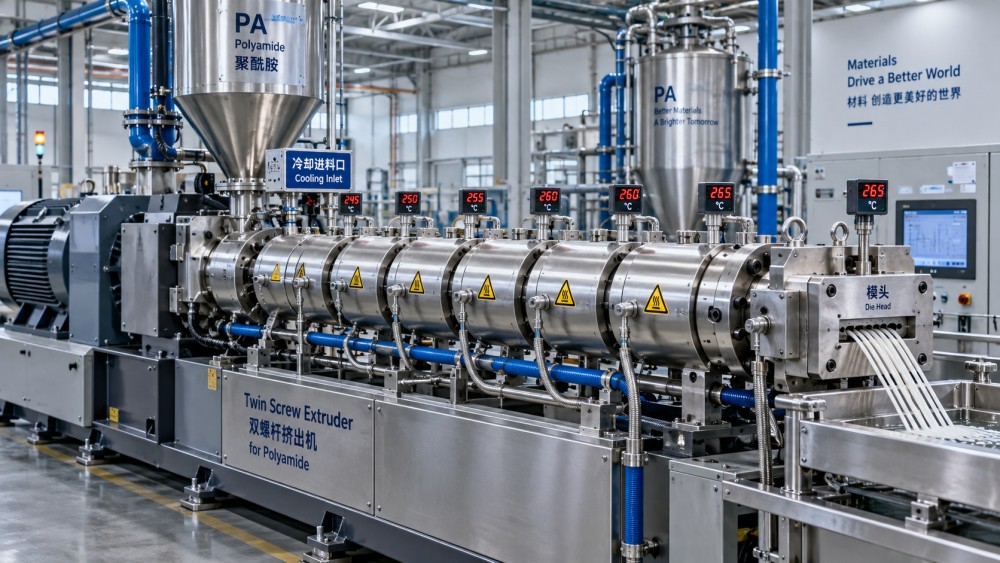
The barrel controller measures temperature near the barrel wall. It does not directly measure the temperature history of the material passing between the screws. Mechanical work adds heat, particularly in high-viscosity formulations and intensive mixing sections.
A stable controller display can therefore coexist with an overheated melt. Use a suitable, calibrated melt-temperature measurement at a defined location, such as the adapter, and document the sensor arrangement. Probe position and immersion affect the result. An infrared reading on an exposed strand is not interchangeable with an in-stream measurement.
Even an adapter sensor reports only one location. It may not reveal an earlier temperature peak inside a kneading section. Interpret it alongside torque, motor load, pressure, output, and signs of degradation. Where available, specific mechanical energy helps compare operating conditions, although it is not a substitute for measuring melt temperature.
Should glass-filled PA use a hotter profile?
Not necessarily. Glass fibers need a sufficiently fluid matrix for wetting and distribution, but increasing temperature is only one way to achieve that. Higher temperature can reduce viscosity; it also narrows the margin against degradation. Excessive mechanical treatment can shorten fibers regardless of whether the barrel settings look reasonable.
In a common side-feeding arrangement, the base polymer should be molten before glass enters. If melting is incomplete at that point, investigate upstream melting capacity and screw configuration rather than immediately heating the whole machine. Moving the problem downstream often leaves less length for wetting and homogenization.
For an automotive bracket compound, good-looking pellets alone are not enough. Residual fiber length, distribution, and molded mechanical properties matter. A hotter, smoother-running process can still produce a weaker material if the matrix degrades or the fibers receive too much work.
What changes with flame retardants, modifiers, or mineral fillers?
Check the thermal limits of the entire formulation, not just the base resin. Flame retardants, pigments, impact modifiers, lubricants, and coupling agents may restrict temperature or allowable exposure time. Reactive modifiers also introduce reaction-dependent viscosity changes, making simple temperature-to-flow assumptions unreliable.
Mineral fillers can change viscosity, heat transfer, and feeding behavior. Their moisture and surface treatment may also matter. If the resin needs a melting temperature that conflicts with an additive’s usable processing window, the answer may be a different addition point, shorter exposure, or reformulation—not a compromise barrel setting.
Can vacuum venting compensate for insufficient drying?
No—not reliably. Moisture can cause hydrolytic chain scission when polyamide melts. A vacuum vent removes moisture and other volatiles that reach it, but cannot rebuild molecular chains already damaged upstream.
Use the grade-specific drying conditions and residual-moisture target. There is no single drying temperature, duration, or moisture limit suitable for every PA formulation. Verify moisture with an appropriate method rather than assuming that time in a dryer proves the material is ready.
Check material handling after drying, too. An open hopper, long transfer route, or poorly controlled storage can undo the drying step. With recycled PA, variable moisture and previous thermal history make incoming checks especially important. Lowering the extrusion temperature does not correct wet feedstock.
What should you check when the line becomes unstable?
Start with the symptom, not the heater controller. High torque can reflect incomplete melting, excessive viscosity, overfeeding, or restrictive screw elements. High die pressure may come from a blocked screen, a cold adapter, or a restrictive die. Those problems require different responses.
- Unmelted particles: check resin identity, feed rate, upstream melting conditions, and available melting length.
- Bubbles or foamy strands: check incoming moisture, vacuum performance, vent condition, and possible additive decomposition.
- Yellowing, odor, or black specks: investigate excessive temperature, long residence time, oxidation, contamination, and stagnant material.
- Pressure oscillation: examine feeder consistency, side-feeder operation, vent flooding, and pelletizing backpressure before changing temperatures.
Residence time deserves particular attention during low-output operation and interruptions. A temperature that works during steady production may be unsuitable when material remains hot for longer. Follow an established shutdown or purge procedure; simply leaving PA at production settings during a prolonged stop increases risk.
How do you validate a profile before releasing production?
Begin with supplier guidance, known feed moisture, and a documented screw layout. Establish a stable baseline at the intended throughput. Change one controlled variable at a time, then allow the process to stabilize before sampling. Record actual zone temperatures, melt temperature, screw speed, output, torque, pressure, and vacuum conditions—not just the recipe setpoints.
Small temperature steps, often around 5°C during controlled trials, can make trends easier to interpret than large jumps. That is a trial approach, not a universal rule. Evaluate pellets and molded specimens against the application requirements. Useful checks may include moisture, an appropriate viscosity measurement, filler content, color, dispersion, and mechanical performance.
Also verify what happens across the expected production-rate range. Changing throughput or screw speed changes filling, mechanical energy input, and residence time. A successful trial at one operating point does not establish a robust production window.
This is the process-to-performance connection emphasized in APIM’s coverage of engineering plastics and extrusion technologies: machine settings are useful only when tied to material condition and end-use results. For technical handovers, share the resin grade, formulation, moisture data, screw layout, operating rate, measured melt temperature, and quality results together.
The right PA temperature profile is the one that delivers complete melting, required dispersion, and stable pelletizing while preserving the compound’s properties. Approve an operating window supported by measurements—not a row of barrel temperatures copied from another line.
Have questions about this sector analysis, or seeking best practices specific to your niche? Drop us a line below and let the senior consultants at APIM assist you.
We respect your privacy. Your information is strictly confidential.
Related News
- 00
0000-00
How to assess batch consistency from a thermal potting compounds supplier - 00
0000-00
How much weight can carbon fiber reinforced plastics save in cars? - 00
0000-00
Are flame retardant industrial materials subject to RoHS restrictions? - 00
0000-00
How to choose speciality films for high-barrier food packaging - 00
0000-00
NAPCOR Report: US PET Bottle Recycling Rate Fell to 29% in 2025