




What Role Does Masterbatch Play in Color-Matching Compound Formulation?
A color match can look correct in a laboratory plaque yet drift visibly on the production line, after a resin change, or when a part becomes thicker. In compound formulation, the masterbatch is often the control point that connects pigment selection to the actual appearance of the molded, extruded, or blown product. Its role is not limited to “adding color.” It determines how evenly the pigment enters the base resin, how stable the shade remains from batch to batch, how much opacity is achieved, and whether the compound can still be processed without defects.
So, what role does masterbatch play in compound formulation for color matching? It serves as a concentrated, pre-dispersed color system that allows compounders to dose pigments accurately and distribute them consistently through the polymer melt. A well-designed masterbatch helps preserve the target color while minimizing pigment agglomerates, streaks, processing instability, and unintended changes to mechanical or surface properties. A poorly matched masterbatch carrier, loading level, or let-down ratio can make the same pigment appear different from one production run to the next.
Masterbatch turns a color target into a processable formulation
Color matching begins with a visual requirement: a reference chip, a printed sample, an existing component, or an approved production standard. The compounder must then reproduce that appearance in a specific polymer under actual processing conditions. The challenge is that color is affected by more than pigment chemistry. Resin color, filler content, glass fiber, recycled content, part thickness, surface texture, crystallinity, and processing temperature can all shift the final result.
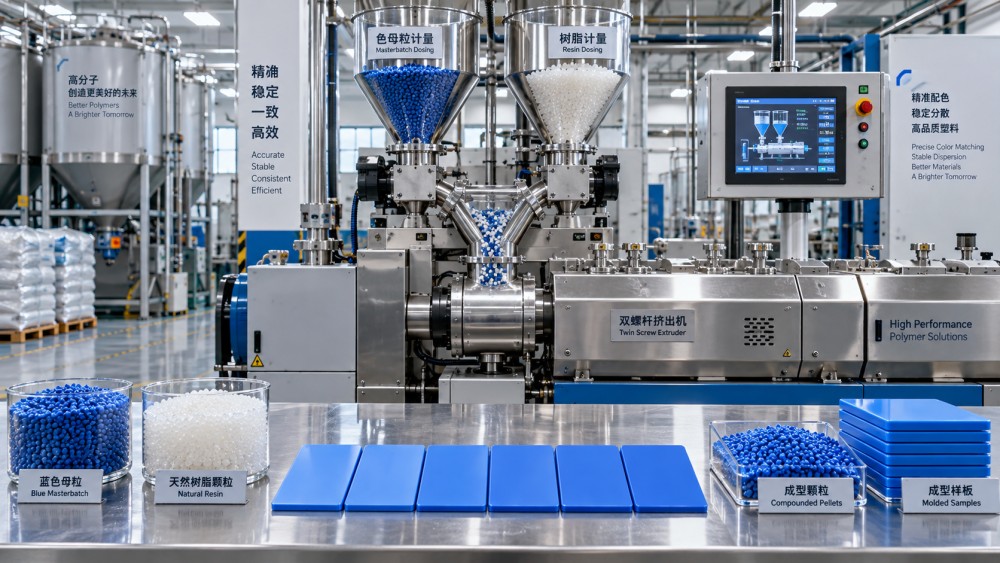
Masterbatch provides a practical route for introducing pigments and, where necessary, functional additives into the formulation. It normally contains colorants dispersed in a compatible carrier resin, sometimes with dispersion aids, stabilizers, or processing components. During compounding or downstream conversion, the masterbatch is blended with the natural resin at a controlled let-down ratio. Because the pigment has already been dispersed during masterbatch manufacture, the compounder does not need to handle loose pigment powders or rely entirely on in-line dispersion inside the final processing step.
This matters when visual consistency is a product requirement rather than a cosmetic preference. A housing for electrical equipment, an automotive interior trim part, a packaging closure, or a sheet with a visible surface may be rejected for shade variation even when its basic mechanical performance is acceptable. Masterbatch helps establish a repeatable relationship between the formulation, the dosing system, and the finished appearance.
Why pre-dispersion has such a strong effect on the finished shade
Pigments must be broken down and distributed throughout the melt. If dispersion is incomplete, pigment clusters can create specks, streaks, cloudy zones, or local color intensity differences. These defects are especially visible in light colors, high-gloss surfaces, translucent parts, films, and thin-wall products.
A color masterbatch is made using mixing conditions intended to wet pigment particles with the carrier resin and distribute them uniformly. The final compound still requires adequate mixing, but the task is much more manageable than dispersing raw pigments from the start. Uniform pigment distribution makes color measurement more meaningful because readings from one area are more likely to represent the entire part.
Good dispersion also reduces the risk that pigment-rich areas behave differently during processing. Concentrated particles or poorly dispersed additives can interfere with surface flow, create die lines, cause filter pressure changes, or appear as visual contamination. The masterbatch therefore influences both the optical result and the reliability of the production process.
The carrier resin must fit the compound, not just the pigment
One of the most frequent formulation mistakes is choosing a masterbatch primarily by color sample while giving too little attention to the carrier. The carrier resin should be compatible with the base polymer and with the processing method. Compatibility affects how readily the masterbatch melts, blends, and disperses, as well as whether it introduces visible or mechanical side effects.
A carrier that is poorly suited to the host resin may produce uneven distribution, phase separation, reduced impact performance, surface haze, or inconsistent gloss. In some systems, a small incompatible fraction may still be tolerated; in others, particularly transparent, high-performance, or tightly specified compounds, it can be unacceptable. The acceptable choice depends on the polymer family, masterbatch concentration, product geometry, and end-use requirement.
Carrier selection also becomes more important when the formulation contains flame retardants, impact modifiers, conductive additives, UV stabilizers, or high levels of filler. These ingredients can alter melt viscosity and optical behavior. A masterbatch that works in an unfilled natural resin may not deliver the same appearance once the complete compound package is present.
Color strength and let-down ratio need to be controlled together
Masterbatch loading defines how much color concentrate is added to the base formulation. The same masterbatch can produce very different results when the let-down ratio changes. Increasing dosage may improve opacity or deepen the shade, but it can also shift hue, change gloss, alter cost, and increase the influence of the carrier resin on the final compound.
It is tempting to correct a weak color by simply adding more masterbatch. That approach can work when the original issue is insufficient pigment concentration, but it will not solve every mismatch. If the material is showing streaks, lot-to-lot variation, yellowing from excessive heat, or a filler-driven change in undertone, higher dosage may only make the problem less predictable.
A more reliable formulation process establishes a target dosage range and verifies the result under the intended production conditions. The evaluation should include the actual base resin grade, filler level, additive package, and processing route. For products with strict visual requirements, it is useful to compare samples made at the lower and upper ends of the practical dosage tolerance, rather than approving only one nominal blend.
Opacity is not the same as color accuracy
Opacity describes the ability of a colored compound to hide the background beneath it. Color accuracy describes how closely the visible shade matches the approved target. A formulation can be highly opaque and still have the wrong undertone. It can also match a color target on a thick plaque but look pale or translucent in a thin section.
Masterbatch selection must therefore consider the final part geometry. Wall thickness, film gauge, ribbing, weld lines, and surface texture can affect how light enters and reflects from the polymer. A color match made on one plaque thickness should not automatically be assumed to match a thin extruded profile or a textured injection-molded component.
Processing conditions can change a correctly formulated color
Even a suitable masterbatch cannot compensate for uncontrolled thermal and mechanical history. Pigments, carrier resins, and the base polymer respond to heat and shear differently. Excessive residence time, an overly high melt temperature, poor temperature control, contamination, or unstable feed rates can all affect appearance.
In production, color variation often appears alongside other signals. A gradual shade drift may occur with changing barrel temperatures or material residence time. Random light and dark bands may point to feeder inconsistency, poor pre-blending, or unstable throughput. Dark specks may suggest degradation, dead spots, incompatible residue, or dirty processing equipment rather than a colorant problem.
When troubleshooting, separate a formulation issue from a processing issue before changing the masterbatch. Replacing the concentrate without checking the process can hide the real cause and create a new color target that only works under one unstable condition.
A practical way to investigate color mismatch
When a compound no longer matches its approved reference, start with the simplest verifiable conditions. Confirm that the correct masterbatch grade and base resin grade are being used, then check batch identification, storage condition, dosing setpoint, and feeder calibration. A material handling error can produce the same visual symptom as an inadequate pigment system.
- Compare the mismatch consistently. Use the same lighting conditions, sample thickness, surface orientation, and reference standard. Visual comparisons made under different lighting can create misleading conclusions.
- Review the full formula. Check changes in resin supplier, recycled content, filler level, stabilizer package, reinforcement, and any additive concentrate. A small change in the background material may shift the apparent color.
- Verify actual dosing. Confirm feeder accuracy and determine whether bridging, segregation, low hopper level, or poor bulk flow is affecting masterbatch addition.
- Inspect dispersion and surface defects. Look for streaks, unmelted particles, pigment agglomerates, filter residue, or localized gloss changes. These signs suggest mixing or contamination problems.
- Review thermal history. Compare barrel zones, melt temperature, screw speed, residence time, and start-up conditions with the approved process window.
- Run controlled samples. Change one relevant variable at a time. Testing several uncontrolled changes together may produce an acceptable color temporarily but provides no basis for repeatable production.
For reinforced compounds, evaluate samples after the same molding or extrusion conditions used for the final product. Fiber orientation, surface exposure of fillers, and shrinkage behavior can change the visible result. For recycled formulations, retain representative samples of the incoming recycled stream whenever possible, since background variability may define the practical color tolerance more than the masterbatch itself.
Masterbatch can carry more than color, but each added function needs review
Some concentrates combine pigments with UV stabilizers, light stabilizers, processing aids, slip agents, or other additives. Combining functions can simplify handling and reduce the number of feeds, but it also makes formulation changes harder to isolate. When shade, gloss, migration behavior, weathering response, or processing stability changes, the compounder must determine whether the cause lies in the pigment package, carrier, additive interaction, or processing condition.
Functional combinations should be evaluated against the intended application. For example, an outdoor colored part may need a pigment system and stabilization package that remain suitable under heat and light exposure. A food-contact, medical, electrical, or regulated application may require additional documentation and material-specific review. The color match alone is not evidence that the total formulation is acceptable for every use.
Questions that often arise during color matching
Can a universal masterbatch be used for every polymer?
Not reliably. A universal concentrate may be workable in certain commodity resin applications, especially at low addition levels, but it should not be assumed suitable for all polymers, high-temperature systems, transparent products, or demanding engineering compounds. Carrier compatibility and thermal stability must be assessed against the actual formulation.
Why does the same masterbatch look different in two resin grades?
The base resin may differ in natural color, crystallinity, melt flow, refractive behavior, additive content, or filler level. These differences affect pigment development and light reflection. A match should be approved in the specific resin grade and finished part condition, not only in a generic polymer category.
Does more masterbatch always produce a darker color?
Usually it increases color strength, but the visual effect is not always linear. Higher dosage can change opacity, undertone, gloss, and carrier influence. It may also expose a dispersion or process-control problem rather than correct it.
Should color matching be checked before or after compounding?
Both stages are useful. A preliminary check can confirm that the concentrate is directionally suitable, but final approval should be based on the fully compounded material and the intended conversion process. The compounded pellet, molded part, sheet, or film is the condition that matters to the end user.
Have questions about this sector analysis, or seeking best practices specific to your niche? Drop us a line below and let the senior consultants at APIM assist you.
We respect your privacy. Your information is strictly confidential.
Related News
- 00
0000-00
How does washing affect contamination in post-consumer recycled PP resins? - 00
0000-00
How does feedstock affect depolymerization equipment selection? - 00
0000-00
US Sets 213.44% Preliminary Antidumping Deposit on Chinese PTMEG - 00
0000-00
When should epoxy be used as a thermal interface material for semiconductors? - 00
0000-00
US Midterm Results Unlikely to Quickly Shift Recycled Plastics Market or Legislation