




Reinforced Thermoplastics Cost: What Drives Material and Processing Expenses?
Reinforced Thermoplastics Cost: What Really Drives Material and Processing Expenses?
When finance teams look at reinforced thermoplastics cost, the first trap is treating it like a simple resin quote. It rarely is. A glass-filled PA, a carbon-fiber reinforced PPS, or a mineral-filled PP can all look expensive on a datasheet, but the real budget impact shows up later: scrap, cycle time, tooling wear, drying energy, regrind limits, quality variation, and the cost of a part that does not meet tolerance the first time.
That is why material cost and processing cost should be reviewed together. In many programs, the resin price is only one line in the model, while conversion behavior decides whether the project stays profitable. APIM often frames this discussion the way technical buyers actually need it: not as “which material is strongest,” but as “which material works inside the process window we can realistically support.”
Why the resin price changes so much
The base polymer is the starting point. Engineering resins such as PA, PBT, PPS, PC, POM, TPU, and high-temperature grades each sit in very different price bands, and the spread can widen sharply depending on supply conditions. Once reinforcement is added, the price moves again. Glass fiber is usually the entry point for stiffness improvement, while carbon fiber pushes cost higher because of fiber price, feed consistency, and the tighter processing control it demands.
Additives matter more than many non-technical approvers expect. Flame retardants, impact modifiers, wear packages, UV stabilizers, conductive fillers, and thermal management additives all affect formulation cost. They also affect how stable the compound is during processing. A lower-priced grade can become the expensive one if it causes warpage, surface defects, or downstream assembly problems.
There is also a practical supply chain issue. Reinforced thermoplastics are not always interchangeable across suppliers, even when the grade name looks familiar. Fiber length retention, dispersion quality, moisture control, color consistency, and lot-to-lot stability can vary enough to affect scrap and cycle time. For procurement, that means price comparison without process context is usually incomplete.
The hidden cost in compounding
If the compound is purchased as a ready-made pellet, the compounding step is already embedded in the quote. If a company compounds internally, the economics change fast. Twin-screw extrusion capacity, feeder accuracy, vacuum degassing, melt filtration, and pelletizing method all affect operating cost and consistency. A line that looks cheap on paper can become costly if it cannot maintain stable output or if it generates too much off-grade material during changeovers.
This is where financial approvers should ask one simple question: what level of quality control is being purchased with the compound price? A well-dispersed glass-fiber reinforced material may reduce molding headaches and shorten troubleshooting time. A cheaper, less consistent lot may need extra drying, tighter machine settings, or more frequent purge cycles. Those costs do not always appear in the resin invoice, but they still hit the P&L.
Processing expense is often where the budget moves
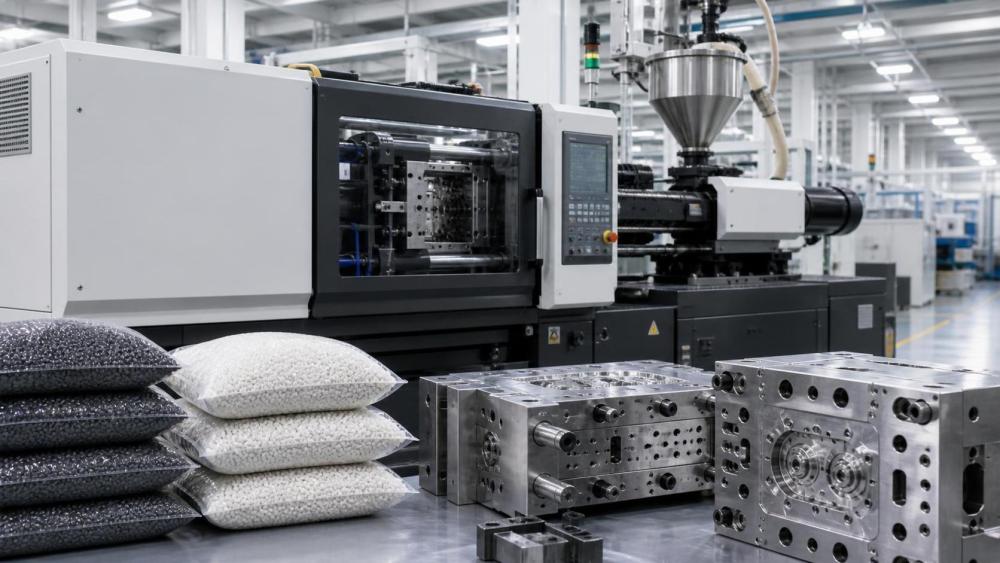
Reinforced thermoplastics are usually more demanding to process than unfilled resins. Glass and carbon fibers increase abrasion, so screw barrels, gates, and molds may wear faster. Some filled compounds are also more sensitive to moisture, meaning drying is not optional. Miss that step, and you may get splay, bubbles, poor mechanical properties, or a batch that has to be quarantined.
Cycle time is another quiet cost driver. A material with higher stiffness may allow wall-thickness reduction, which helps cycle time and part weight. But if the same material needs a slower fill rate, more venting, or a longer cooling phase to control warpage, the economics can swing back the other way. In high-volume programs, a few seconds per cycle can matter more than a modest difference in resin price.
Scrap rate is the issue most buyers underestimate. Reinforced materials can be less forgiving when the mold design, gate location, or processing window is not well aligned. Thin ribs, sharp corners, and uneven wall sections often expose this quickly. If the first production runs require repeated parameter tuning, the “cheap” material becomes expensive through lost output and delayed qualification.
Where the part design changes the answer
Part geometry can completely change the cost equation. A reinforced thermoplastic may be the right choice for a bracket, housing, connector body, or structural cover because it replaces metal, reduces weight, and integrates features into one molded part. In those cases, the material itself may cost more, but total system cost can still improve.
The opposite also happens. If a design is overbuilt and only needs moderate stiffness, moving to a heavily reinforced grade can add cost without meaningful benefit. Finance teams should be cautious when a material upgrade is driven by habit rather than a clear load, temperature, or chemical-exposure requirement. Over-specification is one of the fastest ways to inflate program cost.
For electronics, automotive, and industrial applications, the decision often turns on dimensional stability, heat resistance, and long-term durability. Those are valid reasons to pay more. But they should be matched with a realistic manufacturing route. If the part needs complex cosmetics, very tight tolerances, or post-processing, the selected grade must support that reality instead of just looking good in a comparison sheet.
A practical way to review cost before approval
A useful review usually starts with four checks. First, what property is actually needed: stiffness, impact, thermal resistance, wear resistance, flame retardancy, or a mix of these? Second, what process will be used: injection molding, extrusion, sheet forming, or a hybrid route? Third, what is the likely scrap and rework profile during launch? Fourth, what does the part replace in the assembly?
That last point matters more than people think. If a reinforced thermoplastic lets the team remove a metal insert, simplify assembly, or reduce fastening steps, the material premium may be easier to justify. If it only replaces a lower-cost resin without reducing other expenses, the business case becomes harder. Financial approval should follow the system effect, not the raw resin price.
It also helps to separate one-time and recurring cost. Tool modification, drying equipment, wear-resistant components, or process validation can be front-loaded. Resin spend, energy, scrap, and maintenance continue every month. A material that is slightly more expensive but stable in production is often easier to manage than a lower-cost grade that keeps forcing adjustments.
The questions worth asking suppliers
Before approval, buyers usually get better answers by asking about processing behavior, not just price. How sensitive is the grade to moisture? What kind of fiber retention should be expected? Does the formulation need special screw configuration or venting? Is regrind acceptable, and if so, under what limits? What lot-to-lot variation should be expected in color and mechanical properties?
These questions are not academic. They influence yield, machine uptime, and qualification time. In reinforced thermoplastics, cost control is less about chasing the lowest quote and more about avoiding surprises after the purchase order is issued.
For teams comparing options across multiple applications, APIM’s approach is useful because it ties material selection to compounding quality, processing behavior, and end-use requirements rather than treating the resin as a standalone commodity. That is usually the right lens for procurement, especially when the part carries structural responsibility or the production window is tight.
In practice, the best cost decision is rarely the cheapest material and rarely the highest-performance one. It is the grade that can be processed reliably, meets the part requirement without over-engineering, and keeps total cost of ownership under control after launch.
Have questions about this sector analysis, or seeking best practices specific to your niche? Drop us a line below and let the senior consultants at APIM assist you.
We respect your privacy. Your information is strictly confidential.
Related News
- 00
0000-00
How does washing affect contamination in post-consumer recycled PP resins? - 00
0000-00
How does feedstock affect depolymerization equipment selection? - 00
0000-00
US Sets 213.44% Preliminary Antidumping Deposit on Chinese PTMEG - 00
0000-00
When should epoxy be used as a thermal interface material for semiconductors? - 00
0000-00
US Midterm Results Unlikely to Quickly Shift Recycled Plastics Market or Legislation