




Reinforced Thermoplastic Compounder Selection: Throughput, Dispersion, and Cost
Reinforced Thermoplastic Compounder Selection: Throughput, Dispersion, and Cost
Choosing the right reinforced thermoplastic compounder affects far more than output volume.
It shapes dispersion quality, lot consistency, operating cost, and long-term supply confidence.
That matters when reinforced compounds support automotive, electrical, electronics, packaging, and industrial applications.
In practice, a reinforced thermoplastic compounder is not just a machine or a vendor.
It is a process capability that affects scrap, cycle stability, downstream molding performance, and commercial risk.
This article breaks the decision into throughput, dispersion, and total cost.
The goal is simple: compare options with fewer assumptions and better questions.
Start With The Real Output Requirement
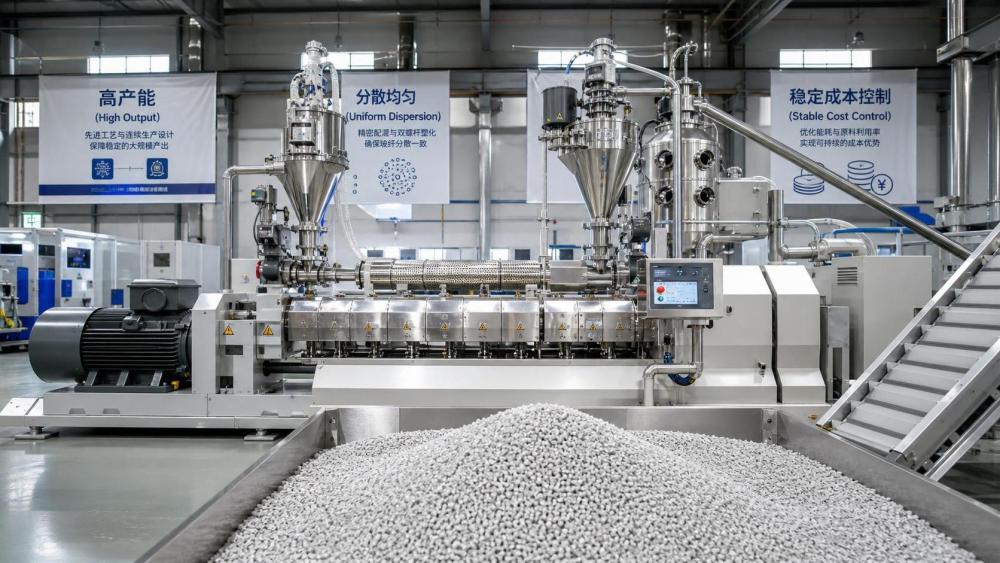
Many buying decisions start with nameplate capacity, and that is usually where mistakes begin.
A reinforced thermoplastic compounder may advertise high hourly output under ideal test conditions.
Actual production rates depend on resin type, filler loading, fiber length targets, moisture control, and pellet quality requirements.
Glass-fiber reinforced PA and mineral-filled PP do not behave the same way.
Neither do carbon-fiber compounds, flame-retardant blends, or heat-sensitive engineering plastics.
A better approach is to define output in commercial terms.
- Net sellable kilograms per hour
- Output at target filler or fiber percentage
- Output with agreed melt temperature range
- Output after startup losses and grade changes
- Output with acceptable pellet shape and moisture
This shifts the conversation from brochure capacity to usable capacity.
It also makes two reinforced thermoplastic compounder options easier to compare on equal ground.
Why Dispersion Deserves Equal Weight
Throughput is visible. Dispersion problems usually appear later, and they are more expensive.
Poor filler distribution can reduce stiffness consistency, surface finish, impact stability, and dimensional control.
Poor fiber management can shorten glass or carbon fibers and weaken mechanical performance.
For a reinforced thermoplastic compounder, dispersion quality comes from the full system.
That includes screw design, feeder stability, side feeding position, temperature profile, vacuum control, and residence time.
In real sourcing work, it helps to ask for proof beyond generic statements.
- Ask for dispersion data by formulation type, not only by polymer family.
- Request micrographs, ash-content uniformity, and mechanical property variation by batch.
- Check fiber length retention for reinforced grades with structural end uses.
- Review torque stability and temperature fluctuation during long runs.
- Confirm whether the same reinforced thermoplastic compounder setup supports multiple recipes reliably.
That last point matters more than it may seem.
A system that runs one showcase grade well may still struggle across a mixed product portfolio.
Equipment Design Signals To Review
Recent market changes have made process details more important than machine size alone.
Buyers now face broader material portfolios, tighter tolerance expectations, and stronger cost pressure.
So the reinforced thermoplastic compounder should be reviewed as a technical platform.
Several design signals are especially useful during comparison.
- Feeding system: Gravimetric accuracy affects ratio stability and lot consistency.
- Screw configuration: Mixing sections should match shear sensitivity and dispersion targets.
- Degassing: Vacuum performance matters for moisture, volatiles, and odor control.
- Melt filtration: Screen change strategy affects contamination control and uptime.
- Pelletizing: Strand or underwater pelletizing influences pellet uniformity and downstream feeding.
- Wear protection: Barrels and screws must handle abrasive glass, minerals, and certain flame retardants.
These points look technical, but they connect directly to financial outcomes.
A reinforced thermoplastic compounder with weak wear resistance may carry a lower purchase price.
Over time, maintenance, output drift, and downtime can erase that apparent saving.
Compare Cost By Total Processing Economics
The lowest quotation rarely delivers the lowest total cost.
For a reinforced thermoplastic compounder, cost should be measured across the full operating cycle.
This is where many sourcing teams get a clearer signal.
If one reinforced thermoplastic compounder delivers better dispersion and fewer off-spec batches, the cost gap can close quickly.
That is especially true for engineering plastics with expensive additives, fibers, or certifications.
Match The Compounder To Material And End Use
Not every reinforced thermoplastic compounder fits every product strategy.
The correct choice depends on resin family, reinforcement type, regulatory demands, and downstream processing route.
A supplier serving automotive under-hood parts may prioritize heat stability and glass-fiber retention.
An electronics application may focus more on flame retardancy, electrical properties, and color consistency.
Packaging or consumer goods may be more sensitive to surface quality, odor, and cycle efficiency.
This means qualification questions should follow application logic.
- Can the reinforced thermoplastic compounder maintain stable properties across seasonal moisture changes?
- How does it perform with recycled or bio-based content where feed consistency varies?
- What process windows are realistic for high-temperature materials such as PPS or PEEK blends?
- Can the line switch between mineral-filled and fiber-reinforced grades without excessive contamination risk?
These are practical questions, not technical extras.
They help connect compounder capability to order fulfillment, warranty exposure, and supplier stability.
Supplier Evaluation Beyond The Machine
A reinforced thermoplastic compounder is only part of the decision.
The operating team, documentation discipline, and quality system usually determine whether good hardware performs consistently.
From a commercial standpoint, the most useful checks are often straightforward.
- Review historical batch consistency and complaint response time.
- Check whether process data can be shared during qualification.
- Confirm spare parts access, maintenance support, and lead times.
- Assess scale-up experience from trial to commercial volume.
- Verify material traceability for regulated or export-sensitive applications.
A strong supplier should explain where the reinforced thermoplastic compounder performs best, and where limits appear.
That kind of clarity usually signals process maturity.
A Practical Shortlist Framework
When comparing options, use a simple scoring model that combines technical and cost priorities.
That keeps the reinforced thermoplastic compounder decision grounded in business needs.
- Throughput at target recipe and quality level
- Dispersion performance and batch uniformity
- Fiber retention or filler distribution quality
- Operating cost per ton
- Maintenance burden and wear risk
- Supplier technical support and documentation quality
- Scale-up confidence and delivery reliability
In most cases, the best reinforced thermoplastic compounder is not the fastest or the cheapest.
It is the option that delivers stable output, predictable quality, and defensible total cost.
That is the combination that protects margins and reduces supply risk over time.
Before final approval, align trial criteria, cost assumptions, and acceptance limits. That turns a reinforced thermoplastic compounder purchase into a controlled decision, not a hopeful one.
Have questions about this sector analysis, or seeking best practices specific to your niche? Drop us a line below and let the senior consultants at APIM assist you.
We respect your privacy. Your information is strictly confidential.
Related News
- 00
0000-00
How does washing affect contamination in post-consumer recycled PP resins? - 00
0000-00
How does feedstock affect depolymerization equipment selection? - 00
0000-00
US Sets 213.44% Preliminary Antidumping Deposit on Chinese PTMEG - 00
0000-00
When should epoxy be used as a thermal interface material for semiconductors? - 00
0000-00
US Midterm Results Unlikely to Quickly Shift Recycled Plastics Market or Legislation