




Polymer Compounding Basics: Process, Quality, and Common Mistakes
Polymer compounding sits behind many plastics that look simple in the final product but are technically complex in production.
A resin pellet may contain fillers, reinforcements, stabilizers, pigments, flame retardants, and processing aids, all tuned for a specific result.
That is why polymer compounding matters across automotive, electronics, packaging, industrial equipment, medical components, and consumer products.
Good compounds support lighter parts, stable dimensions, reliable processing, and predictable long-term performance.
Poor compounds create variability, scrap, color drift, weak mechanical properties, and expensive troubleshooting downstream.
Why polymer compounding deserves closer attention
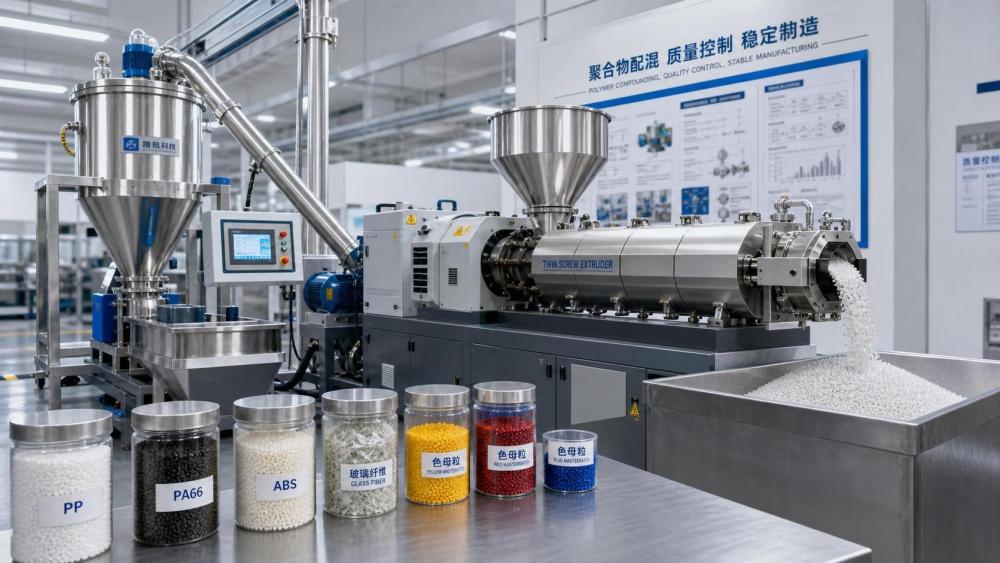
In current manufacturing, material choice is rarely just about selecting a base polymer such as PA, PC, PET, PBT, ABS, TPU, or PEEK.
The real question is how that polymer is modified to meet thermal, mechanical, chemical, optical, electrical, or regulatory requirements.
This is where polymer compounding becomes a business issue, not only a processing topic.
A glass-fiber reinforced polyamide changes stiffness and shrinkage behavior.
A flame-retardant polycarbonate affects safety compliance and molding stability.
A thermally conductive compound may enable heat management in electronics while introducing new viscosity and dispersion challenges.
Platforms such as APIM are useful because they connect formulation logic, equipment behavior, and application performance into one structured picture.
That broader view is increasingly necessary as supply chains become more global and specifications become tighter.
What polymer compounding actually involves
At a basic level, polymer compounding is the controlled blending of a base resin with additives or secondary materials.
The goal is not simple mixing.
The goal is a compound with targeted properties and stable processability.
Typical inputs include mineral fillers, glass fiber, carbon fiber, impact modifiers, UV stabilizers, lubricants, pigments, flame retardants, and recycled content.
Each ingredient changes the melt, the structure, or the final performance.
Twin-screw extrusion is often the preferred route because it offers strong distributive and dispersive mixing.
Feed systems, screw configuration, temperature zones, venting, filtration, and pelletizing all influence the final result.
Residence time matters as much as temperature.
Too little mixing leaves poor dispersion.
Too much shear can degrade the polymer, shorten fibers, or damage sensitive additives.
The balance between formulation and process
A strong formulation can still fail in production if the process window is narrow or poorly controlled.
The opposite is also true.
Well-designed equipment cannot fix an incompatible additive package or unrealistic property target.
That is why compound development usually combines material science, extrusion know-how, and downstream application understanding.
Quality is built through control, not inspection alone
In polymer compounding, quality cannot be verified only at the end of the line.
It has to be built into raw material handling, feeding accuracy, melt stability, and cooling conditions.
Moisture is a common example.
Hygroscopic materials such as PA, PET, and PBT can hydrolyze during processing if drying is insufficient.
That may reduce molecular weight and weaken performance even when pellets still look acceptable.
Dispersion is another critical factor.
Flame retardants, pigments, conductive agents, and fillers must be distributed consistently to avoid local defects.
In films and sheets, poor dispersion may show up as haze, gels, surface streaks, or thickness instability.
In molded parts, it may appear as brittle zones, warpage variation, or uneven color.
Where compounded materials create value
The value of polymer compounding becomes clearer when viewed through application requirements.
In automotive parts, compounds may reduce weight while meeting stiffness, heat aging, and dimensional stability targets.
In electrical systems, flame-retardant and insulating formulations support safety and long service life.
In packaging, barrier compounds and multilayer structures help preserve product quality and support shelf-life goals.
In electronics, conductive or thermally conductive compounds can solve shielding and heat dissipation problems.
In industrial products, wear-resistant and chemically resistant compounds improve maintenance intervals and reliability.
The same logic extends to specialty films, bonded assemblies, and sustainable materials with recycled or bio-based content.
What matters is that the compound fits the real processing route and service environment, not just the lab data sheet.
Common mistakes that distort results
Many polymer compounding problems come from assumptions made too early.
A frequent mistake is treating additives as independent upgrades.
In reality, one additive can change viscosity, color, thermal stability, surface appearance, and mechanical behavior at the same time.
Another mistake is copying a formulation from one base resin to another.
A flame-retardant package that works in PC may not behave the same way in ABS or PBT.
Processing conditions also get underestimated.
Changing screw speed, barrel temperature, or feeder placement can shift dispersion and degradation risk significantly.
- Ignoring resin drying requirements before extrusion.
- Using poor feeder calibration for low-dose additives or colorants.
- Running excessive shear on glass-fiber or heat-sensitive systems.
- Overlooking contamination from recycled streams or line changeovers.
- Evaluating pellets only by appearance, without linking data to downstream molding or extrusion behavior.
- Treating laboratory success as proof of full-scale manufacturing stability.
These mistakes are costly because they often appear later, during molding, film conversion, assembly, certification, or field use.
How to evaluate a compound more effectively
A useful evaluation starts with the end-use demands.
Mechanical strength alone is not enough.
Thermal exposure, humidity, electrical conditions, chemical contact, appearance standards, and processing method all need to be considered together.
For polymer compounding decisions, several questions help separate a promising grade from a risky one.
Practical checkpoints
- Is the formulation designed for injection molding, sheet extrusion, film extrusion, or another route?
- How stable are viscosity, color, and filler content across production lots?
- What tests support heat aging, impact resistance, flame performance, or chemical resistance?
- Does the compound rely on tight processing conditions that may be hard to repeat?
- How does recycled or bio-based content affect consistency and traceability?
- What downstream issues, such as warpage, plate-out, or surface defects, have been observed?
This is where structured technical content becomes valuable.
APIM’s coverage of advanced polymers, compounding systems, specialty films, adhesives, and circular materials supports that broader assessment.
It helps connect material claims with processing realities and supply-chain implications.
A sensible next step
Polymer compounding is best understood as a link between formulation, machinery, and application performance.
When any one of those three is treated in isolation, quality problems usually follow.
For ongoing evaluation, it helps to compare compounds against a clear checklist.
Focus on material purpose, additive interaction, process window, batch stability, testing evidence, and downstream behavior.
That approach makes polymer compounding easier to judge across engineering plastics, modified resins, specialty films, recycled materials, and performance-driven industrial applications.
The next useful move is to map the target application against those checkpoints and identify where deeper technical comparison is still needed.
Have questions about this sector analysis, or seeking best practices specific to your niche? Drop us a line below and let the senior consultants at APIM assist you.
We respect your privacy. Your information is strictly confidential.
Related News
- 00
0000-00
How does feedstock affect depolymerization equipment selection? - 00
0000-00
US Sets 213.44% Preliminary Antidumping Deposit on Chinese PTMEG - 00
0000-00
When should epoxy be used as a thermal interface material for semiconductors? - 00
0000-00
US Midterm Results Unlikely to Quickly Shift Recycled Plastics Market or Legislation - 00
0000-00
When should you choose carbon fiber over glass fiber composites for lightweight parts?