




POM vs Polyamide for Gears and Sliding Parts: Which Delivers Better Wear Performance?
POM vs Polyamide for Gears and Sliding Parts: Which Delivers Better Wear Performance?
When engineers compare POM with polyamide for gears and sliding parts, wear performance is only one part of a broader material decision.
Friction behavior, moisture sensitivity, dimensional stability, load capacity, and processing consistency can all influence real-world results.
This article examines how POM and PA perform in demanding industrial applications to help technical evaluators choose the more reliable option.
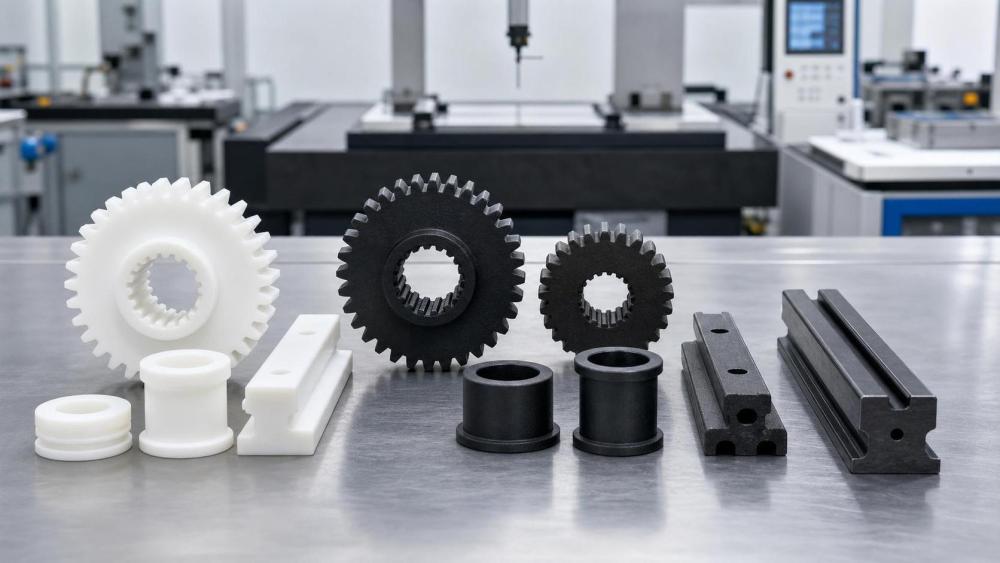
In many industrial designs, the decision is not simply about strength.
It is about how a gear tooth, guide, bushing, or sliding pad behaves after months of repeated movement.
That is where POM often enters the conversation.
POM is widely selected for low friction, good dimensional precision, and stable wear behavior in dry or lightly lubricated systems.
Polyamide, usually PA6 or PA66, brings a different profile.
It often offers higher toughness and load capacity, but moisture absorption can change part dimensions and friction response.
So the better material depends on the operating environment, not on a single datasheet number.
Why Wear Performance Matters Beyond Basic Strength
For gears and sliding parts, wear failure is often gradual.
The part may still look intact while noise rises, backlash increases, or positioning accuracy declines.
This is why material selection needs a broader lens.
A resin with excellent tensile strength may still underperform in sliding contact.
In practical terms, wear performance usually depends on five linked factors:
- Coefficient of friction during startup and continuous motion.
- Resistance to abrasion, scuffing, and surface fatigue.
- Dimensional stability under heat, humidity, and load.
- Ability to carry contact stress without creep.
- Consistency of molded part quality and surface finish.
POM and polyamide can both work well, but they balance these factors differently.
How POM Performs in Gears and Sliding Applications
POM is often favored when stable sliding behavior is the first priority.
Its naturally low friction helps reduce stick-slip, especially in small mechanical systems.
That matters in precision gears, latches, rollers, bushings, and conveyors.
Another advantage is moisture resistance.
Compared with polyamide, POM absorbs very little water.
This means tooth geometry, part clearance, and sliding alignment remain more consistent over time.
In actual equipment, that can reduce noise, uneven contact, and premature wear.
POM also machines cleanly and molds with strong dimensional repeatability.
For technical teams, this supports tighter tolerances and less variation between production lots.
Typical reasons to choose POM include:
- Low friction in dry-running or lightly lubricated contact.
- Better dimensional stability in humid conditions.
- Good fatigue resistance in repeated motion.
- Reliable surface quality for precision movement.
- Lower risk of performance drift after storage or field exposure.
That said, POM is not automatically the winner in every wear situation.
Higher loads, elevated temperatures, and aggressive impact can shift the decision toward polyamide grades.
Where Polyamide Can Outperform POM
Polyamide often earns its place when the application sees higher structural demand.
Many PA grades offer strong toughness and good resistance to repeated mechanical stress.
In larger gears or heavily loaded sliding parts, that can be a major benefit.
Polyamide is also highly versatile.
Unfilled, lubricated, glass-fiber reinforced, and heat-stabilized variants give designers a wider tuning range.
This becomes useful when a gear must handle load and wear at the same time.
Still, moisture absorption remains the key caution.
As polyamide takes up water, dimensions can shift and mechanical properties can change.
In tight-clearance systems, even small changes can alter contact pressure and wear patterns.
Polyamide is often the stronger option when:
- The part carries higher mechanical load.
- Impact resistance matters more than low friction.
- A reinforced or lubricated grade can be optimized.
- The design can tolerate moisture-related dimensional change.
- The operating environment includes moderate lubrication and controlled humidity.
So while POM often leads in stable wear performance, polyamide may win in tougher, more load-driven systems.
Direct Comparison: POM vs PA for Selection Decisions
From a selection standpoint, the most useful question is not which resin is stronger.
The better question is which resin stays reliable under the real duty cycle.
If a design depends on quiet motion, low friction, and precise geometry, POM usually has the edge.
If the design sees heavier force and can manage environmental variation, polyamide may be more competitive.
Common Application Scenarios and Material Fit
Looking at actual use cases makes the comparison clearer.
In office devices, consumer mechanisms, and compact actuators, POM is often preferred.
These systems value low noise, accurate fit, and predictable movement.
For automotive under-hood mechanisms or industrial transport systems, the answer can be less straightforward.
Heat, vibration, load peaks, and chemical exposure can all change the selection logic.
A simple rule of thumb can help:
- Choose POM first for precision gears, dry-running sliders, and tight-tolerance moving parts.
- Review polyamide first for higher-load gears, impact-prone parts, and reinforced design options.
- Reassess both if humidity, lubrication, or heat exposure will vary widely in service.
This kind of application-based screening usually saves time before full validation testing starts.
Selection Risks That Often Get Missed
Many wear problems are not caused by choosing the wrong polymer family alone.
They come from mismatched assumptions during evaluation.
One common mistake is comparing virgin POM with a modified PA grade.
Another is testing dry samples, then deploying parts in humid production environments.
Surface finish, mating material, and contact geometry also matter more than many teams expect.
Before locking in POM or polyamide, check these points:
- Was the wear test run under the same humidity and temperature as field use?
- Is the counterpart metal or plastic surface representative?
- Are tolerances tight enough that moisture expansion affects function?
- Does the selected grade include lubricants, reinforcements, or stabilizers?
- Will molding conditions change crystallinity or surface wear behavior?
These checks often reveal why a promising material later struggles in production.
Final Take: Which Material Delivers Better Wear Performance?
For many gears and sliding parts, POM delivers the more predictable wear performance.
Its low friction, low moisture absorption, and dimensional stability make it a strong default choice.
That is especially true for dry-running, precision, and low-noise mechanisms.
Polyamide remains highly valuable when the design must absorb more load or impact.
However, its wear behavior is more sensitive to moisture and operating conditions.
In other words, POM often wins on stability, while polyamide can win on structural toughness.
The best decision comes from matching resin behavior to duty cycle, environment, and tolerance window.
Start with application conditions, compare grade-specific data, and validate with realistic wear testing.
That approach turns a POM versus polyamide debate into a clearer, lower-risk material decision.
Have questions about this sector analysis, or seeking best practices specific to your niche? Drop us a line below and let the senior consultants at APIM assist you.
We respect your privacy. Your information is strictly confidential.
Related News
- 00
0000-00
NAPCOR Report: US PET Bottle Recycling Rate Fell to 29% in 2025 - 00
0000-00
How does washing affect contamination in post-consumer recycled PP resins? - 00
0000-00
How does feedstock affect depolymerization equipment selection? - 00
0000-00
US Sets 213.44% Preliminary Antidumping Deposit on Chinese PTMEG - 00
0000-00
When should epoxy be used as a thermal interface material for semiconductors?