




Mixing Screw Design Factors That Improve Dispersion in Twin-Screw Compounding
Mixing Screw Design Factors That Improve Dispersion in Twin-Screw Compounding
In twin-screw compounding, mixing screw design directly shapes dispersion quality, melt stability, and downstream consistency.
When dispersion is poor, filler streaks, color variation, weak mechanical properties, and unstable pellet quality usually follow.
That is why screw layout matters well beyond machine setup.
A practical mixing screw design must balance shear, residence time, pressure build-up, temperature rise, and material sensitivity.
This becomes even more important in engineering plastics, filled compounds, recycled polymers, flame-retardant systems, and color concentrates.
The goal is not maximum mixing everywhere.
The goal is controlled mixing at the right locations.
Why Mixing Screw Design Controls Dispersion
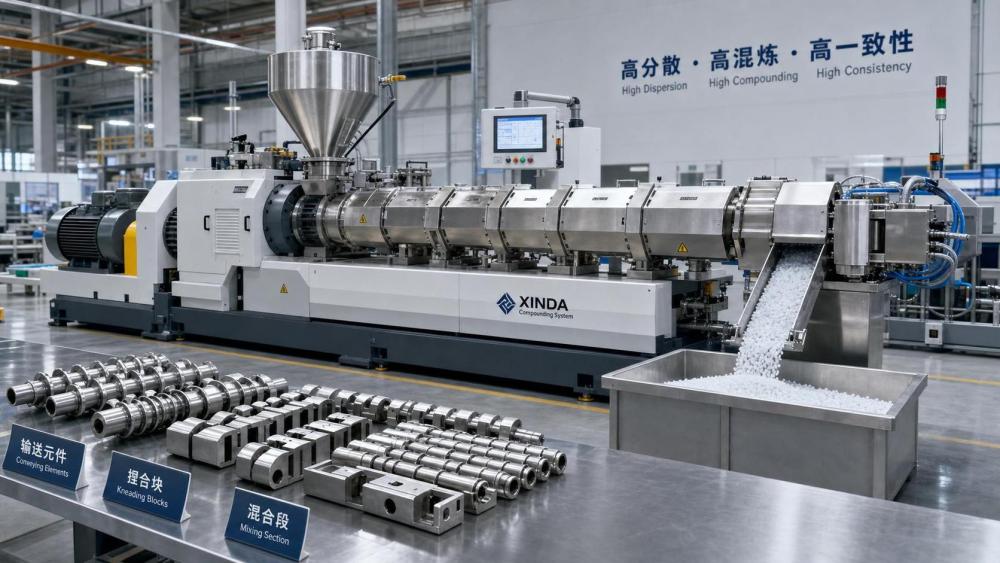
Mixing screw design determines how solids melt, how additives spread, and how agglomerates break down inside the barrel.
In a co-rotating twin-screw extruder, every screw element changes local flow behavior.
Conveying elements move material forward.
Kneading blocks generate shear and renewal of the melt surface.
Reverse elements create fill and pressure, often increasing mixing intensity and residence time.
Dispersion improves when the material sees enough stress to break clusters, but not enough to damage the polymer.
This is especially relevant for glass fiber compounds, mineral-filled polyolefins, conductive plastics, and heat-sensitive formulations.
A strong mixing screw design also supports stable feeding.
If solids are not captured and melted uniformly, later mixing sections work under unstable conditions.
The Core Mixing Mechanisms
A useful mixing screw design must handle two different jobs.
The first is distributive mixing.
This spreads ingredients evenly throughout the melt without necessarily applying extreme stress.
The second is dispersive mixing.
This breaks agglomerates, pigment clusters, or additive pockets into smaller domains.
Many processing problems come from confusing these two functions.
For example, more kneading blocks may increase stress, but they may also overheat the melt and reduce throughput.
A better mixing screw design often stages the process.
- Early zones focus on intake and melting.
- Middle zones build distributive and dispersive mixing.
- Later zones stabilize pressure and protect compound uniformity.
That sequencing usually delivers better results than one aggressive mixing section.
Key Mixing Screw Design Factors
Several design variables have the biggest influence on dispersion.
1. Screw Element Type
Conveying elements mainly transport material with limited mixing action.
Kneading blocks increase shear and melt renewal.
Toothed or specialized mixing elements can improve distributive mixing while controlling temperature rise.
A balanced mixing screw design uses each element for a specific purpose, not as a default choice.
2. Stagger Angle of Kneading Blocks
Stagger angle changes flow restriction and shear intensity.
Lower forward angles generally convey more gently.
Neutral or reverse angles increase residence time and mixing force.
In practical terms, the right angle depends on filler hardness, resin viscosity, and thermal sensitivity.
3. Length and Position of Mixing Zones
Location matters as much as intensity.
If a mixing screw design applies strong shear before full melting, torque spikes and unstable feeding can appear.
If the mixing zone comes too late, agglomerates may survive and show up in pellets or molded parts.
Good layouts usually place intensive mixing after reliable melting and before venting or final pressure control.
4. Fill Level and Residence Time
Dispersion improves when material spends enough time in the active mixing region.
Still, too much fill can create overheating, surging, or excessive pressure.
A strong mixing screw design uses restriction carefully so residence time increases without losing process stability.
5. Shear Versus Temperature Rise
More shear often improves dispersion, but it also adds heat through viscous dissipation.
That trade-off is critical for PVC, PET, bio-based polymers, recycled materials, and flame-retardant systems.
A practical mixing screw design improves dispersion while respecting melt temperature limits.
How Material Type Changes the Best Design
There is no universal mixing screw design for every compound.
The resin system and additive package define what kind of mixing is actually useful.
This is where process logic becomes more useful than general rules.
A mixing screw design for conductive compounds may fail badly in long-glass-fiber formulations.
Common Dispersion Problems and What They Usually Mean
Dispersion issues often leave visible process signals.
- Black specks or unmelted particles often point to poor melting or dead spots.
- Color streaks usually suggest weak distributive mixing.
- Filler clusters often indicate insufficient dispersive action or short residence time.
- Excessive melt temperature can mean the mixing screw design is too aggressive.
- Low mechanical strength may come from poor additive distribution or polymer degradation.
These symptoms should be read together with torque, head pressure, melt temperature, feeder behavior, and product test data.
Changing only barrel temperature rarely fixes a weak mixing screw design.
Practical Steps to Improve Mixing Screw Design Performance
In day-to-day compounding, improvement usually comes from controlled adjustments, not major redesign at the first sign of trouble.
- Confirm whether the issue is melting, distribution, or true dispersion.
- Review screw layout against feed position, venting location, and melt seal formation.
- Check if the current mixing screw design is too early, too late, or too long.
- Measure melt temperature instead of relying only on barrel settings.
- Compare throughput, screw speed, and fill level before replacing elements.
- For shear-sensitive compounds, shift toward gentler distributive elements where possible.
- For hard-to-disperse fillers, add focused dispersive sections instead of raising speed alone.
In many lines, a small change in element sequence gives better results than a large increase in energy input.
What Good Screw Design Looks Like in Practice
A good mixing screw design delivers repeatable compound quality across normal production variation.
The process stays stable when raw material bulk density shifts, ambient conditions change, or throughput is adjusted.
More importantly, the extruder does not need constant correction from the operator.
That kind of stability is the clearest sign that the mixing screw design matches the formulation.
As compounding moves toward higher filler loadings, recycled content, and tighter performance targets, screw design decisions become more critical.
The best results come from treating mixing screw design as a process tool, not just a hardware detail.
When shear, residence time, and element sequence are aligned with material behavior, dispersion improves in a measurable way.
That leads to more consistent pellets, fewer defects, and better confidence in downstream performance.
Have questions about this sector analysis, or seeking best practices specific to your niche? Drop us a line below and let the senior consultants at APIM assist you.
We respect your privacy. Your information is strictly confidential.
Related News
- 00
0000-00
How does washing affect contamination in post-consumer recycled PP resins? - 00
0000-00
How does feedstock affect depolymerization equipment selection? - 00
0000-00
US Sets 213.44% Preliminary Antidumping Deposit on Chinese PTMEG - 00
0000-00
When should epoxy be used as a thermal interface material for semiconductors? - 00
0000-00
US Midterm Results Unlikely to Quickly Shift Recycled Plastics Market or Legislation