




Impact Modified Plastics Mexico: Supply, Grades, and Market Fit in 2026
Mexico is becoming a more strategic production base for vehicles, electronics, packaging, and industrial goods. That shift is raising demand for impact modified plastics Mexico across parts that must resist shock, stress, and handling damage.
In 2026, the conversation is no longer only about resin price. Supply consistency, grade selection, processing behavior, and application fit matter just as much when evaluating commercial viability.
For companies tracking materials through a platform such as APIM, the value lies in connecting polymer performance with sourcing logic, compounding quality, and downstream manufacturing conditions.
What impact modified plastics mean in the Mexico market
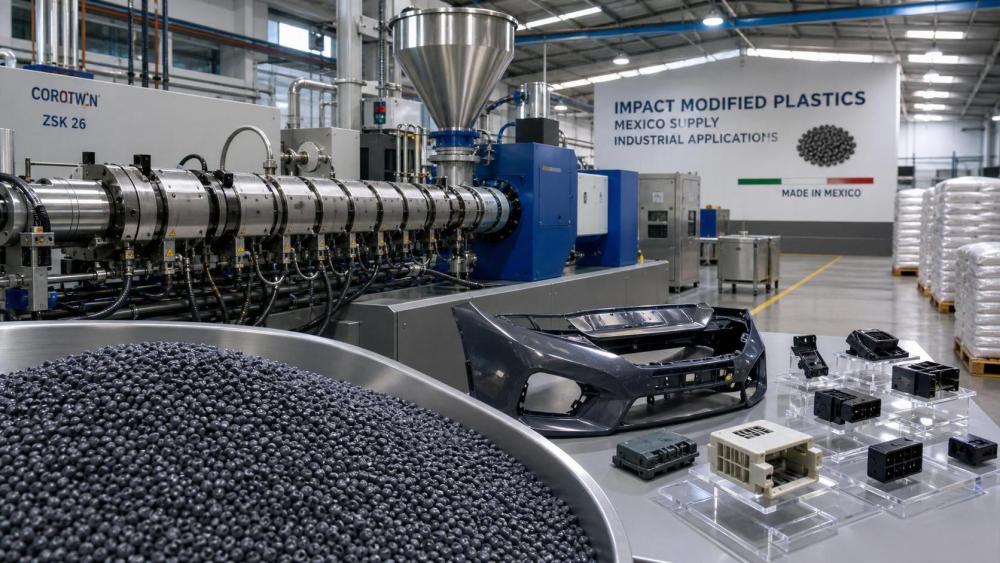
At a basic level, impact modified plastics are polymers formulated to absorb sudden force better than standard grades. They are designed to reduce brittle failure, cracking, or breakage during use or assembly.
In impact modified plastics Mexico, this often includes modified PP, ABS, PC/ABS, PA blends, impact-modified PVC, and specialty compounds tailored for industrial conversion.
The exact modification route varies. It may involve elastomers, rubber phases, copolymer design, fillers, reinforcement balance, or compounding control that preserves toughness without losing too much stiffness.
That balance matters because toughness alone is rarely enough. A part may also need heat resistance, dimensional stability, flame performance, chemical resistance, surface quality, or color consistency.
Why 2026 is a meaningful decision point
Mexico’s role in regional manufacturing keeps expanding, especially for North American supply chains. More localized production means more local demand for engineered compounds that reduce part failure and production loss.
At the same time, market conditions are becoming more selective. Buyers are comparing not only imported resin against local compounding, but also standard grades against application-specific formulations.
This is where impact modified plastics Mexico becomes commercially important. A low-cost material that creates scrap, warpage, inconsistent molding, or field damage can quickly erase any initial savings.
There is also a broader operational issue. Automotive, electronics, and appliance programs increasingly expect tighter documentation, repeatable batches, and clearer performance data across multiple production sites.
That favors suppliers able to support qualification work, process guidance, and grade continuity instead of only offering generic pellets.
Supply structure is changing, not just volume
The supply picture for impact modified plastics Mexico is shaped by three layers: imported base resins, domestic or regional compounding, and sector-specific customization.
Imported material still matters for specialty families and premium grades. Yet regional compounding is gaining attention because it can improve lead time, reduce logistics exposure, and support faster formulation adjustments.
That does not automatically mean local supply is better. Commercial reliability depends on feedstock quality, additive availability, pellet consistency, and process discipline during twin-screw compounding and pelletizing.
APIM’s broader coverage of extrusion and compounding is relevant here. Screw design, feeding accuracy, melt temperature, dispersion, filtration, and degassing all influence whether an impact-modified compound behaves consistently in real production.
For 2026 planning, supply evaluation should include more than capacity claims. It should test whether the supplier can sustain the same grade under scale, seasonal demand shifts, and specification revisions.
What usually deserves closer verification
- Base polymer source stability and lot-to-lot variation.
- Availability of impact modifiers, stabilizers, pigments, and fillers.
- Documented mechanical data at relevant temperatures.
- Support for molding, extrusion, or thermoforming trials.
- Backup production options and regional logistics coverage.
Grade families and where they usually fit
Not every impact-modified resin solves the same problem. In practice, grade choice depends on the combination of toughness, stiffness, heat exposure, appearance, and process route.
This range explains why impact modified plastics Mexico cannot be treated as one uniform category. The commercial question is which grade family aligns with the actual service environment and process economics.
Where business value shows up in real applications
In automotive programs, impact-modified compounds help protect clips, covers, trim parts, battery-adjacent housings, and interior surfaces from assembly stress and daily wear.
In electronics, the priority often shifts toward drop resistance, dimensional stability, and flame-retardant compatibility. A resin may need toughness without sacrificing electrical safety or cosmetic appearance.
Packaging and industrial products create another pattern. Reusable containers, protective components, pallets, and handling parts need toughness under repeated impact, but also stable processing and cost control.
This is why APIM’s application-focused approach matters. Material value becomes clearer when mechanical data is read together with processing method, part geometry, and expected failure mode.
A strong Izod result on a data sheet may not predict field success if weld lines, wall thickness variation, or low-temperature use were ignored during evaluation.
How to judge market fit beyond the data sheet
The most useful review of impact modified plastics Mexico combines technical and commercial filters. Looking at one without the other usually creates blind spots.
Technical fit
- Impact strength under real temperature conditions.
- Stiffness retention after modification.
- Processing window for molding or extrusion lines.
- Compatibility with flame retardants, UV packages, or fillers.
- Long-term behavior under chemicals, humidity, or repeated stress.
Commercial fit
- Lead time and minimum order flexibility.
- Price resilience when additives or base resins tighten.
- Documentation quality, including test methods and compliance files.
- Scale-up support from trial volumes to program production.
- Ability to maintain color, appearance, and batch consistency.
Usually, the strongest candidates are not the cheapest grades. They are the grades that reduce qualification friction and keep total production risk manageable.
The sustainability layer is becoming part of qualification
Sustainability is moving from a reporting issue to a material decision. In impact modified plastics Mexico, that may involve recycled content, traceable feedstock, or lower-waste processing routes.
Still, impact performance and circularity do not always align easily. Recycled streams may introduce variability, especially where toughness, color stability, or surface quality must remain tight.
That does not rule out sustainable options. It means they should be tested with the same discipline as virgin compounds, especially for demanding industrial or safety-related uses.
The better question for 2026 is not whether a grade sounds greener. It is whether the sustainability claim holds up under processing stability, traceability, and end-use performance requirements.
What to do next when assessing options for 2026
A practical next step is to narrow the evaluation to a few clear variables: application stress, required certifications, process route, expected annual volume, and acceptable supply risk.
From there, compare impact modified plastics Mexico by grade family rather than by broad category name. Shortlist the compounds that match both the part function and the production environment.
It also helps to review compounding capability, quality control discipline, and regional support before locking in a material path. Those factors often decide whether a promising grade performs well outside the lab.
For teams using structured market intelligence, the goal is simple: turn material complexity into a workable decision framework. In 2026, the strongest position will come from linking supply, grade logic, and application fit early.
Have questions about this sector analysis, or seeking best practices specific to your niche? Drop us a line below and let the senior consultants at APIM assist you.
We respect your privacy. Your information is strictly confidential.
Related News
- 00
0000-00
How to assess batch consistency from a thermal potting compounds supplier - 00
0000-00
How much weight can carbon fiber reinforced plastics save in cars? - 00
0000-00
Are flame retardant industrial materials subject to RoHS restrictions? - 00
0000-00
How to choose speciality films for high-barrier food packaging - 00
0000-00
NAPCOR Report: US PET Bottle Recycling Rate Fell to 29% in 2025