




How twin-screw extruders affect dispersion in masterbatch manufacturing
How Twin-Screw Extruders Affect Dispersion in Masterbatch Manufacturing
In masterbatch manufacturing, dispersion is not a cosmetic detail. It determines whether a pigment produces uniform color, whether a mineral filler reinforces rather than weakens a polymer, and whether a conductive or flame-retardant additive performs consistently in the final part. A masterbatch may look acceptable at the pellet stage yet still create streaks in film, black specks in injection-molded parts, unstable electrical behavior, or surface defects during sheet extrusion.
Twin-screw extruders are widely used because they give compounders more control over the conditions that govern dispersion: shear stress, material renewal, temperature, pressure, feeding sequence, melt residence time, and devolatilization. That does not mean every twin-screw line automatically delivers good dispersion. The result depends heavily on how the machine is configured and operated. In practice, a well-chosen screw design with poor feeding control can disappoint, while a relatively conventional machine may produce excellent material when formulation, torque load, and thermal profile are understood properly.
For technical evaluation, the useful question is not simply whether a supplier uses a twin-screw extruder. It is whether the extrusion system creates enough controlled mixing to break down additive agglomerates without damaging the carrier resin, pigment, additive package, or downstream processing window.
Dispersion is more than “mixing well”
Two different mixing mechanisms matter in masterbatch production. Distributive mixing spreads material throughout the melt so that each region receives a similar proportion of pigment, filler, wax, stabilizer, or functional additive. Dispersive mixing applies sufficient stress to separate agglomerates into smaller particles or individual primary particles where the formulation allows it.
A color masterbatch provides an easy illustration. If carbon black or an organic pigment is merely distributed as clusters through the polymer, the pellets may appear broadly uniform. Once the customer converts them into a thin film or molded component, however, those clusters can show up as visible dots, streaking, gloss variation, or weak color strength. In a talc-filled PP masterbatch, incomplete breakdown and wetting can create poor mechanical consistency. In conductive compounds, the issue may be even less forgiving: the conductive network can vary locally, leading to unstable resistivity.
Dispersion therefore has to be judged against the end-use requirement. Film and fiber applications generally reveal small defects quickly. Thick-walled molded parts may tolerate some visual variation but still fail on impact performance, dimensional stability, or electrical properties. A compounder should not describe dispersion as “good” without clarifying what is being dispersed, in which carrier resin, at what loading, and for which conversion process.
Why the twin-screw platform changes the outcome
Most masterbatch operations use co-rotating, intermeshing twin-screw extruders because the screws continuously exchange material in the intermeshing region. This promotes self-wiping action and frequent redistribution of the melt. Compared with a simpler conveying system, the processor can divide the barrel into functional zones: solids conveying, melting, side feeding, intensive mixing, pressure build-up, venting, and discharge.
That modularity is the real advantage. Screw elements can be arranged to match the formulation rather than asking one fixed geometry to handle every material. Conveying elements move resin and additives forward. Kneading blocks generate mixing and shear. Reverse elements or other restrictive components can increase fill level and pressure, although they can also raise melt temperature and torque. Mixing elements may improve distributive mixing with less aggressive shear than a tight kneading section. The right sequence is usually more valuable than simply adding more kneading blocks.
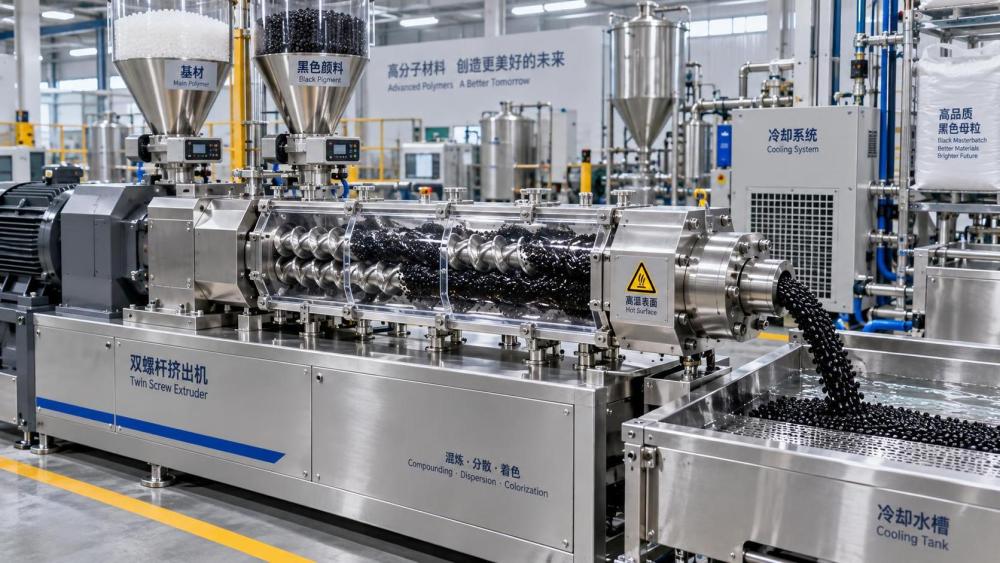
A common mistake is to treat high shear as the universal answer to poor dispersion. It is not. More shear may help deagglomerate a difficult pigment or filler, but it can also degrade heat-sensitive polymers, increase carrier-resin molecular damage, change melt flow behavior, or create excessive temperature peaks. For some organic pigments, excessive mechanical and thermal history may affect shade or color development. For long glass-fiber formulations, aggressive mixing can shorten fibers beyond what the application can accept. A technically sound process aims for the minimum stress needed to achieve the required dispersion level.
Screw design is a balance between shear, residence time, and thermal history
The screw layout influences nearly every part of dispersion behavior. A layout with too little mixing may leave pigment clusters intact. One with excessive restriction can cause material to remain too long in hot, high-shear zones. The consequence may be gel formation, discoloration, odor, volatility, or an unstable melt pressure profile. These risks become more pronounced when working with recycled feedstocks, hygroscopic polymers, reactive additives, or formulations containing several low-dose ingredients.
The location of mixing elements also matters. Applying high shear before the carrier resin has melted adequately is rarely efficient; dry powder may bridge, dust, or travel unevenly. Applying intensive mixing only near the die can leave too little time for material to redistribute after agglomerates are broken down. In many practical designs, the material is first conveyed and melted, then subjected to controlled dispersive mixing, followed by a section that improves distribution and melt uniformity before discharge.
Residence time should be considered as a distribution, not just an average value. Some material can pass through relatively quickly while another portion remains in restrictive sections longer. A broad residence-time distribution can be problematic for formulations sensitive to heat history or additives that must be incorporated consistently. It may also make color changeovers slower and increase the risk of cross-contamination between batches.
The interaction between screw speed and throughput
Screw speed and throughput are often discussed separately, but they should be assessed together. Raising screw speed can increase the frequency of mixing events and improve dispersion in some systems. At the same time, it can increase specific mechanical energy and frictional heating. Increasing throughput may reduce residence time, but depending on the feeding rate and screw configuration, it can also alter fill level and pressure in ways that change the mixing regime.
There is no universally correct operating point. A high-loading carbon black masterbatch and a lightly loaded UV additive concentrate may require very different choices. Technical reviews should ask how the processor controls melt temperature, motor load, pressure stability, and pellet quality across normal production conditions—not only during a short trial run at one setpoint.
Feeding accuracy often decides whether a good screw design can work
Masterbatch dispersion begins before material enters the screws. Pigments, fillers, carrier resin, dispersing aids, waxes, and functional additives need to reach the process at a stable ratio. If the feed fluctuates, the extruder sees alternating lean and rich zones. Those fluctuations can produce variable torque, inconsistent melt viscosity, shifting color strength, and non-uniform dispersion even where the screw layout is technically appropriate.
Fine powders introduce additional complications. They may have poor flowability, entrain air, compact in hoppers, or bridge at the feeder. Some pigments are difficult to wet because of their surface characteristics, while low-bulk-density materials may occupy substantial volume without delivering stable mass flow. Loss-in-weight or gravimetric feeding is often valuable for control, but it is not a cure for poor hopper design, inappropriate agitation, or powder that has absorbed moisture.
Side feeding can be useful when a filler, fiber, or heat-sensitive component should be introduced after the main polymer has melted. However, the downstream screw section must still provide enough melt incorporation and mixing length. A side feeder positioned too close to the discharge zone may reduce thermal exposure, but it may also leave insufficient opportunity for proper wetting and dispersion. That trade-off should be evaluated through actual compound testing rather than assumed from the equipment layout.
Temperature control is not the same as setting barrel temperatures
Barrel-zone settings are only one part of the thermal picture. The actual melt temperature reflects polymer viscosity, screw speed, shear intensity, throughput, degree of fill, and die resistance. A process can be nominally within the recommended barrel range while the melt becomes much hotter in a restrictive mixing zone. This is one reason why direct melt-temperature monitoring and consistent review of torque and pressure trends are more informative than relying on heater settings alone.
Insufficient temperature can also harm dispersion. When viscosity remains too high, pigment wetting may be poor and the system may draw excessive torque. When it is too low, the melt may lose the stress needed to break agglomerates effectively, while additives can migrate or separate more easily. The target is a stable viscosity and thermal state compatible with both the carrier polymer and the additive package.
For recycled polymers, this balancing act is usually harder. Feedstock variability, residual moisture, contamination, prior heat history, and changing melt flow can all affect dispersion behavior. Vacuum degassing, filtration, and drying may be necessary parts of the process strategy, but none of them replaces appropriate mixing. They solve different problems.
How technical teams should evaluate dispersion quality
The most reliable evaluation combines process evidence with application-relevant testing. Pellet appearance alone is a weak indicator. A better approach is to let down the masterbatch at the intended use ratio and process it into a representative plaque, film, sheet, profile, fiber, or molded part. The resulting surface, color, mechanical response, and functional performance will often reveal issues that are invisible in pellets.
Technical teams should also review production consistency. Stable pressure, torque, melt temperature, feeder performance, and pelletizing behavior do not prove dispersion on their own, but unexplained variation in these signals is a warning sign. If one color batch needs materially different operating conditions from another, the cause may lie in pigment surface treatment, bulk density, moisture, carrier-resin lot variation, or the additive package rather than the extruder alone.
What to ask when comparing extrusion capability
When assessing a masterbatch producer or an extrusion solution, broad claims about “advanced mixing” are not enough. More useful questions include: What type of twin-screw configuration is used? How are feed rates controlled? Where are pigments or fillers introduced? Is melt temperature monitored directly? How is the line managed during color changeovers? What downstream filtration is used, and could it mask rather than solve an upstream dispersion problem? How is dispersion verified after let-down?
It is also worth asking whether the process was developed for the actual carrier resin and application. A configuration that works well in PE may not transfer directly to PA, PET, PC, TPU, PBT, or a high-temperature engineering polymer. Polymer rheology, moisture sensitivity, thermal stability, and additive compatibility change the process window. The same applies to recycled resin systems, where incoming variability can be more influential than nominal equipment capacity.
This equipment-and-material relationship is central to the technical coverage developed by Global Advanced Polymers & Industrial Materials Intelligence Network (APIM). For compounders, converters, material suppliers, and engineering teams, extrusion performance is best understood alongside formulation design, feeder selection, degassing, filtration, pelletizing, and the real demands of downstream production.
The practical conclusion: controlled energy beats maximum energy
Twin-screw extruders affect dispersion in masterbatch manufacturing because they make mixing conditions adjustable rather than fixed. Their value lies in controlled material exchange, configurable shear zones, and the ability to manage different ingredients through separate process stages. But the machine is only one part of the result. Formulation quality, powder handling, feeding accuracy, melt temperature, residence-time behavior, and verification at the final let-down ratio all matter.
For a technical evaluator, the strongest evidence is not the number of screw elements or the highest achievable screw speed. It is a stable, repeatable process that produces the required dispersion without unnecessary thermal or mechanical damage. If a supplier cannot link screw configuration and process control to application-level test results, the masterbatch should be treated as technically unproven until further evaluation is completed.
Have questions about this sector analysis, or seeking best practices specific to your niche? Drop us a line below and let the senior consultants at APIM assist you.
We respect your privacy. Your information is strictly confidential.
Related News
- 00
0000-00
Do polyolefin hot melt adhesives bond well to polyethylene? - 00
0000-00
Korean Study Finds PLA Barely Degrades in Landfill After 320 Days - 00
0000-00
How to assess batch consistency from a thermal potting compounds supplier - 00
0000-00
How much weight can carbon fiber reinforced plastics save in cars? - 00
0000-00
Switching from PS to ABS Sheet Extrusion: Equipment Checks