




How to prevent strand breakage in strand pelletizing systems
How to prevent strand breakage in strand pelletizing systems
Frequent strand breaks in strand pelletizing systems disrupt production, increase scrap, and force operators into repeated rethreading. Prevention starts with identifying where strands fail and checking the conditions behind each break—from unstable melt flow and uneven die temperatures to inadequate cooling or excessive tension. Adjusting the pelletizer alone rarely solves a problem that begins inside the extruder.
The practical goal is a stable balance: each die hole delivers consistent output, the strands cool enough to withstand handling, and the feed rolls pull them without excessive stretching. That balance changes with polymer grade, filler loading, recycled content, and throughput. A recipe that runs unfilled polypropylene reliably may not suit glass-filled polyamide or recycled PET.
Find where the strand actually fails
Before changing settings, observe the break location from a safe position. The place where a loose end becomes visible is not always where failure started. A strand found at the pelletizer inlet may have broken near the die and simply traveled downstream.
- At the die or before entering water: investigate low melt strength, excessive drawdown, bubbles, local die restrictions, and temperature imbalance.
- Inside the cooling bath: look for strand collisions, turbulent water, damaged guides, or weak sections produced upstream.
- At a guide, dryer, or bath exit: check friction, sharp bends, alignment, and whether the strand is still too soft or has become brittle.
- At the pelletizer inlet: inspect feed-roll traction, nip pressure, cutter condition, and strand temperature.
Also note whether one strand repeatedly fails or the whole strand curtain becomes unstable. A recurring failure at one die hole points toward a local restriction, damage, or heating issue. Simultaneous thinning across many strands suggests a shared cause such as output fluctuation, haul-off speed, or material condition. These are starting points for investigation, not proof of a single cause.
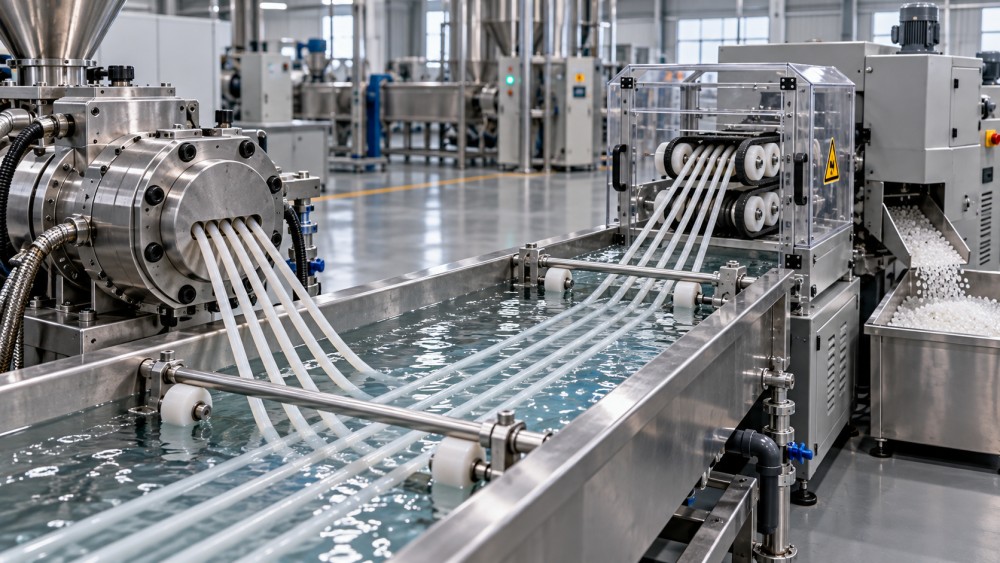
Record when failures occur: during feeder refill, after a screen change, following a speed increase, or only after an extended run. Timing often reveals more than the appearance of the broken end.
Stabilize the melt before adjusting downstream equipment
A pelletizer cannot compensate for intermittent extrusion. Watch die-pressure trends, feeder delivery, screw speed, torque, and actual melt temperature together. Repeated thick-and-thin sections usually justify checking upstream stability before increasing cooling or changing cutter settings.
Check for hopper bridging, inconsistent bulk density, feeder refill disturbances, and irregular side feeding. These deserve particular attention with lightweight regrind, powders, and heavily filled compounds. If output drops while pelletizer feed speed remains unchanged, the strands are drawn thinner and may break.
Compare pressure before and after filtration where instrumentation allows. Increasing differential pressure can indicate screen loading; pressure disturbances around screen changes can briefly alter strand flow. Follow approved screen-changing procedures rather than removing filtration as a shortcut. Contaminants passing through the line can create weak points and damage downstream equipment.
Check moisture and degradation separately
Bubbles, foaming, or porous fracture surfaces can indicate moisture or other volatiles. Hygroscopic polymers such as PET, PA, and PC require grade-specific drying control. Verify dryer temperature, dew point, residence time, airflow, and handling after drying. A dryer setpoint alone does not establish that the resin meets its moisture requirement.
Moisture can also cause hydrolytic degradation in susceptible polymers during melt processing, reducing molecular weight and strand strength. Vacuum venting may help remove volatiles, but it does not reverse degradation that has already occurred or replace required predrying.
Excessive melt temperature and residence time can weaken material too. Raising temperature may improve flow through a cold restriction, but it can also reduce melt strength or accelerate degradation. Confirm actual melt conditions against the resin supplier’s processing guidance before making broad temperature increases.
Treat repeated single-strand failures as a local clue
If the same strand keeps breaking, compare it with its neighbors. Does it emerge thinner, curl differently, pulse, or contain surface defects? Deposits, a partially blocked hole, damaged die lands, or uneven heating can make one strand behave differently even when overall die pressure looks normal.
Check heater operation and thermocouple condition rather than assuming the displayed temperature represents every part of the die. A failed heater or misleading sensor reading can leave a local cold area. Conversely, excessive local temperature may produce a strand that flows readily but cannot tolerate the imposed draw.
Inspect and clean the die using the equipment manufacturer’s procedure during an appropriate shutdown. Avoid improvised drilling or scraping that changes hole geometry. Unequal hole dimensions can create persistent flow differences that operators then struggle to offset with line-wide adjustments.
Match strand pull speed to output—not yesterday’s setting
In strand pelletizing systems, the feed rolls usually provide the downstream pull. At a given output per die hole, increasing strand speed reduces strand cross-sectional area. Too much drawdown can therefore turn a stable strand into a thin, fragile one, particularly before it has solidified.
Use measured throughput, the number of flowing die holes, and observed strand diameter to assess the balance. Screw speed alone is not a reliable substitute for throughput, especially on starve-fed compounding lines. A change in feeder rate can alter output without a corresponding change in screw speed.
If strands become visibly necked or excessively taut, review the pull-speed-to-output relationship. If they sag, cross, or accumulate, the line may have insufficient pull or a downstream traction problem. Adjust in controlled steps and allow the process to settle. Changing output, bath temperature, and pull speed together makes diagnosis difficult.
Do not confuse cutter rotor speed with strand feed speed. Their relationship controls pellet length, while feed speed also affects drawdown and cooling residence time. Check the machine’s control arrangement before changing either; some systems coordinate these drives automatically.
Cool for handling strength, not simply the coldest water
The strand must reach the feed rolls firm enough to resist deformation and cut cleanly. A solid-looking surface can conceal a soft core, particularly with larger strands or higher throughput. Flattening at the rolls, sticking, or smeared cuts can indicate insufficient cooling, although excessive nip pressure or cutter faults can produce similar symptoms.
Cooling depends on water temperature, immersed path length, strand diameter, and line speed. Increasing throughput without reviewing these factors can exceed the bath’s practical capacity. Measure water temperature under sustained production, not only at startup, and check circulation, heat-exchanger performance, water level, and deposits.
Colder water is not always better. Some formulations become more susceptible to brittle handling after excessive cooling, while semicrystalline polymers also respond to their cooling history. If adequately cooled strands snap at bends, assess bath temperature and path severity together rather than automatically increasing cooling.
Keep water movement controlled. Strong crossflow, splashing at entry, and uneven strand spacing can bring soft strands into contact. Adjusting bath position or the unsupported distance from the die may help, but changes must preserve safe access and follow the line manufacturer’s recommendations.
Remove mechanical stress along the strand path
Follow the route from die to cutter and look for anything that bends, scratches, pinches, or drags the strands. Grooved guides, seized rollers, misaligned combs, and damaged wear surfaces can create a repeatable failure point. Abrasive, mineral-filled, and glass-fiber compounds make wear inspections particularly important.
Check the dewatering stage as well. Poorly positioned air knives can cause strand flutter or contact with surrounding hardware. Residual water may contribute to inconsistent feed-roll traction, but increasing air pressure indiscriminately can create another disturbance.
At the pelletizer, worn rolls may slip; excessive nip pressure may crush or mark the strands. Dull knives, incorrect knife clearance, bearing wear, or rotor problems can disrupt clean cutting and add load at the inlet. Use the manufacturer’s adjustment limits rather than tightening the rolls to compensate for every feeding problem.
Never inspect moving nips or cutting chambers by hand. Apply the site’s isolation and lockout procedures before cleaning, clearing wrapped material, measuring knife clearance, or replacing guides. Rethread only through the approved procedure with the required guarding in place.
Build a repeatable operating window
Once the line runs steadily, save more than temperature setpoints. Record material grade, drying conditions, recycled-content level, throughput, active die holes, melt pressure, pull speed, bath conditions, and cutter settings. Include the location and frequency of breaks so the next shift can distinguish an isolated event from a developing pattern.
Validate changes at the intended production rate. A slower line may stop breaking because it imposes less draw and provides longer cooling time; that does not establish that the original constraint has been removed. Track scrap and pellet quality alongside break frequency to avoid trading one problem for another.
The Global Advanced Polymers & Industrial Materials Intelligence Network (APIM) connects material behavior with extrusion and compounding practice. That perspective matters here: repeated strand failure can reflect a formulation’s processing window as much as an equipment setting. If breaks persist after flow, cooling, and mechanical checks, share the operating record and representative samples with the material supplier and equipment manufacturer. The next decision should follow that evidence—not another unsupported temperature increase.
Have questions about this sector analysis, or seeking best practices specific to your niche? Drop us a line below and let the senior consultants at APIM assist you.
We respect your privacy. Your information is strictly confidential.
Related News
- 00
0000-00
Do polyolefin hot melt adhesives bond well to polyethylene? - 00
0000-00
Korean Study Finds PLA Barely Degrades in Landfill After 320 Days - 00
0000-00
How to assess batch consistency from a thermal potting compounds supplier - 00
0000-00
How much weight can carbon fiber reinforced plastics save in cars? - 00
0000-00
Switching from PS to ABS Sheet Extrusion: Equipment Checks