




How to choose engineering thermoplastic compounds for industrial parts
Start with the part's failure conditions, then narrow the material family. A compound that appears strong on a data sheet can still be unsuitable when stiffness is measured at room temperature while the part sees sustained heat, when impact data does not represent a notched geometry, or when a chemical exposure is combined with mechanical stress. The most reliable selection method converts the component's real duty cycle into a short list of material requirements before comparing grades.
Define what the part must do, what would count as failure, and which conditions occur at the same time. A bearing cage, electrical connector, pump housing, threaded fastener, sensor bracket, conveyor guide, or protective enclosure each imposes a different balance of load, temperature, fluids, electrical behavior, friction, appearance, and dimensional tolerance. The resin name alone does not establish that balance. Reinforcement, flame-retardant packages, impact modifiers, lubricants, pigments, recycled content, and moisture conditioning can materially change the behavior of an engineering thermoplastic compound.
Turn the application into a usable material requirement
A useful requirement is specific enough to eliminate poor candidates. “High temperature” is not sufficient. Record the peak temperature, normal operating temperature, time spent at each level, heating and cooling rate, and whether the load remains on the part during exposure. Short temperature spikes and continuous service demand different evidence. A polymer can retain acceptable tensile strength after a brief excursion yet creep excessively under a constant clamp load at a lower temperature over a long period.
Mechanical loading also needs to be described as the part experiences it. Identify whether the dominant condition is tension, compression, bending, torsion, fatigue, impact, vibration, bearing load, or thread engagement. Note the load path and any local stress concentrators. Sharp internal corners, weld lines, knit lines around openings, thin ribs, press-fit bosses, and molded-in inserts often determine performance before the nominal wall section does.
- Static structural parts require modulus, yield behavior, creep resistance, and retention of properties at service temperature.
- Moving or rubbing components need attention to coefficient of friction, wear rate, counterface material, lubrication state, contact pressure, and heat generated at the interface.
- Electrical housings and connectors may require dielectric performance, flame behavior, comparative tracking resistance where relevant, low warpage, and resistance to thermal cycling.
- Fluid-contact parts need chemical resistance at the actual concentration and temperature, plus evaluation of stress cracking, swelling, extraction, and permeation.
Separate mandatory requirements from desirable ones. A tight tolerance may be mandatory for a valve seat, whereas gloss may be secondary. This prevents a visually attractive or easily molded grade from outranking a compound that better protects functional performance.
Read data sheets as screening tools, not final proof
Published values are valuable for initial comparison, but they are generated under defined test conditions. Tensile modulus may be measured on a dry specimen; the molded component may reach a different moisture state in service. Impact values can vary sharply with notch condition, specimen thickness, temperature, orientation, and molding history. Heat-deflection temperature is often misunderstood as a continuous-use limit, even though it describes deformation under a specified laboratory load and does not predict all long-term mechanical behavior.
Use each value in context. Compare test method, specimen conditioning, material orientation, and test temperature before treating one number as better than another. A glass-fiber reinforced polyamide can show high stiffness and strength in the flow direction, while transverse properties are lower. A housing that is loaded across flow lines or around a weld line requires more than the headline tensile value.
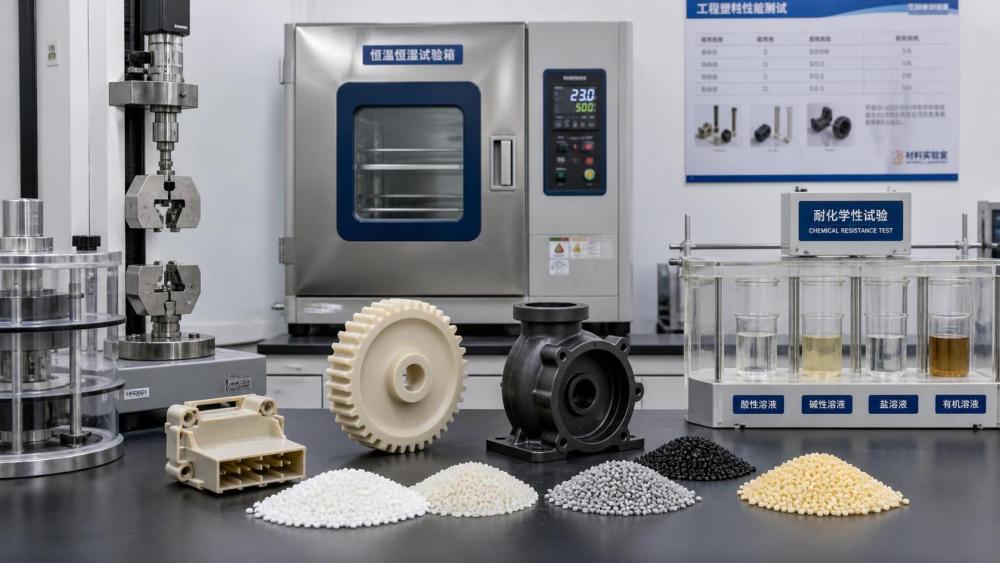
Material suppliers may provide aged-property curves, creep data, chemical-resistance guidance, molding shrinkage ranges, and design recommendations. Request the information that matches the duty cycle rather than relying on a general brochure. Where the part is safety-related, load-bearing, or difficult to replace, validate the shortlisted compound on molded specimens or representative parts.
Choose the polymer family before choosing the modification
Base polymer chemistry establishes the broad operating envelope. Polyamide grades are widely selected for strength, toughness, and wear performance, but moisture absorption can alter dimensions and mechanical response. Polybutylene terephthalate is often valued for dimensional stability and electrical applications, though the exact compound must be assessed for heat, hydrolysis, and impact demands. Polycarbonate offers toughness and useful thermal performance, yet exposure to certain chemicals or cleaning agents can require careful review.
Polyoxymethylene is often considered for low-friction precision components because of its stiffness, fatigue behavior, and dimensional consistency. Its suitability still depends on the chemical environment, assembly design, and service temperature. Thermoplastic polyurethane favors flexible, abrasion-resistant applications, but hardness, hydrolysis resistance, and chemical compatibility differ by formulation. For demanding thermal and chemical environments, PPS, PEEK, and other high-performance polymers may be candidates when their processing requirements, part economics, and joining approach are compatible with the project.
Once the base family fits, examine the compound package. Glass fiber raises stiffness and reduces molded shrinkage, but can reduce impact performance, increase anisotropy, and accelerate wear against mating surfaces. Carbon fiber can add stiffness and electrical conductivity, yet it changes mold flow, surface appearance, and isolation requirements. Mineral fillers can improve dimensional stability and lower expansion, although excessive loading may harm weld-line strength or toughness. Impact modification protects against brittle failure in selected grades but may reduce modulus, heat performance, or surface finish.
Flame-retardant formulations require separate scrutiny. Flame behavior is influenced by thickness, color, regrind practice, moisture, processing history, and the final part configuration. A flame-retardant grade may also exhibit different flow, plate-out behavior, corrosion potential, electrical properties, or long-term color stability from its unmodified counterpart. Treat it as a distinct compound, not as a standard resin with a single added feature.
Part geometry can reverse the apparent ranking
Material selection and component design must be evaluated together. A highly reinforced compound may seem ideal for a bracket because it has superior stiffness, yet its directional shrinkage can distort a broad, thin geometry. A more balanced reinforced formulation, a lower fiber loading, a revised gate location, or a rib redesign may produce a more stable assembly.
Wall thickness changes cooling rate, packing efficiency, fiber orientation, void risk, and residual stress. Thick-to-thin transitions need special attention because differential shrinkage can create sink, internal stress, or distortion. Long flow paths raise the chance that a weld line lands at a highly loaded area. If the component has threads, snap fits, living features, metal inserts, seals, or precision bores, review the local material behavior rather than assuming the bulk property set is sufficient.
Press-fit and insert designs illustrate this interaction clearly. The polymer must withstand assembly stress, retained stress during service, and thermal expansion differences between the insert and surrounding material. A high-modulus compound may resist deformation but crack at a sharp insert feature. A tougher compound may accommodate the assembly but lose retention after heat exposure. Test the actual insertion method and assembly rate, because a slow press fit, ultrasonic insertion, heat staking, and threaded insert can produce different local damage mechanisms.
Match processing behavior to the available production route
An excellent laboratory candidate can fail at the molding machine. Confirm melt-flow behavior against gate dimensions, flow length, wall thickness, and the machine's injection capacity. Reinforced materials are particularly sensitive to gate design and fiber orientation. Grades with narrow processing windows can show unstable dimensions or cosmetic variation when barrel residence time, melt temperature, mold temperature, or back pressure drifts.
Moisture-sensitive materials need defined drying controls. Surface streaks, hydrolytic molecular-weight loss, reduced impact strength, and inconsistent viscosity can result from poorly conditioned pellets. Drying equipment performance, hopper residence time, sealed transfer, and material handling between dryer and machine all matter. A compound that runs well in a controlled trial may behave differently if it is exposed to humid ambient air before processing.
Consider secondary operations early. Painting, laser marking, bonding, welding, plating, printing, machining, and overmolding depend on surface chemistry, filler type, additives, and residual stress. A silicone-containing processing aid, for example, can improve mold release while complicating adhesion. If a component will be ultrasonically welded, the joint design, resin stiffness, moisture condition, and energy-director geometry must be evaluated together.
Evaluate the environment as combined exposures
Industrial parts rarely experience one isolated stress. A pump fitting may see warm fluid, pressure pulses, residual molding stress, and cleaning agents. An enclosure near a motor may experience vibration, elevated temperature, electrical requirements, and oil mist. These combinations expose weaknesses that simple room-temperature tests overlook.
For chemical service, document the exact media: concentration, contaminants, immersion or splash contact, replenishment, temperature, and duration. A compound may tolerate an oil at ambient conditions but lose strength after exposure to hot oil, detergent, fuel blends, oxidizing agents, or alkaline cleaners. The presence of stress changes the question from simple compatibility to stress-cracking resistance. Test coupons should be loaded in a manner that represents the part's stress state where practical.
Outdoor exposure introduces UV radiation, moisture, temperature cycling, and surface contamination. UV stabilization is not interchangeable with heat stabilization, and dark pigmentation does not automatically establish outdoor durability. Where color, gloss, or surface integrity affects function, evaluate the formulated and colored compound rather than an unpigmented base grade.
Control variation before releasing the grade
A material specification should identify more than a trade designation. Record the resin family, reinforcement or filler content, flame-retardant status where relevant, color, recycled-content constraints if applicable, key physical requirements, approved processing range, and permitted substitutions. An apparently equivalent grade can differ in fiber length, viscosity, additive package, pellet quality, color carrier, or lot-to-lot consistency.
Ask for representative molded samples when finish, flatness, optical appearance, weld-line strength, or fit with mating parts matters. Evaluate parts from production-relevant tooling and cycle conditions. Prototype tools and low-cavitation trials are useful for early screening, but they may not reproduce the thermal balance, shear history, packing behavior, or orientation patterns of serial production.
Maintain a record of the selected compound's conditioning state during testing. This is especially important for hygroscopic materials, because dimensions and toughness can shift as the part approaches equilibrium with its environment. A test result without conditioning history is difficult to compare, repeat, or use in later troubleshooting.
The final choice is the compound that meets the critical failure modes in the finished geometry, remains processable within a controlled window, and retains required performance through the intended service conditions. A narrower material specification, supported by part-level validation, usually prevents more rework than adding margin to a single headline property.
Have questions about this sector analysis, or seeking best practices specific to your niche? Drop us a line below and let the senior consultants at APIM assist you.
We respect your privacy. Your information is strictly confidential.
Related News
- 00
0000-00
How does washing affect contamination in post-consumer recycled PP resins? - 00
0000-00
How does feedstock affect depolymerization equipment selection? - 00
0000-00
US Sets 213.44% Preliminary Antidumping Deposit on Chinese PTMEG - 00
0000-00
When should epoxy be used as a thermal interface material for semiconductors? - 00
0000-00
US Midterm Results Unlikely to Quickly Shift Recycled Plastics Market or Legislation