




How to Evaluate a Masterbatch Manufacturing Compounding Line for Output, Dispersion, and Changeover
How to Evaluate a Masterbatch Manufacturing Compounding Line for Output, Dispersion, and Changeover
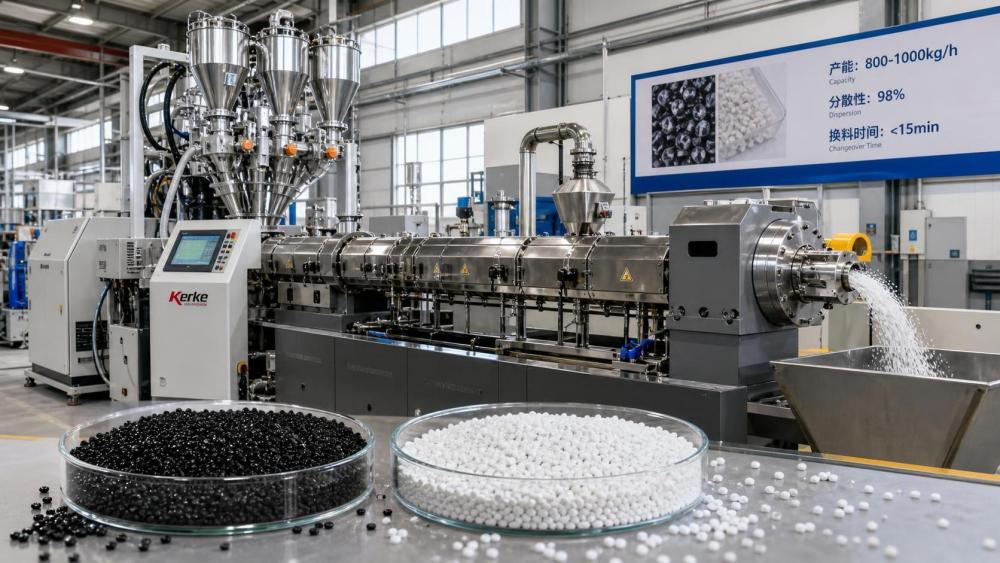
Choosing the right masterbatch manufacturing compounding line requires more than comparing machine size or nameplate capacity. For technical evaluation teams, the real question is how well a line delivers stable output, uniform dispersion, and fast, low-loss changeover under real production conditions. That usually means looking past brochure claims and asking what happens when the formulation is carbon black-heavy, heat-sensitive, mineral-filled, or scheduled in short multi-color runs on the same day.
If you are evaluating a line for buying, qualifying, or benchmarking, this is the checklist that tends to matter on the plant floor.
Start with the product mix, not the extruder size
A compounding line that runs white filler masterbatch well may still struggle with black, conductive, transparent, or additive-rich formulations. Before comparing suppliers, define the real production envelope:
- Carrier resin range: PE, PP, PS, EVA, PET, PA, biodegradable resin systems, or engineering polymers.
- Additive type and loading: pigments, carbon black, TiO2, flame retardants, talc, CaCO3, glass fiber, UV package, slip/antiblock, conductive additives.
- Sensitive materials: moisture-sensitive, shear-sensitive, or temperature-sensitive systems.
- Batch size reality: long campaigns or frequent short runs.
- Downstream use: film, fiber, injection molding, sheet, pipe, blow molding, or cable.
This matters because line design is always a compromise. A setup optimized for high-output mineral-filled masterbatch may not be the best fit for tight color dispersion or rapid color-to-color changeover. Evaluation goes wrong when teams ask for one line to be “universal” without defining what they will really run 80 percent of the time.
Check what “output” actually means
Nameplate throughput is usually the least useful number in the meeting room. Ask what output was achieved on which formulation, at what melt temperature, with what feeder accuracy, and under what product quality target. A line that reaches high kg/h only by running hot, over-shearing the melt, or relaxing dispersion criteria is not giving you usable capacity.
For decision-making, look for these practical checks:
If the supplier cannot tie throughput figures to a real formulation family and operating window, treat the capacity claim as preliminary.
Dispersion is where weak line design usually shows up
In a masterbatch manufacturing compounding line, dispersion quality depends on much more than screw speed. Feed stability, screw configuration, residence time distribution, barrel temperature control, venting, and die pressure all show up in the final pellet. Buyers sometimes focus on whether the line is twin-screw and stop there. That is not enough.
Ask to review the screw design logic by product type. You do not need every element drawing in a first-round discussion, but you do need to know whether the line is configured for distributive mixing, dispersive mixing, fiber protection, devolatilization, or filler wet-out. One screw setup rarely gives the best result for every job.
A few practical warning signs:
- Supplier talks about high rpm but not melt temperature rise.
- Dispersion is described visually, with no agreed test method for your product.
- The line relies on aggressive mixing to compensate for unstable feeding.
- No clear answer on how venting behaves with high volatiles, moisture, or residual monomer concerns.
The right evaluation method depends on the masterbatch type. For color concentrates, teams often care about specks, filter pressure behavior in downstream processing, tint strength consistency, and final article appearance. For additive concentrates, dispersion may need to be judged indirectly through downstream performance. For filler systems, look at loading consistency, pellet integrity, and processing stability in the end-use line. The exact test protocol should come from your application standard, customer requirement, or internal QC method, not from a generic sales slide.
Feeding accuracy deserves more attention than it usually gets
A good extruder cannot fix poor feeding. In many evaluations, the gravimetric system, refill design, hopper agitation, and side feeder suitability get less attention than the main machine. That is a mistake, especially for low-dose additives, fluffy powders, high-bulk-density minerals, and difficult carbon black packages.
Check whether the feeding system is matched to the actual raw materials, not just to a category label. “Powder feeder” is too vague. Fine pigment, compacted carbon black, chopped fiber, waxy additive blends, and recycled regrind all behave differently. Bridging, pulsation, flooding, and refill upset will show up as poor dispersion or unstable output long before anyone blames the feeder.
If possible, ask for a trial with your own difficult formulation. That usually reveals more than any factory acceptance demo using easy materials.
Do not separate pelletizing from compounding in the evaluation
A line can compound well and still create headaches at pelletizing. Strand breakage, inconsistent pellet length, die drool, water carryover, or poor cooling control will affect packaging, conveying, dosing, and even customer perception of quality.
What to check depends on the material system. Underwater pelletizing may suit some high-output or specific melt-flow situations, while strand pelletizing remains common for many masterbatch applications. The decision should be based on polymer behavior, formulation stickiness, productivity target, and cleaning/changeover needs. There is no universal winner.
Also ask how the pelletizing section behaves during start-up and shutdown. Scrap generation often spikes there, and that affects real operating cost more than teams expect.
Changeover time is usually underestimated
If your schedule includes frequent color or formulation changes, changeover may be the deciding factor. Not theoretical changeover. Real changeover, measured from last acceptable pellet of Product A to first acceptable pellet of Product B, including purge, cleaning, off-spec handling, and feeder reset.
This is where many lines lose money quietly. A machine with slightly lower peak throughput but cleaner internal geometry, easier feeder access, faster screen or die cleaning, and better residual material evacuation can outperform a bigger machine over a week of mixed production.
Ask very specific questions:
- How much material is typically consumed during black-to-natural, dark-to-light, or flame-retardant-to-standard transitions?
- Which sections require manual disassembly?
- How accessible are screws, barrel inserts, feeders, vents, die face, and pelletizer contact parts?
- Can recipes and feeder parameters be stored and recalled reliably?
- What is the contamination-control approach for regulated or sensitive applications? This is especially relevant if output may go into food-contact or medical-adjacent supply chains, where additional compliance review may be required【待核实】 based on market and product scope.
A good evaluation team will ask for changeover evidence from comparable production, not just a verbal estimate.
Look at how the line handles thermal history and residence time
For many engineering polymers, recycled blends, or additive-sensitive compounds, thermal history matters as much as mixing intensity. Excess residence time can discolor material, reduce additive effectiveness, increase odor, or shift downstream processing behavior. Yet some evaluations still focus only on whether the line can “melt and mix.”
Ask how the line is controlled during low-rate operation, start-stop conditions, and partial load. A system that looks stable at one design point can become difficult at reduced throughput. That matters if your business model includes development batches, specialty grades, or uneven order sizes.
Controls, data, and operator dependence
Two lines with similar hardware can perform very differently because of controls. Recipe management, trend recording, alarm logic, feeder integration, and user permissions all affect repeatability. If stable quality depends too heavily on one experienced operator “listening to the machine,” you have a scale-up risk.
For technical evaluation, check whether the control system records the process variables you actually need for troubleshooting and quality traceability: feeder rates, barrel temperatures, melt temperature if available, screw speed, torque, pressure, vacuum condition, and pelletizing status. For B2B supply programs, that level of process visibility often matters during customer qualification or complaint analysis.
Maintenance access is not a secondary issue
Maintenance is part of capacity. If cleaning vents is awkward, feeder screws wear quickly, or screw/barrel service takes too long, your output model is already wrong. This becomes more visible in abrasive or corrosive systems, including mineral-filled, glass-filled, flame-retardant, or recycled-content formulations.
You do not need to demand premium metallurgy everywhere, but you do need clarity on wear parts, replacement intervals, and local service support. Any claim on wear life should be tied to formulation type and operating conditions. Otherwise, it is just a rough indication.
What a solid evaluation package should include
By the time you are close to a decision, the supplier should be able to support the discussion with more than a layout and motor size. A useful package usually includes a line configuration matched to your product families, trial records or reference data for similar materials, utility requirements, a change-part list, maintenance scope, and a realistic acceptance framework.
If you run a formal technical review, define in advance what counts as acceptance: output range, dispersion criteria, pellet quality, changeover expectation, scrap boundary, and data collection method. Without that, teams often end up comparing suppliers on presentation quality instead of production fit.
The best masterbatch manufacturing compounding line is usually not the one with the highest headline throughput. It is the one that fits your formulation range, holds dispersion consistently, and comes back to spec quickly after every product change. That is what technical evaluation teams should keep in view when the discussion gets crowded with oversized numbers and polished claims.
Have questions about this sector analysis, or seeking best practices specific to your niche? Drop us a line below and let the senior consultants at APIM assist you.
We respect your privacy. Your information is strictly confidential.
Related News
- 00
0000-00
How does washing affect contamination in post-consumer recycled PP resins? - 00
0000-00
How does feedstock affect depolymerization equipment selection? - 00
0000-00
US Sets 213.44% Preliminary Antidumping Deposit on Chinese PTMEG - 00
0000-00
When should epoxy be used as a thermal interface material for semiconductors? - 00
0000-00
US Midterm Results Unlikely to Quickly Shift Recycled Plastics Market or Legislation