




How to Choose Compounding Equipment for Output, Dispersion, and Material Flexibility
How to Choose Compounding Equipment for Output, Dispersion, and Material Flexibility
Choosing the right compounding equipment directly affects output, dispersion quality, and the ability to handle diverse materials in modern polymer processing. For technical evaluators, the challenge is not only comparing machine specifications, but also understanding how screw design, feeding accuracy, temperature control, and material behavior influence production stability and final compound performance. This article outlines the key factors that matter when selecting equipment for efficient, flexible, and consistent compounding operations.
In practice, the selection of compounding equipment rarely fails because a machine cannot run. It fails because the line cannot hold quality at the required throughput, cannot tolerate material variation, or becomes too narrow for future product plans. That is why technical evaluation should begin with the process window, not the nameplate.
Start with the real production target, not the advertised capacity
One of the most common mistakes in equipment selection is treating output as a single number. A supplier may quote kilograms per hour, but that figure is only meaningful when tied to a specific formulation, bulk density, filler loading, moisture level, target melt temperature, dispersion requirement, and pelletizing method.
For example, a line designed to produce mineral-filled polypropylene at moderate filler levels may not deliver the same throughput when running glass-fiber reinforced polyamide, flame-retardant PBT, or thermally conductive compounds. Each of these formulations creates different torque demand, feeding behavior, viscosity response, and thermal sensitivity. A technical evaluator should therefore ask a more useful question: What output is sustainable at acceptable melt quality and acceptable process stability for my actual product family?
That shifts the evaluation toward measurable operating conditions:
- specific torque and available motor reserve;
- free volume relative to the planned filler or additive package;
- maximum screw speed versus practical operating speed;
- melt temperature rise under real load;
- pressure stability at downstream die and pelletizing sections;
- ability to maintain output when formulation variability increases.
In other words, output should be judged as usable output, not peak output.
Dispersion quality depends on screw design more than line size alone
Many buyers initially compare compounding equipment by screw diameter and motor power. Those parameters matter, but they do not explain whether the line can actually deliver the required distributive and dispersive mixing. Dispersion quality is heavily influenced by screw configuration, length-to-diameter ratio, kneading block arrangement, shear exposure, residence time distribution, venting layout, and feeding sequence.
For technical compounds, the target is often not “maximum mixing” but controlled mixing. Too little shear leaves pigments, flame retardants, carbon black, mineral fillers, or recycled stream contaminants poorly distributed. Too much shear may shorten glass fibers, degrade heat-sensitive polymers, increase gel formation, or shift color consistency.
That tradeoff becomes especially important in several common material classes:
- Glass-fiber reinforced compounds: good wet-out is required, but excessive shear reduces retained fiber length and can undermine mechanical performance.
- Flame-retardant systems: some additive packages need strong distribution, but thermal exposure must be limited to avoid decomposition or corrosive byproducts.
- Conductive and antistatic compounds: carbon black, CNT, or other conductive additives demand tight dispersion control because electrical properties are highly sensitive to agglomeration and network structure.
- Recycled polymer blends: broader viscosity variation and contaminant risk increase the importance of homogenization and venting, but overworking the melt may further reduce polymer stability.
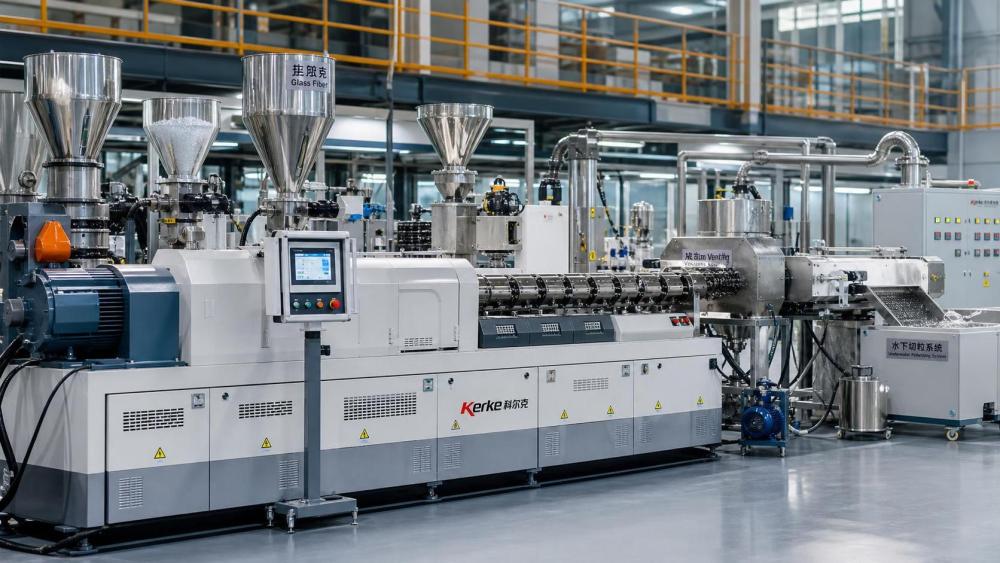
When comparing lines, technical teams should request example screw layouts for their target formulations rather than accepting generic statements about “high dispersion.” If the supplier cannot explain why the proposed mixing sections match the material system, that is an early warning sign.
Material flexibility is a design issue, not a marketing claim
“Flexible” compounding equipment is often marketed as capable of handling everything from virgin polyolefins to engineering plastics, recycled feedstocks, and high-fill technical formulations. In reality, flexibility depends on how much process compromise the plant can accept.
A line optimized for high-output masterbatch may not be ideal for low-bulk-density powders or moisture-sensitive polymers. A system built for heavily filled compounds may be less efficient on frequent color changes or short campaigns. Equipment flexibility should therefore be evaluated against the expected production mix over at least the next three to five years.
Technical evaluators should look at flexibility across several dimensions:
- Feed flexibility: pellets, powders, fibers, flakes, liquids, pastes, and regrind all behave differently in feeding and conveyance.
- Thermal flexibility: can the barrel, screw metallurgy, and heating/cooling system support both lower-temperature polyolefins and higher-temperature engineering resins?
- Formulation flexibility: does the feeder layout allow multiple side feeders, liquid injection points, venting zones, and downstream addition positions?
- Cleaning flexibility: how long does product changeover take, especially for black-to-natural, halogenated-to-non-halogenated, or food-contact-sensitive transitions?
- Control flexibility: can the control system store recipes, manage feeder interlocks, and capture trend data useful for troubleshooting?
If the business expects a narrow product range and very high utilization, a specialized line may be the better choice. If the plant is moving toward shorter runs, more customer-specific formulations, or recycled and bio-based material development, flexibility becomes more valuable than absolute peak throughput.
Feeding accuracy often determines whether the extruder performs as intended
In many compounding lines, the extruder gets most of the attention, but the feeding system determines whether the process enters the extruder in a controlled way. Poor gravimetric feeding can create concentration drift, unstable torque, color variation, filler streaks, inconsistent bulk density, and pellet-to-pellet property variation.
This is especially critical when handling:
- low-dose additives;
- fibers that bridge or fluff;
- light powders with poor flowability;
- hygroscopic materials requiring closed handling;
- recycled streams with variable particle shape and density.
Technical evaluators should assess not only feeder count, but feeder suitability. A line with many feeders is not necessarily more capable if refill design, agitation, screw geometry, hopper isolation, and loss-in-weight response are poorly matched to the raw materials.
In practical terms, if a formulation’s cost and performance depend on tight additive ratios, feeder design deserves the same scrutiny as screw configuration. That includes feeder calibration stability, refill interruption behavior, and the control logic used to maintain ratio accuracy during speed changes.
Temperature control and devolatilization are central to stable quality
Compounding decisions are often framed around mixing energy, but thermal management is just as important. Heat generated through shear, especially at higher screw speeds, can narrow the safe process window for engineering plastics, recycled polymers, flame-retardant systems, and reactive additives.
For technical evaluation, the key issue is not whether the barrel has multiple heating zones. Almost all modern systems do. The real question is whether the line can remove heat, manage melt temperature profile, and maintain stable devolatilization under variable load.
This matters in several scenarios:
- Moisture-sensitive resins such as PA, PET, PBT, or certain biopolymers may require robust upstream drying and effective vent management to avoid hydrolytic degradation.
- Recycled feedstocks can release volatiles, odor compounds, residual monomers, inks, or contamination-related gases that challenge vacuum efficiency.
- Liquid additive systems need carefully placed injection and venting to avoid slippage, surging, or incomplete incorporation.
- High-temperature engineering compounds require barrel and screw metallurgy compatible with temperature, wear, and possible corrosive additives.
A technical evaluation should therefore include vacuum system performance, vent port accessibility, condensate handling, and the interaction between devolatilization and throughput. A line that vents well at moderate output may not vent adequately once production is pushed toward commercial targets.
Wear resistance and metallurgy should match the formulation, not the base polymer
Another recurring selection error is specifying wear protection based on the polymer family alone. In compounding, wear risk is often driven more by the additive system than by the resin itself. Glass fiber, mineral fillers, flame-retardant packages, reclaimed material contaminants, and certain pigments can dramatically increase abrasive or corrosive stress.
For example, calcium carbonate-filled polypropylene and neat polypropylene should not be treated as equivalent from a wear standpoint. The same applies to halogen-containing flame-retardant systems or recycled streams with unknown contamination history. Screw elements, barrels, liners, side feeders, and die components may all require upgraded materials depending on the expected formulation mix.
Technical evaluators should ask for a wear map tied to the actual recipe portfolio. Otherwise, the initial equipment cost may look attractive while maintenance intervals, screw rebuild frequency, and product consistency deteriorate faster than expected.
Downstream pelletizing and handling can become the hidden bottleneck
Compounding equipment should be evaluated as a line, not just an extruder. In many projects, the downstream section determines practical output, scrap rate, and operator burden. Strand pelletizing, underwater pelletizing, and water-ring systems each have different strengths depending on polymer rheology, stickiness, throughput, and product quality requirements.
For example:
- Strand pelletizing is widely used and relatively familiar, but strand breakage, cooling consistency, and handling of soft or sticky materials can limit stability.
- Underwater pelletizing may support higher output and improved handling for certain polymers, but introduces additional complexity in water management, die-face operation, and maintenance.
- Hot-face systems may suit some filled or lower-viscosity materials, but require careful matching to melt behavior.
Technical teams should also consider metal detection, fines control, dryer performance, pellet shape consistency, and packaging integration. If the commercial target requires excellent downstream feeding into injection molding or film extrusion, pellet quality is not a secondary issue.
The right comparison is process capability over lifecycle cost
For technical evaluators working with procurement or management, the difficult part is often translating engineering differences into decision logic. The least expensive line may require tighter raw-material consistency than the business can realistically guarantee. The highest-capacity line may run inefficiently at the smaller lot sizes that dominate the order book. A highly flexible platform may be justified only if future product development is credible rather than aspirational.
A useful evaluation framework includes the following questions:
- Which product families generate the majority of expected machine hours?
- What dispersion level is actually required to meet end-use performance, not just lab targets?
- How much variability exists in incoming materials, especially recycled or multi-source feedstocks?
- Will the plant run long campaigns, frequent changeovers, or both?
- What is the acceptable tradeoff between throughput and compound consistency?
- How sensitive is the business to downtime, spare-part lead time, and specialist maintenance requirements?
Lifecycle cost should include energy use, wear-part replacement, cleaning time, operator skill demands, scrap during startup and changeover, and the cost of quality deviations. In compounding, poor stability is often more expensive than moderate undercapacity.
What experienced evaluators validate before approving a line
Before final selection, technical teams usually benefit from moving beyond brochure review and requesting proof in conditions close to production reality. That may include trial runs with representative formulations, torque and melt-temperature data at commercial rates, retained fiber length analysis, dispersion testing, feeder accuracy checks, devolatilization performance, and pellet quality inspection.
Reference checks matter as well, but they should be targeted. A supplier with strong references in color masterbatch may not be equally strong in glass-reinforced engineering plastics or recycled compound stabilization. What matters is process similarity, not just industry reputation.
It is also worth reviewing service depth: commissioning competence, spare-part availability by region, control-system support, and the supplier’s ability to help optimize screw design after startup. For many compounders, the line is only truly selected once it has been stabilized in plant conditions.
The best compounding equipment choice is rarely the machine with the broadest claims. It is the one whose design logic fits the actual formulation range, quality target, and operating discipline of the plant. For technical evaluators, that means focusing less on headline capacity and more on whether the line can repeatedly deliver usable output, controlled dispersion, and enough material flexibility to support both current business and near-term development.
Have questions about this sector analysis, or seeking best practices specific to your niche? Drop us a line below and let the senior consultants at APIM assist you.
We respect your privacy. Your information is strictly confidential.
Related News
- 00
0000-00
Do polyolefin hot melt adhesives bond well to polyethylene? - 00
0000-00
Korean Study Finds PLA Barely Degrades in Landfill After 320 Days - 00
0000-00
How to assess batch consistency from a thermal potting compounds supplier - 00
0000-00
How much weight can carbon fiber reinforced plastics save in cars? - 00
0000-00
Switching from PS to ABS Sheet Extrusion: Equipment Checks