




How Surface Treated Mineral Fillers Improve Dispersion and Impact Strength
Start with the failure mode, not the filler name
When a compound with mineral filler underperforms, teams often blame loading level or resin grade too early. In practice, dispersion is usually the first thing worth checking. A surface treated mineral filler can improve impact strength, stiffness balance, appearance, and process stability, but only when the treatment matches the polymer system and the compounding route. If that match is wrong, the same filler may still reduce cost or control shrinkage while quietly damaging toughness.
For technical evaluation work, the useful question is not “Is the filler coated?” It is “What is the surface treatment meant to do in this resin, under this shear history, at this filler level, for this end-use requirement?” That framing saves time. It also stops the common mistake of treating all coated calcium carbonate, talc, wollastonite, mica, or similar minerals as interchangeable.
The checklist below follows the way experienced compounders usually review these materials before approving a trial or changing a formulation.
Check what the surface treatment is supposed to improve
Surface treatment is not a generic upgrade. It usually targets one or more of these problems:
- poor wet-out in the melt
- filler-filler attraction that creates agglomerates
- weak adhesion at the filler-polymer interface
- excess viscosity or unstable feeding
- property loss after impact modifier or reinforcement is added
That sounds obvious, but it matters. A treatment that mainly improves flow may not improve impact performance much. Another treatment may strengthen interfacial bonding but give less help on dispersion if your feeding system is poor. Ask for the intended mechanism in plain technical terms. “Improved compatibility” is too vague to support a material decision.
Match the treatment chemistry to the resin family
This is where many evaluations go off track. Surface treated mineral fillers behave differently in non-polar polyolefins, polar engineering plastics, elastomer-modified blends, and higher-temperature systems. A treatment that helps dispersion in PP may not deliver the same result in PA, PBT, or TPU. The reason is straightforward: the interface only improves when the treatment can interact with the matrix strongly enough to reduce interfacial stress concentration.
Review these points before you compare candidates:
- Is the matrix mostly non-polar, moderately polar, or strongly polar?
- Will the compound include coupling agents, impact modifiers, or reactive additives that also affect the interface?
- Does the process temperature risk degrading the treatment layer or changing its effectiveness?
- Is the filler being used mainly for stiffness, dimensional stability, scratch resistance, cost balance, or impact retention?
A useful warning here: if a supplier only shows good results in one polymer family, do not assume the same improvement transfers across the board. Ask to see performance in a matrix close to yours, with similar loading and a similar additive package.
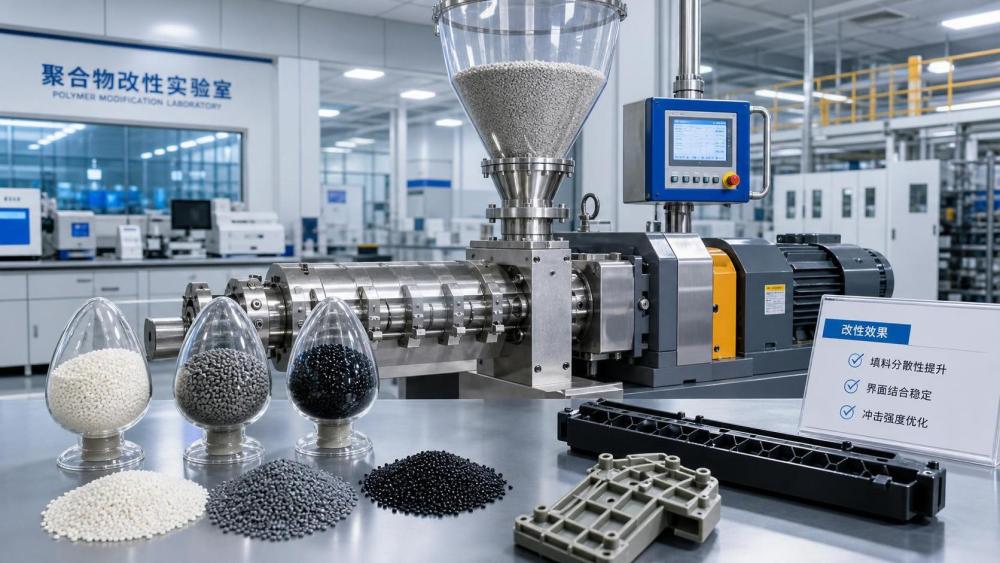
Look at particle shape and size together with treatment
Teams sometimes discuss coating quality as if it can overcome everything else. It cannot. Particle size distribution, aspect ratio, and base mineral morphology still drive a large part of the result. Fine particles can improve dispersion uniformity but may raise surface area enough to increase demand on the treatment. Plate-like or needle-like minerals may improve stiffness and dimensional control, yet they can also create local stress concentrations if orientation or dispersion is poor.
A practical review goes like this: if impact strength is critical, do not evaluate the treatment independently from agglomeration tendency and particle geometry. A well-treated filler with the wrong morphology for your part design can still lower notched impact performance, especially around weld lines, gate areas, or thin-wall sections.
Separate dispersion improvement from simple lubrication effects
One trap in trial work is mistaking easier processing for better dispersion. Some treated fillers reduce melt friction enough to lower torque or improve flow, which is useful, but that does not automatically mean agglomerates have been broken down or that stress transfer has improved. You need evidence from both process behavior and finished properties.
Good signs of real improvement usually show up as a combination of results: more stable extrusion pressure, cleaner pellet appearance, fewer visible specks in molded parts, narrower property variation between batches, and better retention of impact performance at the target filler loading. If the only positive result is easier flow, keep the conclusion narrow.
Review the compounding route before judging the filler
A technically sound surface treatment can still look ineffective in a poorly configured process. Technical evaluation teams should ask for the compounding setup used to generate the data. That includes feeding point, screw design, side feeder performance, venting, melt temperature profile, and whether the filler was added in one step or via masterbatch.
Why this matters: dispersion depends on both wetting and distributive or dispersive mixing. If your line does not provide enough shear in the right zone, treatment benefits may never show up. If shear is too high, fragile structures can break down, additives can separate, or the polymer can degrade, which then distorts any impact result.
This is also where scale-up problems begin. Lab twin-screw results often look cleaner than production because the feeding is steadier and residence time is easier to control. Build your checklist around production reality, not only lab data.
Use impact strength data carefully
Surface treated mineral fillers do not improve impact strength in a simple, universal way. What they often do is reduce the damage that untreated or poorly dispersed fillers would otherwise cause. In some systems, a better interface helps stress transfer and limits crack initiation. In others, the main value is preserving acceptable toughness while still gaining stiffness, dimensional control, or cost efficiency.
When reviewing impact claims, check the test context, not just the headline result:
- Was the comparison made at the same filler loading?
- Was the resin grade unchanged?
- Were impact modifiers present?
- Was the specimen injection molded, extruded, or compression molded?
- Was the part tested dry, conditioned, or after heat aging?
Without that context, numbers can mislead. For technical screening, consistency of trend across realistic processing conditions is more valuable than one strong data point from a favorable setup.
Check where dispersion quality will show up in the finished part
Not every application exposes filler problems the same way. Housings, under-hood components, appliance parts, electrical carriers, films, sheets, and extrusion profiles all punish poor dispersion differently. In one part, you may see brittle failure at a notch. In another, you get surface streaks, inconsistent gloss, die build-up, unstable gauge control, or excessive wear on tooling.
For that reason, tie the evaluation to the failure mode the part actually cares about. A mineral-filled PP for a rigid interior component may accept some loss in impact if dimensional stability is the governing requirement. A thin-wall technical part with snap-fit features usually cannot. The same surface treated mineral filler may be acceptable in one and a poor choice in the other.
Do not skip moisture, contamination, and storage checks
Surface treatment performance can be undermined before the material even reaches the extruder. Storage conditions, dust contamination, moisture pickup, and handling damage can all change feed behavior and dispersion quality. Fine minerals are especially sensitive because the effective surface area is high and small changes can amplify agglomeration.
This part of the checklist is not glamorous, but it saves a lot of false conclusions:
Ask for documents that support technical judgment
For standard technical evaluation, you do not need marketing slides. You need documents that let you compare materials on a like-for-like basis. A technical data sheet is the minimum, but it is usually not enough on its own. Request the product description that clarifies mineral type, intended polymer families, and recommended use level. Then check whether the supplier can provide information on handling guidance, test method references for key properties, and any processing notes tied to the treatment.
The point is not paperwork for its own sake. It is to see whether the filler is being positioned as a real formulation component with defined boundaries, or as a broad “performance enhancer” with no usable evaluation frame.
Run comparison trials that isolate the variable
If you change filler treatment, keep the rest of the formulation and process as stable as possible. Otherwise the trial becomes impossible to interpret. Comparing a treated filler in one resin grade against an untreated filler in another tells you very little. The same problem happens when screw speed, drying history, or impact modifier level shifts between runs.
A clean technical comparison usually includes:
- One base resin system.
- The same filler loading across candidates.
- The same molding or extrusion conditions for test specimens.
- A record of feeder stability, torque, pressure, and visual compound quality during the run.
- Mechanical results interpreted together with surface and process observations.
That last point matters more than people admit. Impact strength alone does not explain whether a treatment improved dispersion, or whether another variable masked the result.
Know the common mistakes before they become expensive
A few errors come up repeatedly in mineral-filled compound reviews:
- Selecting by filler name and price while ignoring treatment-resin compatibility.
- Using flow improvement as proof of better mechanical performance.
- Evaluating lab samples under conditions that do not reflect production shear and feeding.
- Reading impact data without checking conditioning state or specimen preparation.
- Trying to fix poor process control by changing filler grade too early.
Most of these mistakes lead to the same outcome: the team either rejects a workable filler for the wrong reason or approves one that looks fine in trial data but creates instability later in production.
Use a decision order that reflects real compounding work
If you need a practical sequence, use this one. Start with the application requirement: where toughness must be retained, where stiffness or dimensional stability matters more, and where surface quality cannot be compromised. Then screen the mineral type and morphology. After that, evaluate surface treatment compatibility with the resin and additive package. Only then does it make sense to compare processing behavior and impact results from controlled trials.
That order keeps the evaluation grounded. Surface treated mineral fillers can absolutely improve dispersion and support better impact performance, but the benefit is conditional, not automatic. The teams that get good results are usually the ones that treat filler selection as an interface problem, a processing problem, and a part-performance problem at the same time.
Have questions about this sector analysis, or seeking best practices specific to your niche? Drop us a line below and let the senior consultants at APIM assist you.
We respect your privacy. Your information is strictly confidential.
Related News
- 00
0000-00
How does washing affect contamination in post-consumer recycled PP resins? - 00
0000-00
How does feedstock affect depolymerization equipment selection? - 00
0000-00
US Sets 213.44% Preliminary Antidumping Deposit on Chinese PTMEG - 00
0000-00
When should epoxy be used as a thermal interface material for semiconductors? - 00
0000-00
US Midterm Results Unlikely to Quickly Shift Recycled Plastics Market or Legislation