




How Polymer Formulation for Engineering Plastics Affects Heat Resistance and Impact Strength
What to Check When Heat Resistance and Impact Strength Pull in Different Directions
In high-performance applications, polymer formulation for engineering plastics directly shapes the balance between heat resistance and impact strength. For technical evaluators, understanding how resin selection, fillers, reinforcements, and modifiers interact is essential for judging real-world material reliability. This article explains the formulation logic behind performance trade-offs and helps identify what matters most in demanding industrial environments.
If you are reviewing a material for an under-hood automotive part, an electrical housing, a connector, a pump component, or a structural electronics part, the first practical point is this: heat resistance and impact strength rarely improve together for free. Most formulations gain one by giving up some of the other, or by increasing cost, processing difficulty, or variability. That is why a datasheet alone is not enough.
A useful technical review starts with the failure mode you can least tolerate. If the part cannot crack during assembly or drop impact, impact retention matters more than headline thermal numbers. If the part sits near soldering heat, hot oil, or continuous electrical load, thermal aging and dimensional stability move to the front. Good formulation review is not about chasing the highest property value. It is about checking whether the property survives the actual service condition.
Start with the Base Resin, Not the Additives
Many evaluation mistakes happen because teams spend too much time on modifiers and not enough on the backbone polymer. The base resin already defines the thermal ceiling. A toughened PA66, for example, may absorb impact well, but that does not make it a substitute for PPS or PEEK in continuous high-temperature service. A glass-filled PBT can give solid dimensional control and electrical performance, but it will not behave like a high-temperature aromatic polymer under long dwell heat.
When reviewing resin choice, check these questions early:
- What is the actual thermal exposure: short peak, repeated cycling, or continuous use?
- Is the risk thermal softening, oxidative aging, hydrolysis, creep, or dimensional drift?
- Does the part need structural toughness at room temperature only, or after heat aging as well?
- Will the polymer face oils, coolants, cleaning agents, humidity, or solder reflow conditions?
That last point matters more than people expect. A resin can look acceptable in dry-lab testing and then lose impact performance after moisture uptake or chemical exposure. Polyamide systems are the classic example. Moisture can improve apparent toughness in some conditions, but it can also change dimensions and stiffness enough to create other failures. So the question is never just “Is the resin tough?” It is “How is it tough after conditioning and end-use exposure?”
Do Not Treat Glass Fiber as a Universal Upgrade
Glass fiber is often the first lever used to push heat resistance upward, especially heat deflection under load and dimensional stability. That part is real. Reinforcement can also improve stiffness and lower creep. But once fiber loading rises, impact behavior often becomes more sensitive to notch effects, weld lines, gate design, and fiber orientation. A molded test bar may look fine while a real part with ribs, holes, and knit lines becomes brittle.
This is where technical evaluation needs discipline. Check whether the supplier is showing unnotched or notched impact data, and under what conditioning state. If the application includes screw bosses, snap-fits, thin walls, or sharp transitions, notched impact data usually tells you more. Also ask whether performance was measured on injection-molded specimens aligned with fiber direction. In glass-filled systems, anisotropy is not a side detail. It can decide whether a part survives.
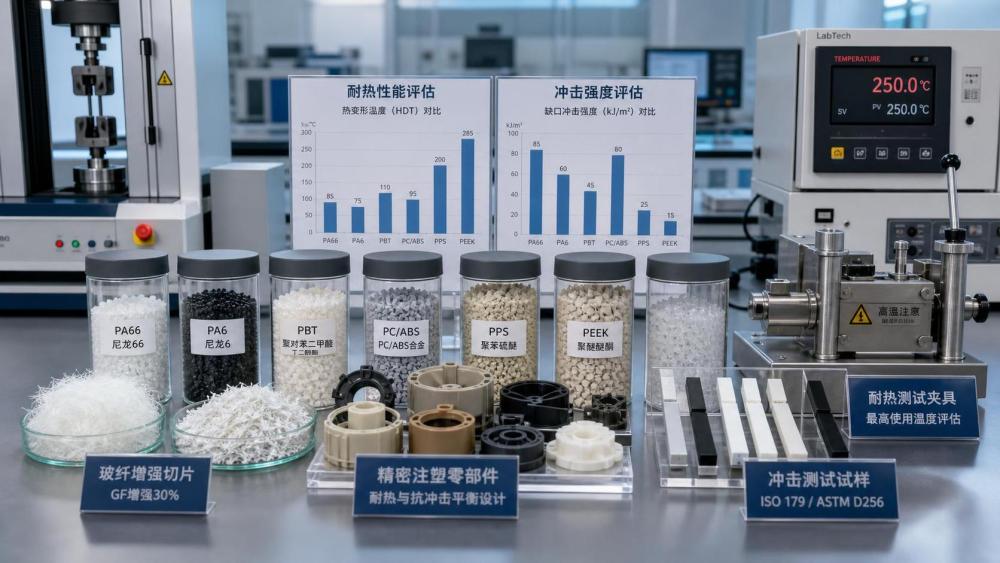
For many engineering plastics, increasing glass content helps thermal and structural performance up to a point, then starts creating processing and toughness penalties that are expensive to manage. There is no universal loading target. The right question is whether the reinforcement level matches part geometry, molding flow path, and assembly stress. If your part sees impact at weld lines, a lower fiber level with better formulation balance can outperform a heavily reinforced grade on the shop floor.
Impact Modifiers Help, but They Change More Than Impact
Impact modification is one of the most common tools in polymer formulation for engineering plastics, especially in PA, PBT, PET, PC blends, and ABS-based systems. The trade-off is familiar: toughness improves, while stiffness, heat performance, surface quality, or chemical resistance may move the wrong way. Sometimes the shift is small. Sometimes it is enough to disqualify the grade for a connector, housing, or precision-fit component.
Technical evaluators should ask what type of modifier is being used and what it is expected to do in that polymer family. Not every elastomer phase behaves the same way in thermal aging, and compatibility matters. Poor dispersion or weak interfacial adhesion can give you attractive initial impact values with poor lot-to-lot consistency. If the material is for regulated sectors or demanding validation routes, ask for retention data after aging, not just initial mechanical data.
Separate Short-Term Heat Resistance from Long-Term Thermal Reliability
This is one of the most important checks, and it is often blurred in marketing language. Heat deflection temperature, melting point, glass transition, solder resistance, and continuous-use behavior are not interchangeable. A formulation may tolerate a short assembly temperature spike yet still embrittle over long-term exposure. Another may keep properties after aging but distort under load during a brief high-temperature event.
For technical review, line up the test method with the real failure risk. If the part carries load at elevated temperature, ask about creep and retention after aging. If it sits in an engine bay or near power electronics, ask for thermal aging data tied to mechanical properties. If the part must meet electrical requirements, bring in the relevant insulation or flammability framework as applicable, and verify the exact grade status with the supplier rather than assuming family-level approval. UL recognition, RTI values, or similar listings should always be checked against the specific grade and color where relevant. Anything else is a shortcut.
Processing Quality Can Undo a Good Formulation
A technically sound formulation can still fail if compounding and molding are poorly controlled. Excess residence time, thermal history, moisture, shear damage, and weak dispersion all show up as property scatter. In heat- and impact-sensitive systems, this scatter is exactly what causes argument between purchasing, molding, and engineering teams later.
When comparing suppliers, ask practical questions about process capability, not just nominal recipe. Is the formulation made on equipment suited to reinforcement and additive dispersion? Is moisture control critical for this polymer family? Does the supplier provide processing windows narrow enough to be useful? In PA, PET, PBT, TPU, and other moisture-sensitive systems, drying discipline is not optional. In reinforced grades, screw design and shear history influence fiber length retention and therefore final performance.
If you only review pellet data and skip molding trials under realistic conditions, you are leaving a large blind spot. Heat resistance and impact strength are both strongly affected by how the part is actually made.
Check the Condition of Test Data Before You Trust It
This sounds basic, but it filters out a lot of weak comparisons. Engineering plastics data can change significantly depending on specimen thickness, conditioning, humidity, molding parameters, and whether values are typical, minimum, or design values. Technical evaluators should be careful with side-by-side charts built from mixed test conditions.
Useful review questions include:
- Was impact measured as Izod or Charpy, notched or unnotched?
- Was the sample dry-as-molded, conditioned, or heat-aged?
- Are thermal values linked to a recognized test method, and do they reflect load?
- Were the results generated on standard bars or on application-relevant plaques or parts?
- Is the data from the current commercial grade or from development material 【待核实】?
The more the application depends on a narrow performance window, the less acceptable it is to rely on broad brochure claims.
Watch the Secondary Additives
Secondary additives are often where hidden trade-offs live. Flame retardants, lubricants, pigments, UV stabilizers, nucleating agents, antistats, conductive additives, and recycled content can all shift the heat-impact balance. Sometimes the shift is expected and manageable. Sometimes it is only noticed after validation parts are molded.
For example, flame-retardant packages may influence toughness and flow behavior. Mineral additions can improve dimensional consistency but hurt drop performance. Conductive fillers can change both stiffness and crack behavior. Recycled content may be acceptable in some industrial uses, but molecular history and contamination risk require tighter verification when heat aging and impact reliability are critical. There is no blanket rule here. The check is whether the additive package was designed for the same end-use stress pattern you have.
Application Context Decides What “Good Balance” Actually Means
A balanced formulation for an automotive clip is different from a balanced formulation for a connector body or a pump impeller. Technical evaluators should push the discussion back to operating context every time a supplier presents attractive property numbers.
In snap-fit parts, local ductility and notch performance often matter more than maximum stiffness. In electrical and electronics applications, dimensional stability after heat exposure may outweigh room-temperature impact. In industrial housings, chemical environment and long-term creep can decide the grade. In transparent or cosmetic parts, some toughening routes may create haze or surface trade-offs that make the formulation unsuitable before mechanical testing even starts.
That is why material selection meetings work better when the team brings real drawings, wall sections, gate options, and service conditions into the room. Formulation review in isolation is slower and less reliable.
A Short Working Checklist for Technical Evaluation
- Define whether the critical risk is breakage, deformation, aging, or dimensional drift.
- Match the base resin to the real thermal environment before discussing modifiers.
- Check reinforcement level against geometry, weld lines, and anisotropy risk.
- Ask for impact data under the right conditioning state, not only dry initial values.
- Separate short-term heat events from long-term thermal aging requirements.
- Review additive package effects, especially flame retardants, minerals, conductive fillers, and recycled content.
- Verify processing sensitivity: drying, residence time, shear, and molding window.
- Confirm whether approvals or ratings apply to the exact commercial grade being sourced.
- Run application-relevant trials before locking the grade.
The most reliable decisions usually come from teams that treat polymer formulation for engineering plastics as a system question. Resin chemistry, reinforcement, modifier package, compounding quality, molding conditions, and end-use environment all interact. If one of those is reviewed in isolation, the material can look better on paper than it will perform in production.
So when you are comparing grades, do not ask which formulation has the best heat resistance or the highest impact number. Ask which formulation still behaves predictably after the part is molded, assembled, aged, and exposed to the actual environment it was built for. That is usually where the right answer shows up.
Have questions about this sector analysis, or seeking best practices specific to your niche? Drop us a line below and let the senior consultants at APIM assist you.
We respect your privacy. Your information is strictly confidential.
Related News
- 00
0000-00
How does washing affect contamination in post-consumer recycled PP resins? - 00
0000-00
How does feedstock affect depolymerization equipment selection? - 00
0000-00
US Sets 213.44% Preliminary Antidumping Deposit on Chinese PTMEG - 00
0000-00
When should epoxy be used as a thermal interface material for semiconductors? - 00
0000-00
US Midterm Results Unlikely to Quickly Shift Recycled Plastics Market or Legislation