




How Moisture Affects Polyamide Parts and What to Check Before Final Material Selection
Moisture rarely acts like a minor variable in polyamide parts. It changes how the material feels, measures, processes, and ages. In production environments where dimensional control, safety margins, and repeatability matter, moisture behavior can decide whether a polyamide grade remains stable in service or creates avoidable risk after launch.
That is why final material selection cannot rely only on a dry-state datasheet. Polyamide often performs differently after conditioning, during storage, or after exposure to humid air, water, heat, and repeated operating cycles. A realistic review looks at the full moisture profile, not only the nominal resin family.
Why moisture matters so much in polyamide
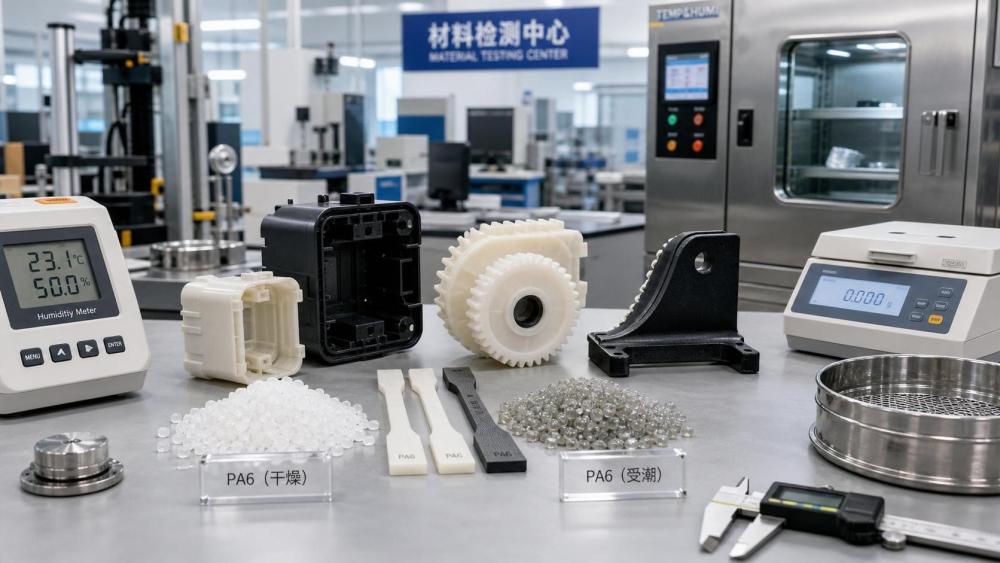
Polyamide is widely used because it combines strength, wear resistance, chemical tolerance, and design flexibility. It is common in automotive housings, electrical connectors, industrial gears, cable management parts, appliance components, and structural brackets.
Its challenge is equally well known. Polyamide absorbs moisture from the surrounding environment. Water molecules enter the polymer structure and act as a plasticizer. This reduces stiffness and can increase toughness, but the effect is not automatically beneficial.
In practice, the same part may show one set of values after molding and another after storage or field use. That gap matters when tolerances are narrow, insulation performance is critical, or a loaded part must keep its shape over time.
Across sectors tracked by APIM, this issue keeps gaining attention because advanced polymer selection now affects lightweight design, electrical reliability, flame safety, and total lifecycle cost. Moisture is not only a laboratory topic. It is a production and application variable.
What actually changes after moisture uptake
The first visible effect is dimensional change. Polyamide parts can swell as moisture content rises. Even modest expansion may disturb snap fits, sealing interfaces, gear backlash, or connector alignment.
The second effect is mechanical shift. Tensile modulus and stiffness usually decline with increasing moisture. Impact resistance may improve in some grades, yet that does not cancel the loss in rigidity.
Heat-related performance can also move. A conditioned polyamide part may respond differently under load at elevated temperature. Creep, deformation, and long-term dimensional drift deserve closer review than a single short-term strength value suggests.
Electrical properties are another concern. Moisture can influence insulation resistance, dielectric behavior, and tracking performance. In electronics, battery systems, and sensor housings, that can change the safety window.
Surface condition may shift as well. Appearance, fit, and friction behavior can change when absorbed water alters crystallinity balance or interacts with fillers and additives. This becomes more important in visible parts or moving assemblies.
Dry as molded is not the whole story
Many polyamide datasheets list dry and conditioned values for a reason. Dry-state properties often look stronger on paper. However, the part in service may never remain that dry.
A sound decision compares at least three states: after molding, after controlled conditioning, and after expected field exposure. This approach usually reveals whether the selected polyamide is truly fit for the application.
Different polyamide grades do not respond the same way
Not all polyamide materials absorb moisture at the same rate or to the same level. PA6 and PA66 behave differently. Long-chain polyamides generally absorb less moisture. Reinforced and filled grades may show reduced swelling, but they introduce other trade-offs.
Glass fiber reinforcement can improve stiffness and dimensional stability. Still, the matrix remains moisture sensitive, and anisotropic shrinkage or warpage may remain a concern. Mineral-filled compounds may lower movement further, but can change toughness and processing behavior.
Flame-retardant, conductive, recycled, or impact-modified polyamide compounds require even more careful review. Additive packages can shift water uptake, hydrolysis resistance, surface quality, or electrical results. A base resin reputation should not replace grade-specific testing.
This is where structured technical information becomes useful. APIM often frames material choices around real processing and application conditions, not only generic resin names. That perspective is especially valuable for moisture-sensitive decisions.
Where the risk usually appears in business practice
Moisture-related failure is not always dramatic. More often, it appears as a pattern of small deviations that slowly become expensive.
- Incoming pellets arrive with inconsistent moisture content, causing molding instability.
- Drying settings look acceptable, but actual residual moisture remains too high.
- Parts pass initial inspection, then move out of tolerance after storage.
- A reinforced polyamide bracket keeps strength, but loses required fit accuracy.
- An electrical housing performs in dry testing, yet insulation margins narrow in humid conditions.
- Field returns show cracking or deformation after heat and moisture cycling.
These cases matter across automotive, electrical, industrial equipment, construction systems, and consumer products. The cost is not limited to scrap. It can include warranty issues, delayed qualification, compliance concerns, and weaker supplier communication.
What to verify before final material selection
A practical selection review should connect resin data, process control, and end-use exposure. The table below highlights the checkpoints that usually deserve attention before approval.
Questions worth asking suppliers
Supplier conversations should move beyond generic brochures. Useful questions often include the following points.
- Which test condition produced the published mechanical values?
- How does this polyamide behave at 50% and 85% relative humidity?
- What residual pellet moisture is recommended before molding?
- Are there lot-to-lot controls for reinforcement, additives, and moisture packaging?
- Is there application data for hot-water, under-hood, or electrical enclosure use?
Processing control is part of material selection
A polyamide grade may be suitable on paper and still fail in production if moisture handling is weak. Storage, drying, transport to the machine, hopper residence time, and regrind policy all affect part consistency.
Compounding quality also matters. In reinforced or flame-retardant polyamide, dispersion quality, degassing efficiency, residence time, and pellet uniformity influence downstream performance. This links material science with extrusion and molding discipline.
That is one reason industrial teams increasingly evaluate the full system around the resin. Material choice, equipment capability, drying validation, and inspection criteria need to work together.
A practical way to make the final decision
A useful decision path is to define the real exposure profile first. Consider humidity, water contact, temperature, load, service life, and dimensional tolerance. Then compare candidate polyamide grades under those exact conditions.
Next, align laboratory testing with production reality. Include molded samples, conditioned samples, and aged samples. If the part is safety-relevant, build acceptance limits around the conditioned state, not only the dry state.
Finally, document the process assumptions. Drying temperature, drying time, residual moisture target, storage rules, and requalification triggers should be clear before release.
For teams comparing several options, the strongest next step is often a focused matrix: grade type, moisture uptake, dimensional shift, retained stiffness, electrical behavior, and aging resistance. That creates a more reliable basis for selecting the right polyamide for long-term use.
Have questions about this sector analysis, or seeking best practices specific to your niche? Drop us a line below and let the senior consultants at APIM assist you.
We respect your privacy. Your information is strictly confidential.
Related News
- 00
0000-00
Do polyolefin hot melt adhesives bond well to polyethylene? - 00
0000-00
Korean Study Finds PLA Barely Degrades in Landfill After 320 Days - 00
0000-00
How to assess batch consistency from a thermal potting compounds supplier - 00
0000-00
How much weight can carbon fiber reinforced plastics save in cars? - 00
0000-00
Switching from PS to ABS Sheet Extrusion: Equipment Checks
Tag