




How Glass Reinforced PBT Improves Dimensional Stability
Dimensional stability is often the deciding factor when a plastic part must fit, seal, align, or survive repeated thermal change. In that context, glass reinforced PBT earns attention because it helps control shrinkage, warpage, and size variation without losing the processing advantages that make PBT attractive in the first place.
That matters across automotive, electrical, electronics, and industrial products, where tighter tolerances are no longer optional. A material that holds shape more consistently can reduce assembly problems, support long-term reliability, and simplify material selection discussions upstream.
Why dimensional stability matters in real parts
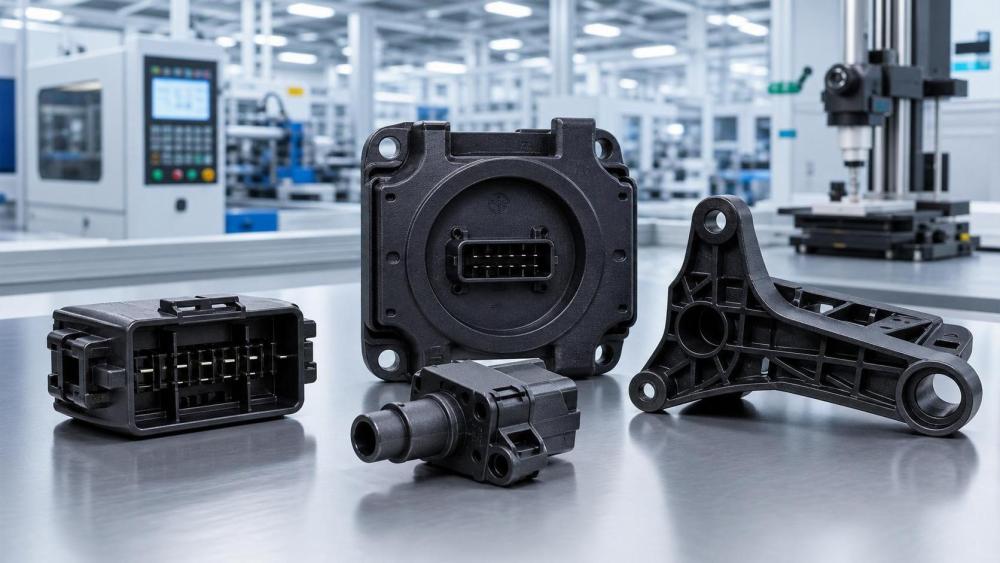
In molded components, dimensional change rarely comes from one source alone. Resin shrinkage, uneven cooling, fiber orientation, moisture exposure, and service temperature all influence final geometry.
For connectors, housings, sensor bodies, switch components, pump parts, and precision brackets, even small movement can create practical failures. Misalignment, poor snap-fit retention, leakage, and stress concentration often start as dimensional issues.
This is why APIM and similar material intelligence platforms place strong focus on modified engineering plastics. Material choice is not just about nominal strength. It is about how a compound behaves through molding, assembly, and long-term use.
What changes when PBT is reinforced with glass fiber
PBT already offers useful electrical performance, chemical resistance, surface quality, and efficient cycle times. Its limitation in tighter tolerance work is that unfilled grades can show more shrinkage and deformation than demanding applications allow.
Glass reinforced PBT changes the internal structure of the compound. The glass fibers act as a rigid phase inside the polymer matrix, restricting resin movement during cooling and under mechanical or thermal load.
Simple resin contraction becomes more controlled. The result is usually lower mold shrinkage, better stiffness, and improved retention of part geometry over time.
In practical terms, glass reinforced PBT helps a molded part stay closer to its intended dimensions from the tool to the application environment.
The main mechanisms behind the improvement
- Glass fibers reduce overall shrinkage during solidification.
- Higher stiffness limits creep and deformation under load.
- Improved heat resistance helps parts maintain shape at elevated temperatures.
- Moisture-related size change remains lower than in many competing engineering plastics.
Where the industry is paying closest attention
Interest in glass reinforced PBT has grown because product designs are becoming smaller, lighter, and more integrated. Components now combine electrical, structural, and thermal requirements in the same space.
Automotive electrification is one driver. Battery systems, charging hardware, control modules, and sensor platforms need parts that keep shape near heat sources and under vibration.
Electronics is another. Connectors and insulating structures need stable dimensions for pin alignment, sealing integrity, and repeated mating performance.
Industrial equipment also adds pressure. Compact housings, valve elements, and precision molded parts often face chemical exposure, heat cycling, and assembly loads at the same time.
In these areas, dimensional stability is linked directly to field reliability, scrap rate, and tooling confidence. That is why glass reinforced PBT is frequently evaluated beside PA, PPS, PET, and other reinforced engineering resins.
How glass reinforced PBT performs across common decision points
Performance should be viewed as a balance, not a single-property claim. The table below captures the dimensions that usually matter most during technical review.
Typical applications where the benefit is most visible
Not every PBT part needs reinforcement. The strongest case appears where shape retention affects downstream performance, compliance, or service life.
- Electrical connectors that require consistent terminal positioning.
- Automotive sensor housings exposed to heat, fluids, and vibration.
- Relay, switch, and breaker parts where dimensional drift affects function.
- Pump, fan, and motor-adjacent components needing stiffness and thermal stability.
- Precision industrial parts with clips, guides, or threaded interfaces.
From an application logic standpoint, glass reinforced PBT is most valuable when a part must keep its designed relationship with another part. That includes holes, pins, ribs, sealing edges, and mating surfaces.
What to verify before selecting a grade
A stable material can still produce unstable parts if the evaluation is too narrow. Grade selection should link formulation data with processing and geometry.
Start with reinforcement level
Higher glass loading often improves stiffness and dimensional stability, but it can also affect toughness, flow, surface quality, and anisotropy. A 15% grade and a 30% grade may behave very differently in the same tool.
Review mold design and fiber orientation
Glass reinforced PBT does not eliminate warpage automatically. Gate location, wall thickness variation, rib design, and flow path still shape fiber orientation, which can create uneven shrinkage across the part.
Check the service environment
Thermal cycling, humidity, chemicals, and sustained load should be reviewed together. A material can pass room-temperature dimensional checks yet drift after exposure to real operating conditions.
Look beyond datasheet values
APIM’s broader materials perspective is useful here. Compound quality, additive package, processing window, and supplier consistency can influence performance almost as much as the base polymer family.
Business relevance beyond the lab
Choosing glass reinforced PBT is often a cost-of-failure decision rather than a resin price decision. Better dimensional control can reduce rejected parts, assembly adjustments, and field returns.
It can also shorten technical discussions between design, tooling, and sourcing teams. When shrinkage behavior is more predictable, design rules become easier to standardize and validation work becomes more efficient.
This is particularly relevant in global supply chains, where equivalent grades, certification support, and batch consistency matter as much as nominal properties. A reinforced compound must perform reliably across production sites, not just in one trial.
A practical next step for evaluation
The best way to assess glass reinforced PBT is to build a short comparison matrix around the actual part. Include dimensional tolerance, service temperature, moisture exposure, wall geometry, expected load, and cosmetic requirements.
Then compare reinforced PBT grades against realistic alternatives, not generic resin families. Mold-flow analysis, conditioned testing, and supplier process guidance usually reveal more than headline datasheet numbers.
For teams using APIM-style structured material intelligence, the key is to connect compound design, processing behavior, and end-use conditions in one review. That is usually where the real value of glass reinforced PBT becomes clear.
Have questions about this sector analysis, or seeking best practices specific to your niche? Drop us a line below and let the senior consultants at APIM assist you.
We respect your privacy. Your information is strictly confidential.
Related News
- 00
0000-00
Do polyolefin hot melt adhesives bond well to polyethylene? - 00
0000-00
Korean Study Finds PLA Barely Degrades in Landfill After 320 Days - 00
0000-00
How to assess batch consistency from a thermal potting compounds supplier - 00
0000-00
How much weight can carbon fiber reinforced plastics save in cars? - 00
0000-00
Switching from PS to ABS Sheet Extrusion: Equipment Checks