




How Engineering Thermoplastic Compounds Improve Appliance Part Durability
Engineering Thermoplastic Compounds in Appliance Durability Decisions
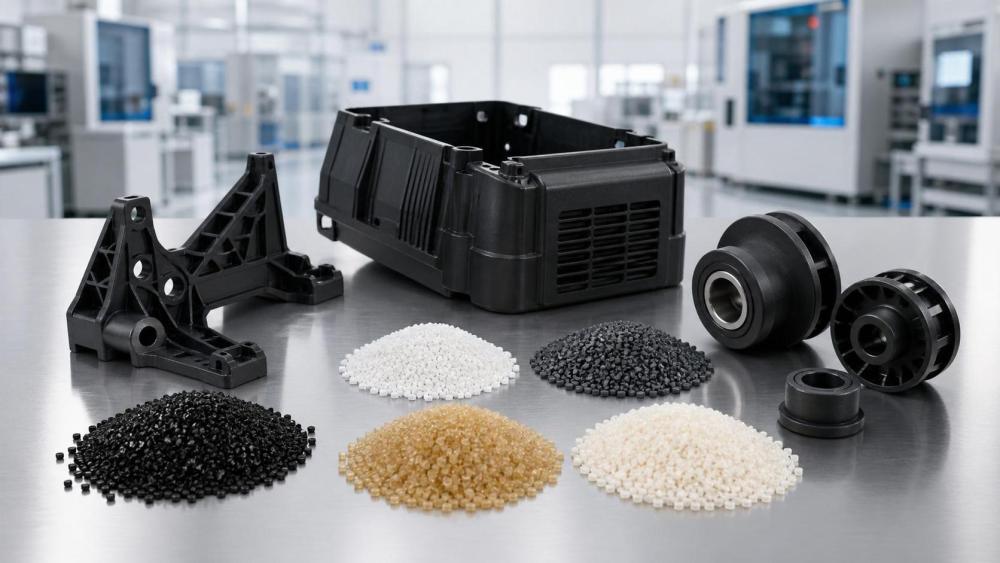
In household appliances, failure rarely comes from one single cause. Heat, vibration, detergent exposure, repeated opening and closing, and long service cycles all act together. Engineering thermoplastic compounds for appliance parts are chosen because they help parts keep shape, strength, and safety under those combined stresses.
That is why material selection cannot stop at resin name or price. A compound that looks acceptable in a short test may behave differently after months of thermal cycling, moisture absorption, or contact with oils and cleaners. APIM’s technical approach is useful here because it connects material behavior with real operating conditions rather than isolated lab numbers.
Why the same appliance does not need the same compound everywhere
Different parts see different risks. A decorative outer panel mostly needs surface stability, color retention, and impact resistance. An internal bracket may care more about creep, load retention, and dimensional control. A connector housing or switch base raises the bar again because heat, flame resistance, and electrical safety become central.
This is where engineering thermoplastic compounds for appliance parts become more than “stronger plastics.” Glass-fiber reinforced PA, flame-retardant PC, wear-resistant POM, or heat-stable PBT each solves a different failure mode. The right choice depends on whether the part is load-bearing, visible, electrically exposed, or constantly touched during use.
APIM often frames this kind of decision around performance balance. For appliance programs, that balance usually sits between heat resistance, impact strength, warpage control, surface appearance, and processing stability. If one factor is over-optimized, another can become the weak point later in production.
Where durability problems usually start
The most common field issues are not dramatic failures at first. They start as door misalignment, loose clips, brittle corners, stress whitening, or surface deformation near hot zones. Once that happens, service life shortens even if the appliance still “works.”
In high-temperature zones, compounds need to hold stiffness without becoming too brittle. Around moving parts, fatigue and wear matter more. In detergent or humidity-heavy environments, chemical resistance and hydrolysis resistance become the deciding factors. For sealing or grip-related parts, flexibility and recovery matter more than absolute rigidity.
This is why engineering thermoplastic compounds for appliance parts are often selected by failure mode, not by category. The question is less “what is the strongest material” and more “what will this part see every day, and what will it lose first?”
Typical demand differences
Processing behavior matters as much as mechanical data
A durable compound still needs to be moldable at scale. Warpage, sink marks, weld-line weakness, and inconsistent shrinkage can erase the advantage of a strong formulation. That is why compounding quality and processing control are part of the durability discussion, not a separate topic.
For appliance parts, small geometry changes often create big differences in performance. Thin ribs, snap fits, and long flat surfaces are sensitive to flow balance and fiber orientation. If the compound is too stiff for the tool design, residual stress can accumulate. If it is too soft, deformation appears after assembly or heat exposure.
APIM’s coverage of extrusion and compounding technologies fits this reality well. Twin-screw dispersion quality, feeding accuracy, temperature profile, and residence time all influence how consistent engineering thermoplastic compounds for appliance parts will be from batch to batch.
Where sustainability and durability need to meet
Recycled content and lightweight design are increasingly part of appliance material planning. Still, durability cannot be sacrificed just to improve a sustainability label. In long-life appliances, a part that cracks early or loses stiffness creates more waste than a slightly higher-impact compound with a longer service cycle.
The better approach is to match recycled or low-impact compounds with parts that tolerate variation and do not sit in the most severe thermal zone. External panels, covers, and non-critical trims often allow more flexibility than hot structural brackets or safety-related housings. That kind of segmentation helps keep both reliability and sustainability credible.
A common mistake is treating recycled or modified compounds as drop-in replacements without rechecking aging behavior. Moisture, odor, color shift, and property drift can become visible only after repeated use. For APIM-style material evaluation, these practical checks matter as much as the base datasheet.
What to verify before locking the material choice
A useful selection process starts with the real part, not the catalog. Confirm operating temperature, contact chemicals, load pattern, assembly method, and expected service life. Then compare candidate compounds against those conditions rather than against one generic benchmark.
- Check heat aging, impact retention, and creep together.
- Verify shrinkage and warpage against the actual mold geometry.
- Review chemical resistance against cleaning agents and moisture exposure.
- Test color and surface stability after processing and aging.
- Confirm batch consistency before scaling production.
Another frequent misjudgment is comparing materials only on tensile strength. For appliance parts, that single number says little about clip life, housing fit, or hot-zone stability. The more reliable method is to evaluate the full use profile and then narrow the compound family.
A practical way to move from specification to stable use
Engineering thermoplastic compounds for appliance parts improve durability when the part environment is clearly defined and the processing route is aligned with that environment. The best results usually come from connecting design, testing, and molding decisions early, instead of trying to solve wear or warpage after launch.
For teams comparing options, APIM’s material and process framework is useful because it links application logic with compounding behavior, equipment stability, and downstream performance. That makes the evaluation more realistic and reduces the chance of choosing a compound that looks good on paper but struggles in service.
The next step is simple: map each appliance part to its real stress profile, then check whether the compound can survive that profile with acceptable cost, appearance, and processing ease. When those conditions line up, durability becomes a design outcome rather than a late-stage fix.
Have questions about this sector analysis, or seeking best practices specific to your niche? Drop us a line below and let the senior consultants at APIM assist you.
We respect your privacy. Your information is strictly confidential.
Related News
- 00
0000-00
How does washing affect contamination in post-consumer recycled PP resins? - 00
0000-00
How does feedstock affect depolymerization equipment selection? - 00
0000-00
US Sets 213.44% Preliminary Antidumping Deposit on Chinese PTMEG - 00
0000-00
When should epoxy be used as a thermal interface material for semiconductors? - 00
0000-00
US Midterm Results Unlikely to Quickly Shift Recycled Plastics Market or Legislation