




How Do You Select POM for Precision Gear Manufacturing?
Start with the gear duty cycle and accuracy target, then select a POM grade whose friction, wear behavior, shrinkage control, and molding window match that duty. A grade with higher tensile strength is not automatically the better gear material. Precision gears fail or become noisy when tooth geometry changes, the contact surface wears unevenly, the hub creeps on its shaft, or molding variation shifts the center distance between meshing parts.
For a small, lightly loaded gear in a dry mechanism, a standard injection-molding POM grade may be suitable when the mold is stable and the tooth profile is well designed. A continuously loaded drive, a gear that reverses frequently, or a compact assembly with little tolerance for backlash usually needs a closer review of tribological modification, stiffness, thermal behavior, and long-term dimensional consistency.
Define the gear contact before comparing grades
POM is widely used for gears because it combines low friction, good fatigue resistance, useful stiffness, and relatively low moisture uptake compared with many polyamides. Those properties are valuable, but the selection must begin with the real contact condition. A gear transmitting intermittent motion sees a different failure pattern from one running at high speed for long periods.
Record the mating material, transmitted torque, speed, start-stop frequency, temperature near the mesh, expected service life, lubrication state, and whether the gear is exposed to cleaners, oils, dust, or condensed moisture. Also identify whether the gear is spur, helical, worm-driven, internal, or part of a planetary set. The same POM resin may work well in a spur gear pair yet show rapid wear against a metal worm because sliding dominates the contact.
Surface pressure and sliding velocity should be considered together. High torque at low speed tends to stress tooth roots and hubs. Higher speed increases frictional heating and can alter the surface condition of the teeth. Reversing motion can be especially demanding because contact repeatedly transfers between opposite flanks, exposing any inconsistency in tooth form, shaft alignment, or material distribution.
Gear noise also deserves a separate requirement. Audible noise is often blamed on the resin, although tooth error, concentricity, housing stiffness, shaft runout, and excessive backlash can have a larger effect. POM can dampen vibration better than metal in many assemblies, but changing to a softer or more lubricated grade will not correct a poorly aligned mesh.
Choose between unfilled, lubricated, and reinforced POM deliberately
An unfilled POM grade is often the starting point for precision molded gears. It offers a balanced combination of toughness, stiffness, surface finish, and flow. It is usually easier to mold into fine teeth than a heavily filled compound, and its more uniform structure can support predictable shrinkage when process control is established.
Internally lubricated or wear-modified POM grades are relevant when dry sliding, low breakaway force, or reduced friction against a specific mating surface matters. Their performance should be assessed as a system rather than from a single friction coefficient on a data sheet. A modification that reduces friction against steel may behave differently in POM-to-POM contact, in a dusty enclosure, or under boundary lubrication. Some low-friction formulations also change flow, shrinkage, surface appearance, or weld-line behavior, all of which can affect tooth accuracy.
Reinforced POM can increase stiffness and reduce creep in selected designs, especially where a gear hub carries sustained stress or where elevated temperature threatens tooth deflection. The tradeoff is important: fibers and mineral fillers can increase abrasion against the mating gear, introduce anisotropic shrinkage, and reduce the ability to reproduce very fine tooth details. A reinforced grade is therefore better evaluated for a gear with a substantial module and a well-defined load path than for a small, quiet gear where smooth meshing and low runout dominate.
Dimensional stability is a gear-system requirement
A gear can meet a nominal outside diameter and still run poorly. Pitch diameter, tooth thickness, profile form, lead, bore concentricity, and the relation between the bore and the tooth ring all influence mesh quality. Material selection must therefore be tied to the dimensions that control engagement, not only the overall drawing tolerance.
POM has relatively low water absorption, which is one reason it is favored where humidity changes would noticeably alter a polyamide gear. That advantage should not be treated as immunity to environmental change. Thermal expansion, post-molding relaxation, residual stress, and exposure to chemicals can still change fit or clearance. Where operating temperature cycles are wide, the housing, shaft, mating gear, and POM gear should be reviewed together. A stable gear inside a housing that expands differently may still lose its intended backlash.
Shrinkage is also directional. Molecular orientation during filling and packing can make dimensions parallel and perpendicular to flow behave differently. This is particularly relevant for thin tooth sections, asymmetric gates, and gears with a thick hub attached to a thin rim. A resin choice with a narrower and more controllable processing window can be more valuable than a nominally stronger grade that produces greater lot-to-lot or cavity-to-cavity variation.
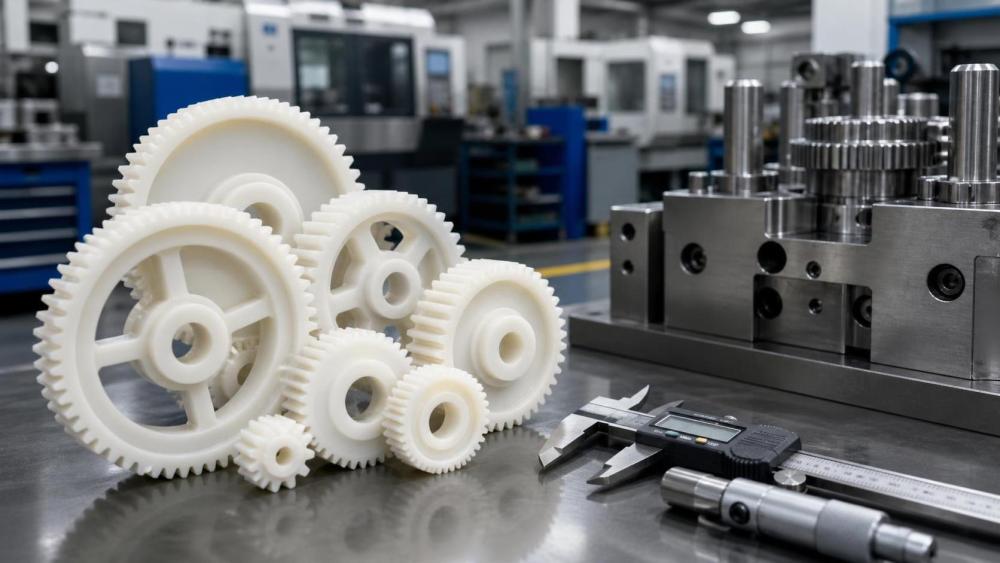
For tight-tolerance gears, use production-condition samples rather than relying solely on first-off trials. The intended resin lot, color package, regrind policy, mold temperature control, cooling time, and measurement conditioning should be represented. Measuring a warm part immediately after ejection can obscure the dimensions that matter after stabilization.
Match flow behavior to tooth geometry and mold layout
Fine-pitch teeth, thin webs, and long flow paths demand enough melt flow to fill the cavity without unstable pressure peaks. Yet selecting the highest-flow grade solely to improve filling can create other issues, including more difficult packing control or altered mechanical performance. The suitable viscosity range is determined by the part geometry, gate location, number of cavities, wall transitions, and the available injection pressure.
Gate placement deserves material-specific attention. A gate that sends flow symmetrically into the gear ring can reduce uneven orientation and improve roundness. A side gate may be practical, but it can create a local orientation pattern that affects shrinkage, especially when the rim is thin. The gate vestige must also be positioned where it will not interfere with mounting, tooth engagement, or balance at rotational speed.
Weld lines require more than a visual review. Where flow fronts join near the tooth ring or at the root of a loaded feature, the weld line can become a mechanical weak point. Its significance depends on the local stress direction, molding temperature, venting, and the grade's weld-line strength. Moving the gate or improving venting may solve the issue more effectively than changing to a more expensive resin.
POM is sensitive to excessive residence time and poor thermal control. Degradation can reduce toughness and create surface defects or odor, while trapped moisture or contamination can disturb molding consistency. Drying requirements vary by grade and storage condition, so material handling should follow the grade supplier's documented guidance rather than a generic setting. Purge practice, barrel residence time, and regrind limits need the same discipline when dimensional capability is tight.
Do not separate material choice from tooth and hub design
A POM grade cannot compensate for a tooth root that is too sharp, a hub with an aggressive press fit, or a wall transition that freezes unevenly. Tooth-root radius, rim thickness, web geometry, and bore construction determine where stress is concentrated and how the part cools. Sharp transitions near the hub can produce residual stress that later appears as cracking, bore distortion, or eccentric rotation.
Press-fitting onto a metal shaft needs particular care. POM can tolerate interference in many applications, but sustained hoop stress combined with elevated temperature can lead to creep and torque loss. Knurls, splines, flats, or inserts should be assessed for local stress concentration. A metal insert may improve torque transfer, but it also changes cooling and can pull the bore out of round if the molding and insert-temperature conditions are not controlled.
Metal mating gears are not automatically preferable. They can improve load capacity, but their surface finish, hardness, alignment, and lubrication condition influence wear of the POM flank. A rough counterface can act as an abrasive. POM-to-POM pairs often run quietly, though thermal buildup and wear distribution require evaluation. When one gear is intended to be the sacrificial wear component, that decision should be explicit because it affects the selected grade and the allowable maintenance interval.
Read data sheets as screening tools, not gear predictions
Tensile strength, flexural modulus, impact strength, and heat-deflection values help narrow the candidate set, but they do not directly predict gear life. Gear performance is governed by repeated tooth loading, contact stress, sliding, temperature rise, and the quality of the molded profile. A grade with a favorable tensile value may still be unsuitable if it wears quickly against the chosen counterface or cannot maintain pitch accuracy after molding.
Request information that relates to the actual uncertainty. Useful evidence includes shrinkage direction, recommended processing conditions, wear or friction results with identified counterfaces, thermal aging behavior, creep data, colorant compatibility, and guidance on allowable regrind. When two candidate grades appear similar, moldability and dimensional capability often provide the deciding distinction.
Prototype testing should include both inspection and running evaluation. Measure tooth geometry, bore roundness, runout, and part-to-part variation. Then test under representative torque, speed, temperature, reversal pattern, lubrication state, and contamination exposure. Track changes in backlash, torque transmission, noise, tooth surface appearance, and hub retention. A short unloaded rotation test can confirm assembly, but it will not reveal the thermal and wear mechanisms that control service life.
Questions that commonly change the selection
Is copolymer or homopolymer POM better for a precision gear?
Neither form is universally better. The decision should follow the required balance of mechanical performance, thermal and chemical exposure, processing behavior, and the grade-specific tribological package. Compare commercial grades by their documented behavior in the intended molding and operating conditions rather than by polymer family alone.
Will a glass-fiber-reinforced grade always reduce gear deformation?
It can reduce deflection in certain load directions, but reinforcement may complicate shrinkage control and increase wear against the mating surface. For fine, quiet gears, the resulting profile accuracy and surface quality may outweigh the stiffness gain.
Can a lubricant be added after selecting standard POM?
External lubrication can improve a gear system, but it does not necessarily reproduce the behavior of an internally modified resin. Lubricant compatibility, retention, contamination, temperature, and migration into adjacent components should be established before treating it as a substitute for grade selection.
The most reliable choice emerges when the resin, tool design, molding conditions, counterface, and assembly tolerances are evaluated as one mechanical system. That approach prevents a material change from being used to mask a geometry or process problem that will return during production.
Have questions about this sector analysis, or seeking best practices specific to your niche? Drop us a line below and let the senior consultants at APIM assist you.
We respect your privacy. Your information is strictly confidential.
Related News
- 00
0000-00
Do polyolefin hot melt adhesives bond well to polyethylene? - 00
0000-00
Korean Study Finds PLA Barely Degrades in Landfill After 320 Days - 00
0000-00
How to assess batch consistency from a thermal potting compounds supplier - 00
0000-00
How much weight can carbon fiber reinforced plastics save in cars? - 00
0000-00
Switching from PS to ABS Sheet Extrusion: Equipment Checks