




How Can You Optimize a Plastic Compound for Better Impact Resistance?
Optimizing a plastic compound for better impact resistance starts with identifying why it breaks—not simply increasing the impact-modifier loading. A brittle base resin, incompatible modifier, poorly dispersed filler, moisture-driven degradation, or weak weld line can produce similar failures, but each requires a different correction. Adding more elastomer will not repair molecular-weight loss or eliminate a stress concentration in the finished part.
The most effective formulation is the one that meets the required impact performance under actual service conditions while preserving acceptable stiffness, heat resistance, processing behavior, and cost. That means defining the failure conditions, selecting a compatible toughening system, controlling its morphology during compounding, and validating the result in molded parts rather than relying on a single datasheet value.
What should you establish before changing the formulation?
Start with a clear definition of the impact requirement. A housing dropped onto a concrete floor, a clip snapped into place, and a structural component struck at low temperature experience different combinations of loading rate, constraint, and stress concentration. “Better impact resistance” is not a sufficiently precise development target.
Record the service temperature, part thickness, likely impact location, assembly stresses, and exposure to moisture, chemicals, or outdoor weathering. Identify whether the requirement concerns a notched test specimen, an unnotched specimen, a falling-weight test, or the finished component. These measurements describe different failure conditions and should not be treated as interchangeable.
Inspect how the existing material fails. A sharp fracture with little deformation suggests limited energy absorption under the test conditions. Extensive deformation before fracture indicates a different response. Failure concentrated at a weld line, screw boss, sharp corner, or filler agglomerate points toward a local weakness that bulk toughening alone may not resolve.
Before reformulating, compare the suspect material with a controlled baseline processed under documented conditions. Check drying, melt temperature, residence time, regrind content, and molding settings. If the same compound becomes brittle only after a processing change, correcting that change should take priority over adding another ingredient.
How does the base resin affect the toughening strategy?
The matrix must be capable of absorbing energy once the modifier initiates deformation. Impact modifiers can promote mechanisms such as shear yielding or crazing, depending on the polymer system. If the matrix is severely degraded or has insufficient molecular weight, an otherwise suitable modifier may deliver a limited benefit.
A higher-molecular-weight grade can improve toughness, but it also increases melt viscosity and may make thin-wall filling more difficult. A high-flow grade can simplify molding while reducing the toughness margin. Grade selection therefore needs to balance flow requirements against mechanical performance rather than treating the resin family as a complete material specification.
For semicrystalline polymers such as polypropylene, polyamide, PBT, and PET, crystallinity and crystal morphology influence impact behavior. Cooling conditions, nucleating agents, and thermal history can alter the stiffness–toughness balance. Comparing formulations without controlling specimen preparation can mistakenly attribute a crystallinity effect to the impact modifier.
Polyamide also requires particular attention to conditioning. Dry and moisture-conditioned specimens can behave very differently because absorbed water changes the matrix response. Neither condition is universally correct: testing must reflect the specified qualification condition and the expected service environment.
Which impact modifier should you choose?
Choose a modifier by matrix compatibility, operating temperature, processing stability, and the properties that cannot be sacrificed. The rubber phase must retain sufficient flexibility at the intended impact temperature. A compound that performs well at room temperature can still become brittle in cold service if its toughening phase no longer responds effectively.
These are starting points for screening, not universal recipes. Grades within the same modifier family can differ in rubber content, shell chemistry, particle structure, viscosity, and functionalization. A material described only as an “impact modifier” does not provide enough information for substitution.
Optical and environmental requirements can narrow the options substantially. Transparent compounds require control of light scattering as well as mechanical performance. Outdoor applications need a modifier system suitable for weathering; initial impact strength alone does not establish retained performance after exposure.
Why are compatibility and particle dispersion so important?
A toughened compound needs the right dispersed-phase structure, not merely the right ingredients. Modifier particles must be distributed through the matrix with an appropriate size and spacing. Large agglomerates can become defects, while a poorly developed morphology may fail to activate enough energy-absorbing deformation around a crack.
Interfacial adhesion determines how stress transfers between the matrix and modifier. An interface that separates too easily can create a premature fracture path. However, maximum adhesion is not automatically the optimum: controlled cavitation or debonding can contribute to toughening in some systems. The desired interface depends on the matrix, modifier, and deformation mechanism.
Compatibilizers and reactive functional groups can improve phase interaction, but their concentration must be controlled. Excessive reaction can increase viscosity, create gels, or change morphology in ways that undermine processing consistency. The objective is a stable, effective interface—not the highest possible level of functionalization.
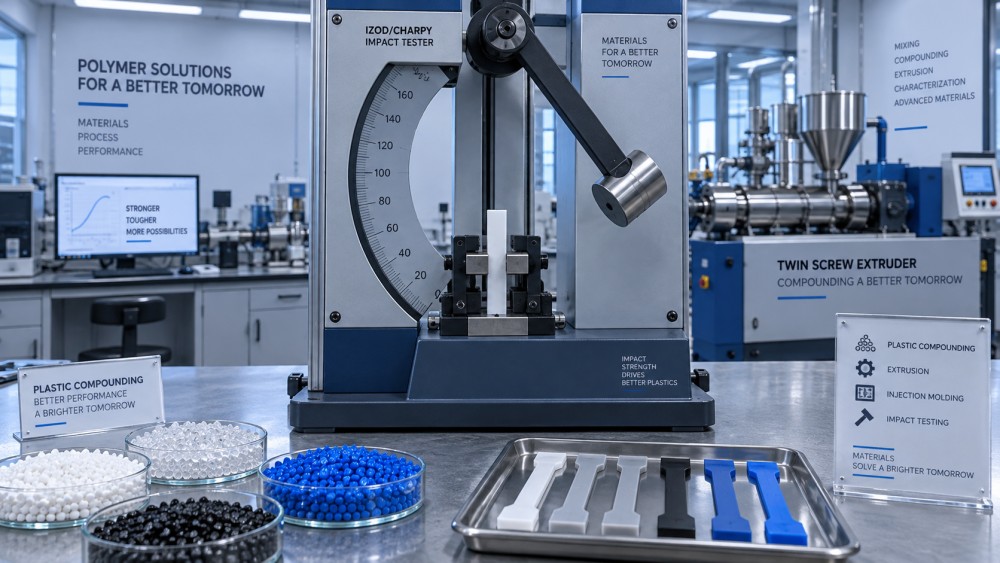
Microscopy can help distinguish a formulation problem from a compounding problem by revealing modifier distribution, agglomerates, and fracture features. When impact results plateau despite higher loading, examining morphology is more informative than continuing to increase dosage without understanding where the additional modifier is going.
How much impact modifier is enough?
There is no reliable loading recommendation that applies across all plastic compounds. The required amount depends on the matrix grade, modifier efficiency, filler content, target temperature, specimen geometry, and minimum acceptable stiffness. A concentration that works in an unfilled resin cannot be transferred directly to a glass-filled version.
Use a controlled loading series while keeping the base resin and processing conditions consistent. Measure impact performance alongside modulus, yield strength, melt flow or rheology, and the relevant heat-resistance property. This reveals whether the compound is becoming meaningfully tougher or merely softer.
Some systems show a pronounced improvement once modifier concentration and interparticle spacing support widespread matrix deformation. Beyond that region, further additions may provide diminishing impact gains while continuing to reduce rigidity or alter flow. The useful loading is therefore determined by the full performance window, not by the highest impact result.
Specify how loading is calculated. Weight percentage of the total compound and parts per hundred resin are different conventions
Have questions about this sector analysis, or seeking best practices specific to your niche? Drop us a line below and let the senior consultants at APIM assist you.
We respect your privacy. Your information is strictly confidential.
Related News
- 00
0000-00
Do polyolefin hot melt adhesives bond well to polyethylene? - 00
0000-00
Korean Study Finds PLA Barely Degrades in Landfill After 320 Days - 00
0000-00
How to assess batch consistency from a thermal potting compounds supplier - 00
0000-00
How much weight can carbon fiber reinforced plastics save in cars? - 00
0000-00
Switching from PS to ABS Sheet Extrusion: Equipment Checks