




How Barium Sulfate Mineral Fillers Affect Density, Brightness, and Cost
Barium sulfate mineral fillers sit at an important intersection of formulation design, visual quality, and cost control. In polymer compounds, films, coatings, and molded parts, they do more than occupy space. They change density, influence brightness, affect stiffness, and reshape the economics of the finished material. That is why they remain under close review across automotive, electronics, packaging, construction, and industrial product development.
The topic matters even more now because material selection is becoming less forgiving. Lightweight targets, optical expectations, batch consistency, and procurement pressure often point in different directions. In that environment, barium sulfate mineral fillers are rarely judged by price alone. Their value depends on how they perform inside a specific formulation and process window.
Why barium sulfate remains relevant in industrial materials
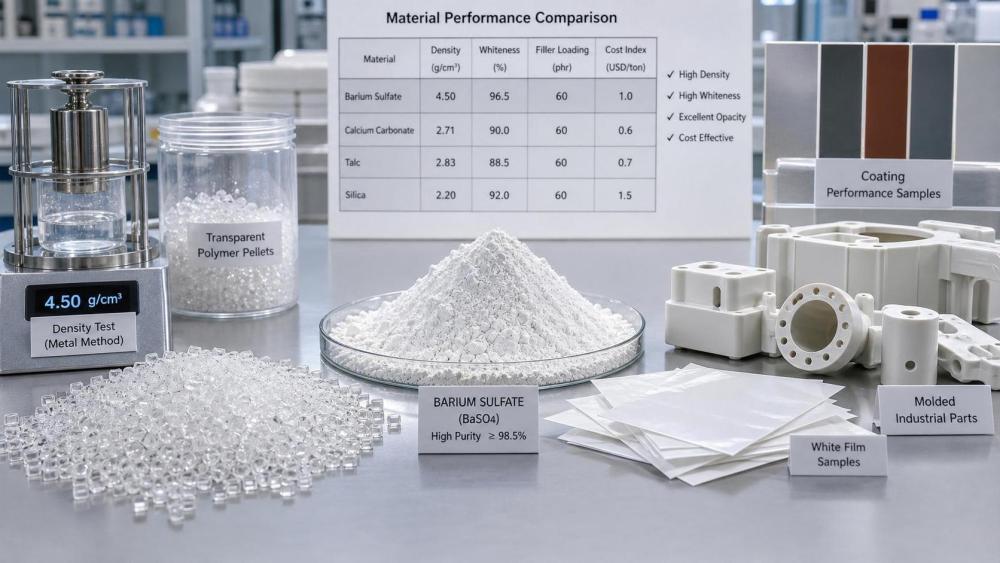
In practical terms, barium sulfate is a high-density, chemically stable, white mineral filler. It is used in plastics, rubber, coatings, adhesives, sealants, and specialty substrates where formulators need controlled weight, brightness, and dimensional behavior.
Compared with lighter fillers such as calcium carbonate or talc, barium sulfate mineral fillers bring a different balance. They add mass efficiently. They can support a clean white appearance. They also offer low oil absorption and good chemical inertness, which helps in selected compound systems.
That profile fits well with the kind of material decisions APIM tracks across advanced polymers, modified compounds, extrusion, films, and industrial bonding systems. A filler is not just a cost reducer. It becomes part of the performance logic of the whole system.
Density is the most immediate effect
The first reason formulators choose barium sulfate mineral fillers is density. Barium sulfate has a much higher specific gravity than many common fillers. When added to a polymer matrix, it raises compound density quickly, even at moderate loading levels.
This can be useful or problematic, depending on the application. In cable compounds, flooring layers, sound-damping parts, or counterbalance components, more mass may be desirable. In lightweight automotive or portable electronics parts, added density may work against the design target.
The key is to separate filler loading from part performance. A lower resin cost per kilogram does not automatically translate into a lower cost per part. If part weight rises significantly, logistics cost, cycle balance, and end-use handling can shift as well.
Where higher density adds value
- Acoustic barriers and damping parts that benefit from added mass.
- Protective sheets and industrial boards where solid feel matters.
- Adhesives and sealants requiring body, stability, or sag control.
- Radiation-shielding or specialty technical compounds in selected uses.
From an evaluation standpoint, density must be tied to the real unit of sale. That may be per part, per square meter, per linear meter, or per installed assembly. This is often where filler decisions become clearer.
Brightness is not only about color
Brightness is the second major reason barium sulfate mineral fillers are specified. The mineral is naturally white, and high-purity grades can support brightness, opacity, and a cleaner visual base in formulations that require a light appearance.
That sounds simple, but brightness is not just a visual metric. It affects pigmentation efficiency, perceived cleanliness, surface uniformity, and how easily a compound reaches its target shade. In white or pastel formulations, filler quality can change the amount of titanium dioxide or color masterbatch required.
Particle size distribution also matters. Finer grades may improve surface appearance and gloss consistency in some systems. Coarser or poorly dispersed grades may introduce surface defects, haze changes, or uneven color development.
For films, sheets, and molded housings, brightness must be checked together with dispersion quality and processing stability. A white filler that agglomerates can weaken the very visual benefit it is supposed to create.
Brightness-related checkpoints
Cost impact is more complex than filler price
Cost discussions around barium sulfate mineral fillers often start with raw material substitution. A filler may replace a portion of higher-cost resin, which can improve compound economics. But that is only the first layer of the analysis.
The real cost outcome depends on loading level, throughput, wear, scrap rate, color package demand, and final part weight. In some formulations, barium sulfate reduces overall cost. In others, the filler lowers resin expense but introduces hidden costs elsewhere.
For example, a dense filler may increase transportation cost per shipped unit. A finer grade may improve brightness, yet require tighter feeding control. In extrusion and compounding lines, poor dispersion can create rejects that erase apparent savings.
This is one reason APIM’s broader material intelligence model matters. A filler decision belongs inside a larger chain of variables: formulation design, process settings, application requirements, and supply stability.
Questions that improve cost evaluation
- Is the comparison based on cost per kilogram or cost per finished unit?
- Does added density create a freight or handling penalty?
- Will brightness gains reduce titanium dioxide demand?
- Does the filler affect screw wear, filtration load, or downtime?
- How stable is the supply specification across different batches?
Where barium sulfate mineral fillers are commonly evaluated
The most suitable use cases usually share one feature: density or visual control matters enough to justify the formulation trade-off. That is why barium sulfate mineral fillers appear across several industrial segments rather than in one narrow category.
In modified plastics, they are often considered for rigid compounds, appliance housings, cable materials, engineering blends, and decorative or functional sheet products. In specialty films and substrates, they may be reviewed where opacity, white tone, or tactile feel must be tuned carefully.
In adhesives, sealants, and potting materials, the filler can contribute to body, flow adjustment, and cost balance. In coatings or industrial surfaces, it may help with brightness and bulk while supporting formulation stability.
The same mineral can serve very different goals. That is why application context matters more than generic claims about filler performance.
Processing and quality control often decide the outcome
A promising filler grade can still underperform if processing control is loose. Feeding accuracy, screw design, melt residence time, filtration, and cooling all shape how barium sulfate mineral fillers behave in production.
In twin-screw compounding, dispersion quality is usually the first checkpoint. Poorly distributed filler creates visible defects, unstable mechanical properties, and inconsistent density from pellet to pellet. That can become a major downstream issue in molding or film extrusion.
Moisture is generally less critical than with hygroscopic resins, but contamination and particle control remain important. Abrasiveness, though lower than some minerals in certain grades, still deserves review when long production runs are planned.
For that reason, qualification should include both lab data and line data. A datasheet can describe whiteness and particle size. It cannot fully predict how the filler will behave in a real extrusion or molding environment.
A practical way to compare options
When reviewing barium sulfate mineral fillers, the most reliable approach is comparative, not absolute. The question is rarely whether the filler is good or bad. The question is whether it improves the full material system more effectively than the alternatives.
A useful comparison framework includes physical, visual, process, and economic factors together.
What to do next with this information
Barium sulfate mineral fillers deserve attention because they can reshape a formulation in several directions at once. They can increase density, support brightness, and improve cost structure, but not always in the same proportion. The balance depends on the resin system, target appearance, process discipline, and end-use economics.
The next sensible step is to define the decision in operational terms. Identify whether the priority is weight control, visual quality, processing stability, or cost per finished unit. Then compare filler grades against realistic loading levels and production conditions, not only supplier literature.
For organizations following compounds, films, adhesives, extrusion systems, and industrial materials more broadly, this kind of structured comparison leads to better specification choices. It also makes supplier discussions more precise, especially when density, brightness, and cost are all moving at the same time.
Have questions about this sector analysis, or seeking best practices specific to your niche? Drop us a line below and let the senior consultants at APIM assist you.
We respect your privacy. Your information is strictly confidential.
Related News
- 00
0000-00
How does washing affect contamination in post-consumer recycled PP resins? - 00
0000-00
How does feedstock affect depolymerization equipment selection? - 00
0000-00
US Sets 213.44% Preliminary Antidumping Deposit on Chinese PTMEG - 00
0000-00
When should epoxy be used as a thermal interface material for semiconductors? - 00
0000-00
US Midterm Results Unlikely to Quickly Shift Recycled Plastics Market or Legislation