




High Strength Polymers: How Twin-Screw Compounding Affects Fiber Retention
Reinforcement content alone does not explain the strength of fiber-reinforced high strength polymers. Two compounds with the same resin and glass- or carbon-fiber loading can perform differently because twin-screw compounding changes fiber length, bundle dispersion, and the condition of the polymer–fiber interface. The useful comparison is not simply how much fiber enters the extruder, but what reinforcement structure survives into the molded component.
Good compounding therefore does not mean minimizing shear at every stage. It means melting and conditioning the polymer before fiber introduction, achieving adequate wetting and distribution, and avoiding unnecessary mechanical work afterward. Preserving long fibers without separating bundles can produce defects; dispersing fibers aggressively can leave a uniform compound with reduced reinforcement efficiency.
Why retained fiber length matters
A reinforcing fiber carries load through stress transferred from the surrounding polymer across the interface. Near each fiber end, axial stress builds over a finite distance. When fibers become shorter, these end regions occupy a greater share of their length, reducing their contribution to composite strength.
A simplified critical-length relationship expresses this dependency:
lc = σfd / (2τi)
Here, lc is critical fiber length, σf is fiber tensile strength, d is fiber diameter, and τi is effective interfacial shear strength. This idealized relationship explains why length cannot be evaluated independently of fiber diameter, sizing, and matrix compatibility. It is not a universal acceptance limit: actual stress transfer also depends on loading conditions, matrix behavior, and interface damage.
Length changes can affect properties differently. Tensile strength and impact behavior may respond strongly to shortening, while stiffness can remain comparatively less affected over certain length ranges. A compound can therefore retain an acceptable modulus while losing strength or damage tolerance. Modulus alone is insufficient evidence that a revised process preserves reinforcement performance.
The distribution matters as much as the average. A population containing many short fragments and a smaller number of long fibers can share the same number-average length as a narrower population, yet behave differently during loading and molding.
Where twin-screw compounding breaks fibers
In a co-rotating twin-screw extruder, fibers experience viscous forces from the melt, bending in changing flow fields, contact with screw and barrel surfaces, and fiber–fiber interactions. Breakage is not controlled by screw speed alone. Local stress depends on melt viscosity, element geometry, channel filling, and the concentration and orientation of fibers.
Polymer melting is a particularly unfavorable stage for fiber preservation. If fibers enter with the main feed, they travel through zones containing solid resin, partially molten material, and intensive melting elements. Introducing fibers after the resin has melted removes much of this exposure. However, downstream feeding must still leave sufficient processing length for bundle opening, wetting, distribution, and stable discharge.
Repeated passage through restrictive mixing sections can add damage after useful dispersion has already been achieved. Pressure generation near the discharge also deserves attention: restrictive adapters, screens, and dies impose additional flow stresses. An apparently gentle screw configuration cannot compensate fully for a highly restrictive downstream melt path.
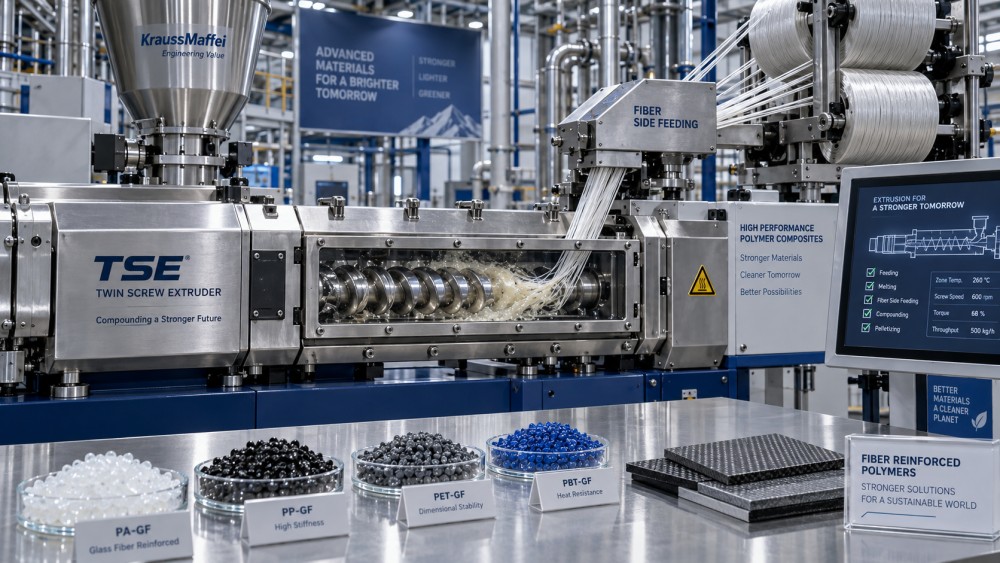
Feeding location and screw configuration must work together
Downstream side feeding is a practical route for reducing fiber exposure to the melting zone, but moving the feed port closer to the die is not automatically an improvement. A shorter post-feed section may preserve length while leaving poorly wetted bundles or uneven reinforcement distribution.
The matrix should be sufficiently molten and thermally uniform at the introduction point. The receiving section must also accommodate the bulk volume of the fiber feed without excessive local pressure or feeder instability. Low-bulk-density fibers can make feeding capacity a constraint before the extruder reaches its nominal mass-throughput limit.
After introduction, the screw needs enough mixing action to incorporate fibers without repeatedly subjecting them to high-stress deformation. Distributive mixing spreads reinforcement through the melt; dispersive mixing helps separate bundles but can also increase breakage. These functions overlap in actual equipment, so element labels alone do not establish whether a configuration is gentle.
Kneading-block stagger angle, disk width, conveying direction, and placement affect pressure, back-mixing, and mechanical work. Reverse elements and strongly restrictive sections may serve necessary process functions, but their use after fiber feeding requires justification. The relevant question is what each section accomplishes and whether that benefit exceeds the additional fiber damage.
Different reinforcement routes also require different expectations. Chopped-fiber twin-screw compounding and long-fiber impregnation processes do not produce equivalent structures. For pellets made by cutting impregnated rovings, fiber length can approach pellet length; for chopped-fiber compounds, pellet dimensions do not reliably indicate internal fiber length.
Operating conditions create competing effects
A lower screw speed can reduce some deformation rates, but it also changes channel filling, mixing frequency, and residence time at a given throughput. Conversely, a higher throughput at fixed speed can increase filling and alter local pressure and contact conditions. Neither adjustment has a universal direction of benefit.
Melt viscosity connects temperature, resin selection, and fiber attrition. A more viscous matrix can impose higher hydrodynamic forces under comparable flow conditions. Raising temperature may reduce these forces, but thermal exposure can damage the polymer or fiber sizing. Barrel setpoints are not sufficient evidence: actual melt temperature also reflects mechanical heating.
Moisture-sensitive matrices add another complication. Inadequately dried polyamide or polyester can undergo hydrolytic molecular-weight loss during processing. The resulting lower viscosity might reduce some fiber stresses while simultaneously weakening the matrix. Longer retained fibers would not make that compound better.
Specific mechanical energy, torque, melt pressure, and melt temperature are useful process indicators, but none directly measures fiber retention. Overall energy consumption includes work before fiber introduction. Two configurations with similar specific mechanical energy can expose fibers to substantially different post-feed stress histories.
Glass and carbon fibers need separate assumptions
Glass and carbon reinforcement differ in diameter, stiffness, failure strain, surface treatment, and bundle structure. These differences influence bending failure, bundle opening, and interfacial bonding. A configuration optimized for one reinforcement should not be transferred to the other solely because the nominal fiber loading is identical.
Sizing must be evaluated against the matrix and processing temperature. It supports fiber handling and interfacial compatibility, but its suitability depends on the specific chemistry. Preserving fiber length cannot compensate for poor adhesion; stronger bonding may improve load transfer without any increase in retained length.
Mass fraction also requires care. Equal weight percentages of glass and carbon do not represent equal volume fractions because their densities differ. For meaningful comparisons, report both reinforcement mass fraction and calculated volume fraction, using appropriate constituent densities and accounting for other fillers.
Measure a distribution, not just “fiber retention”
A claim of fiber retention needs a defined baseline and sampling location. Feedstock length, pellet fiber length, and molded-part fiber length describe different stages. A ratio between pellet length and nominal incoming chopped length can be useful, but it may hide differences in the incoming distribution or the recovery method.
Number-average length is calculated as Σli/N. A length-weighted mean, Σli2/Σli, gives greater influence to longer fibers. For fibers of uniform diameter and density, this also corresponds to mass weighting. Both values are useful, but neither replaces the distribution.
A defensible report should identify:
- The sample location and sampling method, including batch coverage.
- The matrix-removal procedure and precautions against additional fiber breakage.
- The number of fibers measured, image-analysis rules, and measurement range.
- Number-average and length-weighted mean lengths, with distribution percentiles or a histogram.
- The treatment of unresolved bundles, overlapping fibers, and very short fragments.
ISO 22314 provides a method for determining fiber length in glass-fiber-reinforced plastics. Its scope should not be assumed to cover carbon-fiber compounds. Glass-fiber recovery can use controlled matrix removal under suitable conditions, but recovery and handling must not distort the distribution. Carbon fibers require particular care because oxidative treatment can consume or damage the reinforcement.
Automated image analysis can introduce selection bias. Missing short fragments raises the reported mean; excluding long overlapping fibers can lower it. Reporting only a single average, without preparation and counting details, makes supplier-to-supplier comparisons unreliable.
Connect pellet measurements to molded-part performance
Injection molding adds another fiber-damage stage through plasticization, flow restrictions, gates, and cavity filling. Fiber orientation then creates directional properties. A compound with better pellet-level retention may not deliver a proportional benefit in a thin-walled part with restrictive gates or unfavorable weld lines.
Comparative trials should therefore use both pellet measurements and a controlled molding protocol. Keep drying, melt temperature, screw operation, back pressure, gating, specimen geometry, and conditioning consistent. If settings are optimized separately for each material, distinguish that application-level comparison from a controlled comparison of compounding effects.
Tensile testing under ISO 527 or ASTM D638 and flexural testing under ISO 178 or ASTM D790 can support evaluation when the selected method fits the material and specimen. Results from different methods should not be treated as interchangeable. Conditioning is particularly important for polyamides because moisture changes matrix behavior.
Fracture examination helps separate competing explanations. Fiber pull-out, broken fibers, residual bundles, and voids provide evidence about interface quality and dispersion, although they do not replace quantitative testing. Where component performance depends on flow direction or weld lines, molded coupons alone may not represent the limiting region.
What a defensible process comparison looks like
A useful compounding trial changes a defined variable while controlling resin grade, fiber grade and sizing, reinforcement loading, moisture, and downstream molding. Record the screw layout relative to the fiber port, actual melt temperature, throughput, speed, torque, pressure, and the discharge arrangement—not merely the extruder diameter and nominal output.
The evidence should connect process changes to retained-length distributions, dispersion quality, and relevant mechanical properties. If longer fibers coincide with visible bundles or greater property scatter, retention has improved without necessarily improving compound quality. If strength falls despite preserved length, investigate matrix degradation, interface compatibility, voids, and orientation before changing the screw again.
There is no universal retained-length target for all high strength polymers. A suitable process window is the one that delivers adequate reinforcement length and wetting, preserves the matrix, and produces repeatable performance after the intended conversion step. The strongest specification therefore combines fiber-distribution criteria with molded-property requirements and documented test conditions, rather than relying on fiber loading or a single pellet-level average.
Have questions about this sector analysis, or seeking best practices specific to your niche? Drop us a line below and let the senior consultants at APIM assist you.
We respect your privacy. Your information is strictly confidential.
Related News
- 00
0000-00
Do polyolefin hot melt adhesives bond well to polyethylene? - 00
0000-00
Korean Study Finds PLA Barely Degrades in Landfill After 320 Days - 00
0000-00
How to assess batch consistency from a thermal potting compounds supplier - 00
0000-00
How much weight can carbon fiber reinforced plastics save in cars? - 00
0000-00
Switching from PS to ABS Sheet Extrusion: Equipment Checks