




Gravimetric Feeding Systems for Continuous Dosing: Setup and Accuracy Tips
Gravimetric Feeding Systems for Continuous Dosing: Setup and Accuracy Tips
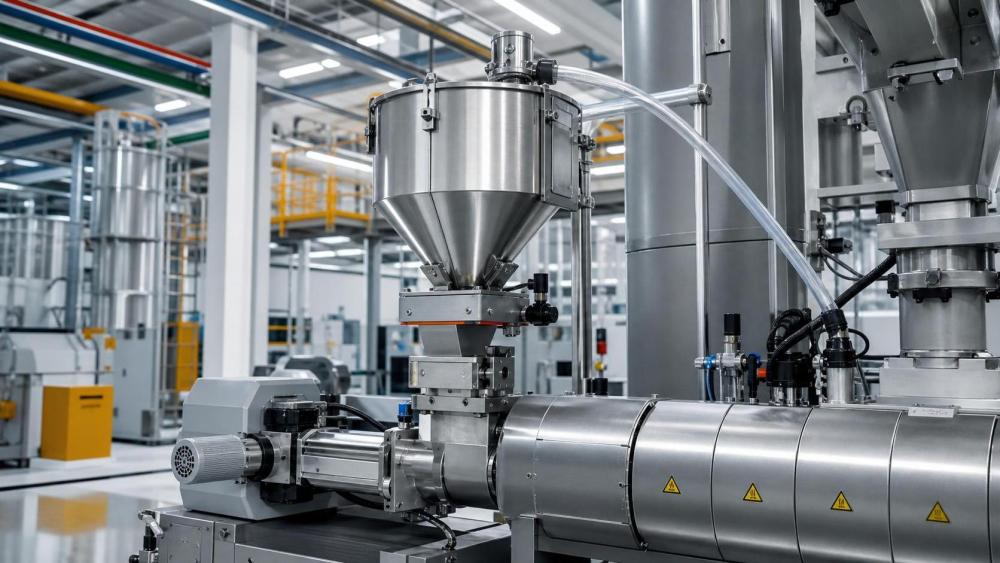
Gravimetric feeding systems for continuous dosing sit at the center of stable extrusion and compounding performance.
When dosing drifts, formulation quality moves with it. Throughput, melt behavior, and final part consistency can all change fast.
That is why setup matters as much as feeder selection. Good equipment still underperforms when installation, calibration, or material handling are weak.
In practical operations, continuous dosing accuracy is not one setting. It is the result of mechanics, controls, bulk density behavior, and disciplined maintenance.
For plants handling engineering plastics, recycled polymers, additives, fillers, or color masterbatch, small errors can become expensive scrap or unstable output.
This guide focuses on how to improve gravimetric feeding systems for continuous dosing with setup choices and accuracy tips that hold up on real production lines.
Why Accuracy in Continuous Dosing Matters
Gravimetric feeding systems for continuous dosing measure material by weight over time, not only by screw speed or volume.
This makes them more reliable than volumetric methods when bulk density changes during production.
The business impact is direct. Accurate dosing supports tighter formulation control, lower raw material loss, and fewer quality claims.
It also helps stabilize downstream variables such as melt pressure, motor load, pellet appearance, sheet thickness, or film gauge.
More importantly, accurate continuous dosing protects decision-making. Teams can troubleshoot with confidence when feed data reflects real material flow.
Without that, operators often chase false causes, changing temperatures, screw speeds, or formulations when the feeder is actually the problem.
Start with the Right System Configuration
Not every gravimetric feeder fits every material. Resin shape, flowability, moisture sensitivity, and target rate all shape the best configuration.
Free-flowing pellets may run well in a standard single-screw feeder. Powders, flakes, glass fiber, and regrind often need more specialized handling.
A poor match creates refill shock, bridging, rat-holing, pulsation, or inconsistent discharge. All of these reduce continuous dosing accuracy.
During project planning, review these points before installation:
- Material form: pellet, powder, granule, flake, fiber, or blend
- Target throughput range and turndown requirement
- Feeder screw type and agitation need
- Hopper geometry and refill design
- Integration with extrusion or compounding control logic
- Expected cleaning frequency and material changeover time
A well-matched gravimetric feeding system for continuous dosing starts with material behavior, not with catalog capacity alone.
Installation Details That Affect Feeder Performance
Installation errors are a common reason why gravimetric feeding systems for continuous dosing fail to reach expected accuracy.
Load cells must measure only feeder mass change. They should not carry hidden force from piping, cable tension, or rigid upstream connections.
Vibration is another frequent issue. Nearby motors, platforms, or material transfer devices can distort the weight signal.
In actual plants, this often appears as noisy readings, unstable control output, or unexplained rate oscillation.
Use this installation checklist:
- Mount the feeder on a rigid, level structure.
- Isolate it from external vibration sources.
- Use flexible connections for inlet and outlet interfaces.
- Keep electrical grounding stable and noise low.
- Protect the feeder from air drafts around the weighing frame.
These steps look simple, but they strongly influence whether continuous dosing data is trustworthy enough for production control.
Calibration Practices That Improve Dosing Accuracy
Calibration should never be treated as a startup formality. It is a routine control task for gravimetric feeding systems for continuous dosing.
Zero drift, span error, and refill disturbance can all reduce dosing accuracy over time.
The better approach is to define a repeatable calibration schedule tied to material criticality and production risk.
Good practice usually includes:
- Verifying zero before each production campaign
- Checking load cell response with certified test weights
- Confirming rate output against actual collected material mass
- Reviewing refill compensation settings after recipe changes
- Recording results in a maintenance and quality log
One useful tip is to calibrate near the real operating range. A feeder tested far from production conditions may still drift during live dosing.
That matters even more for low-rate additives, where a small absolute deviation becomes a large formulation error.
Material Behavior Is Often the Hidden Variable
Many dosing issues come from the material, not from the controller. Gravimetric feeding systems for continuous dosing still depend on stable material presentation.
Powders can compact. Recycled flakes can interlock. Glass fiber can bridge. Hygroscopic materials can change flow after moisture pickup.
Even pelletized compounds may separate if blends have different size, shape, or density.
To improve continuous dosing stability, check these material-side controls:
- Drying conditions and moisture control
- Consistent upstream blending quality
- Proper hopper refill timing and refill volume
- Agitation or flow aids for poor-flow materials
- Screening out oversized contamination or stringers
From a project perspective, this means feeder accuracy should be reviewed together with material preparation and storage design.
Control Settings and Refill Strategy
A well-installed feeder can still perform poorly if the control loop is badly tuned.
Gravimetric feeding systems for continuous dosing rely on stable signal filtering, smart refill logic, and rate correction that fits process dynamics.
If filtering is too aggressive, the system reacts slowly. If it is too loose, the output chases noise.
Refill events deserve special attention. Weight gain during refill interrupts normal loss-in-weight measurement, so compensation logic must be validated.
Useful tuning questions include:
- Is refill frequency too high for the hopper size?
- Does refill create surges or compact the material bed?
- Is the feeder controller synchronized with extruder speed control?
- Are alarms set at realistic limits for rate deviation?
When these settings are aligned, continuous dosing becomes easier to predict and easier to scale across multiple lines.
Common Accuracy Problems and Fast Diagnostics
Most plants see the same failure patterns in gravimetric feeding systems for continuous dosing. The key is diagnosing them without wasting production time.
Fast diagnosis works best when feeder data, operator notes, and product quality results are reviewed together, not in isolation.
A Practical Operating Standard for Better Results
The most reliable gravimetric feeding systems for continuous dosing are usually supported by a simple operating standard.
That standard does not need to be complex. It needs to be repeatable across shifts, materials, and lines.
A strong baseline includes pre-start checks, refill rules, calibration intervals, cleaning points, and alarm response steps.
It should also define when dosing deviation requires intervention, and who owns the decision in production.
For growing operations, this is where gravimetric feeding systems for continuous dosing become a process capability, not only a machine feature.
A practical next step is to audit one line, compare actual feeder accuracy with target recipe tolerance, and close the biggest gap first.
That approach improves formulation control, supports more stable throughput, and builds better confidence in every continuous dosing decision.
Have questions about this sector analysis, or seeking best practices specific to your niche? Drop us a line below and let the senior consultants at APIM assist you.
We respect your privacy. Your information is strictly confidential.
Related News
- 00
0000-00
NAPCOR Report: US PET Bottle Recycling Rate Fell to 29% in 2025 - 00
0000-00
How does washing affect contamination in post-consumer recycled PP resins? - 00
0000-00
How does feedstock affect depolymerization equipment selection? - 00
0000-00
US Sets 213.44% Preliminary Antidumping Deposit on Chinese PTMEG - 00
0000-00
When should epoxy be used as a thermal interface material for semiconductors?