




Conductive Polymer Compounds: Key Trade-Offs in Processing and Performance
Why conductive polymer compounds matter now
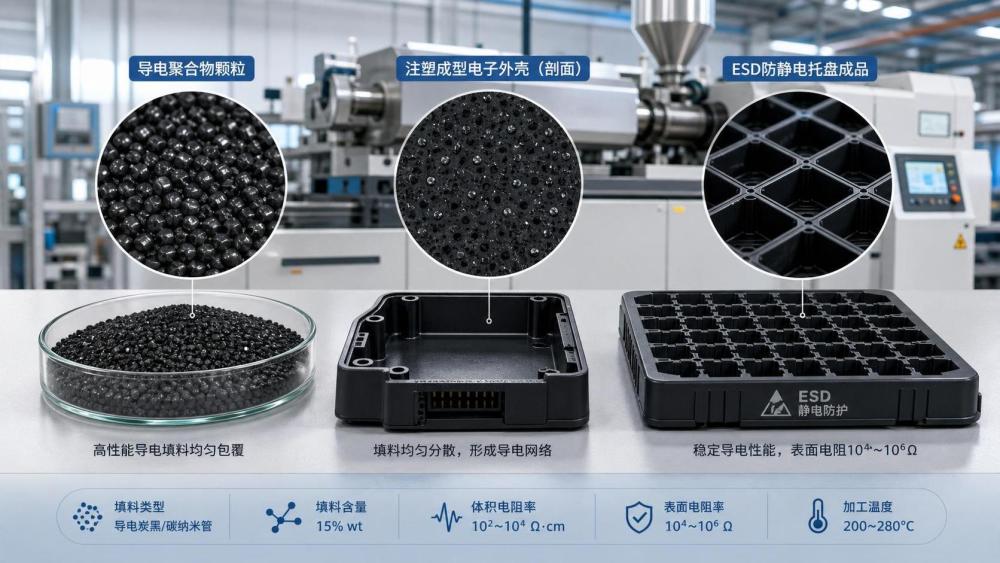
Conductive polymer compounds sit at the intersection of electrical function and manufacturable plastic design.
They are no longer niche materials used only in specialist electronics.
They now appear in automotive housings, ESD trays, connectors, sensors, films, industrial equipment parts, and battery-related components.
The appeal is easy to understand.
A plastic part can reduce weight, support part integration, simplify geometry, and still deliver controlled conductivity or static dissipation.
That combination matters when products must meet electrical targets without giving up cost discipline or production efficiency.
For many industrial programs, the real question is not whether conductive polymer compounds work.
The harder issue is how much electrical performance can be achieved before processing, strength, surface quality, or consistency starts to suffer.
That trade-off is why this topic deserves close attention across advanced materials, compounding, extrusion, and downstream converting.
What these materials really are
In simple terms, conductive polymer compounds are base resins modified with conductive fillers.
The resin may be PP, PA, ABS, PC, PBT, TPU, PEEK, or another engineering polymer.
The filler may be carbon black, carbon fiber, carbon nanotubes, graphene, metal powder, or hybrid additive packages.
Electrical behavior depends on whether those fillers form a stable conductive network inside the polymer matrix.
That sounds straightforward, but the structure is sensitive.
Small changes in filler loading, dispersion, shear history, and part orientation can shift resistivity by orders of magnitude.
This is why APIM often frames material selection as a system decision rather than a resin-grade decision.
The compound, the process window, the equipment setup, and the final application all interact.
Three common conductivity targets
Not every application is trying to create a highly conductive plastic.
A compound that is ideal for static dissipation may not be suitable for shielding or precision sensing.
Where the main trade-offs begin
The first trade-off is usually between conductivity and mechanical balance.
As conductive filler content rises, resistivity often improves.
At the same time, elongation, impact resistance, weld line strength, and surface appearance may decline.
The second trade-off appears in processing.
Many conductive polymer compounds become more viscous than unfilled resins.
That can raise injection pressure, complicate thin-wall filling, and narrow the operating window for extrusion or molding.
The third trade-off is economic.
High-performance fillers such as nanotubes or specialty carbon systems may lower loading levels.
But they can also raise raw material cost and increase sensitivity to compounding quality.
More importantly, cost should be judged at part level, not only at kilogram level.
A more expensive compound may still win if it reduces coating steps, grounding hardware, or assembly complexity.
Filler choice changes everything
Carbon black remains widely used because it offers a practical balance of conductivity and cost.
It is common in ESD packaging, industrial housings, and molded parts where black color is acceptable.
Carbon fiber can add stiffness while contributing conductivity.
That can be useful in structural parts, although anisotropy becomes a real concern.
Nanotubes and graphene attract attention because they may reach conductivity at lower loadings.
Lower loading can preserve toughness, lower weight gain, and improve dimensional control.
Still, these systems demand strong dispersion control and supplier consistency.
Metal-filled systems can deliver strong conductivity or shielding performance.
However, they often bring higher density, corrosion considerations, and more difficult wear conditions for equipment.
A useful selection lens
- Choose the lowest conductivity level that still meets the real application target.
- Check whether stiffness, impact, or cosmetic quality matters more than absolute resistivity.
- Review whether black color, fiber print-through, or surface roughness is acceptable.
- Assess the compound in the intended process, not only from supplier datasheets.
Processing is often the hidden performance variable
In practice, two parts molded from the same pellet can show different electrical results.
The reason is that conductive networks are shaped during processing.
Screw design, shear intensity, melt temperature, residence time, feeder stability, and moisture control all matter.
In twin-screw compounding, dispersion must be strong enough to distribute the filler.
Yet excessive shear can shorten fibers or damage conductive structures.
In injection molding, gate design and flow path can orient filler in ways that change local conductivity.
In film and sheet extrusion, thickness uniformity and cooling profile can affect both electrical and surface behavior.
This is where APIM’s focus on compounding and extrusion technology becomes especially relevant.
Material intelligence is more useful when it connects formulation design with equipment realities.
Process checkpoints worth validating
- Lot-to-lot resistivity variation after actual molding or extrusion
- Melt flow behavior under production temperatures
- Tool wear, screw wear, and filtration impact
- Surface defects, streaking, and gloss reduction
- Electrical stability after aging, humidity, or thermal cycling
Application value depends on the end-use context
Automotive programs often use conductive polymer compounds for sensor housings, fuel-system parts, battery-related structures, and interior electronics protection.
Here, weight reduction and assembly simplification are usually as important as conductivity.
In electronics, ESD trays, connector parts, device housings, and shielding elements often demand tighter dimensional stability and cleaner surfaces.
In industrial equipment, wear, oils, cleaning agents, and continuous duty may matter more than appearance.
Conductive films and sheets bring another set of decisions.
Optical quality, haze, thickness tolerance, and surface treatment can compete directly with conductive performance.
That is why a compound should be judged against the application environment, not against a generic conductivity benchmark.
How to evaluate a compound without missing the real risks
A narrow lab result can be misleading.
A better evaluation framework combines electrical data, processing behavior, and durability checks.
This broader view is especially important when qualification timelines are tight or downstream changes are expensive.
A practical next step
The strongest decisions around conductive polymer compounds usually start with a clearer specification.
Define the electrical window, the mechanical floor, the processing route, and the exposure conditions before comparing grades.
Then review filler type, dispersion strategy, and compounding quality with the same seriousness as price.
For many programs, the best path is to compare two or three conductive polymer compounds in actual production conditions, not only in lab plaques.
That approach makes trade-offs visible early.
It also creates a more useful basis for supplier discussions, equipment adjustments, and long-term material planning.
As conductive materials move deeper into automotive, electronics, films, and industrial systems, better decisions will come from linking formulation data with processing reality and application risk.
Have questions about this sector analysis, or seeking best practices specific to your niche? Drop us a line below and let the senior consultants at APIM assist you.
We respect your privacy. Your information is strictly confidential.
Related News
- 00
0000-00
How does washing affect contamination in post-consumer recycled PP resins? - 00
0000-00
How does feedstock affect depolymerization equipment selection? - 00
0000-00
US Sets 213.44% Preliminary Antidumping Deposit on Chinese PTMEG - 00
0000-00
When should epoxy be used as a thermal interface material for semiconductors? - 00
0000-00
US Midterm Results Unlikely to Quickly Shift Recycled Plastics Market or Legislation