




Carbon Fiber Conductive Polymers: Performance Limits in Real Applications
Carbon fiber conductive polymers sit at an important intersection of lightweight design, electrical performance, and manufacturability. They are often selected to replace metal in housings, brackets, covers, trays, and structural parts that also need controlled conductivity.
That promise is real, but application results are rarely defined by conductivity alone. Heat history, fiber orientation, resin choice, processing stability, and part geometry can all shift performance enough to change whether a program succeeds in production.
In practice, the most useful question is not whether carbon fiber conductive polymers work. It is where their limits appear, how predictable those limits are, and what tradeoffs emerge once lab data meets long-term operating conditions.
What the material really is
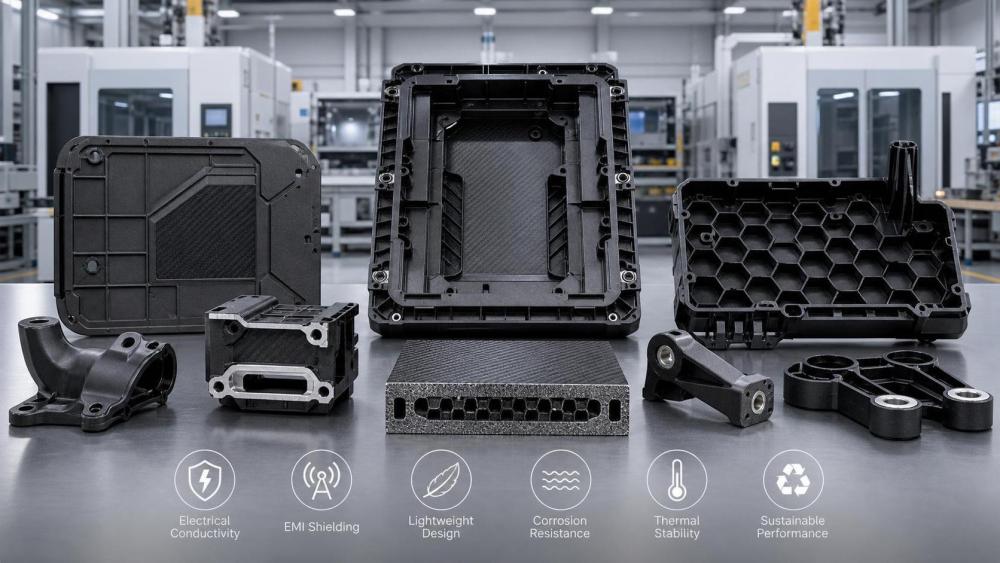
At a basic level, these materials combine a polymer matrix with carbon fiber to create a compound that can carry electrical charge better than standard engineering plastics.
The matrix may be PA, PBT, PC, PPS, PEEK, or other engineering resins, depending on thermal requirements, chemical exposure, stiffness targets, and processing route.
Carbon fiber does two jobs at once. It raises stiffness and reduces weight compared with metal alternatives, while also forming conductive pathways that support static dissipation or EMI shielding.
Simple descriptions can be misleading, though. Conductivity in filled polymers is not uniform like conductivity in solid metal. It depends on filler loading, dispersion, fiber length retention, and the connectivity of the internal network.
That is why two grades with similar datasheet numbers may behave differently after molding, machining, welding, or assembly.
Why the market keeps paying attention
Across automotive, electronics, industrial equipment, and specialty packaging, pressure is rising to reduce weight, simplify assembly, and manage electromagnetic interference without adding too many secondary operations.
Carbon fiber conductive polymers fit that direction because they can combine structural and electrical functions in one molded part. That can reduce fasteners, coatings, inserts, and shielding layers.
They also align with the broader shift that platforms like APIM track closely: advanced polymers are no longer niche substitutes. They are engineered materials competing on system value, process efficiency, and supply chain practicality.
More attention is going to compounds where formulation design, extrusion quality, and downstream processing have direct business impact. Conductive compounds are a clear example of that shift.
Where performance limits usually appear
The first limit is usually electrical consistency. Conductivity can look stable in a plaque sample yet drift in complex parts with ribs, weld lines, thin walls, or changing flow paths.
The second limit is thermal aging. Elevated temperature can change the polymer matrix, alter internal stress, and affect the conductive network over time, especially near the upper continuous-use range.
The third limit is mechanical compromise. Higher fiber loading may improve conductivity and stiffness, but it can also reduce elongation, impact resistance, and surface quality.
Then there is process sensitivity. Shear history during compounding and molding can shorten fibers, change orientation, and weaken the conductive path that the formulation depends on.
This is where technical evaluation becomes more demanding. A promising grade may fail not because the chemistry is wrong, but because the process window is too narrow for production variation.
The hidden effect of anisotropy
Carbon fiber conductive polymers are often anisotropic. Electrical and mechanical properties can differ sharply between flow direction, transverse direction, and thickness direction.
That matters in EMI shielding covers, battery system components, sensor housings, and ESD-safe fixtures. A part may pass one orientation-based test while underperforming in the actual use position.
How application value changes by use case
The value of carbon fiber conductive polymers depends heavily on what conductivity is expected to do. Static dissipation, signal protection, and shielding are not the same requirement.
In other words, the same compound can be strong value in one application and poor value in another. Selection logic should start from failure mode, not from filler type alone.
Processing is often the deciding factor
For conductive compounds, process history is part of the material. Twin-screw compounding quality influences dispersion, fiber breakage, volatile control, and pellet consistency before molding even begins.
During injection molding or extrusion, temperature profile, screw design, residence time, gate location, and cooling rate shape the final conductive network.
That is why APIM’s broader focus on compounding and extrusion matters here. Equipment configuration and process control are not background issues. They directly affect whether a conductive polymer performs as promised.
- Over-shear can cut fiber length and reduce conductivity.
- Poor drying can damage hydrolysis-sensitive resins and shift mechanical properties.
- Inconsistent feeding can change filler distribution from batch to batch.
- Tool design can localize weak electrical zones in critical areas.
When evaluation data does not include process details, the numbers should be treated carefully.
What to verify beyond the datasheet
Datasheets are useful for screening, but they rarely capture the full risk profile of carbon fiber conductive polymers in real applications.
A more reliable review usually includes these checkpoints:
- Volume resistivity and surface resistivity after molding, not only pellet-based values.
- Mechanical retention after heat aging, humidity, chemical contact, and thermal cycling.
- EMI or ESD performance at part level, including joints, fasteners, and assembly features.
- Dimensional stability, warpage, and shrinkage behavior in actual geometry.
- Batch-to-batch consistency from the intended production source.
- Secondary process effects such as painting, bonding, laser marking, or welding.
These checks are especially important when comparing conductive grades based on PA, PPS, PBT, or high-temperature polymers, because the matrix changes both processability and durability.
Cost, supply, and sustainability are part of the limit
Performance alone does not close a selection decision. Carbon fiber conductive polymers often carry higher raw material cost than mineral-filled or carbon black-based alternatives.
That premium may still be justified if the part consolidates functions, reduces shielding layers, shortens assembly, or improves system-level reliability. The business case depends on total design impact.
Supply chain readiness also matters. Carbon fiber type, resin platform, compounding capability, and regional availability can influence lead time, approval cycles, and long-run sourcing security.
Sustainability adds another layer. Recyclability, regrind tolerance, and traceability are becoming more relevant, but conductive compounds can be harder to standardize in circular material streams than unfilled polymers.
This does not remove them from consideration. It simply means selection should include end-of-life and material recovery logic early, especially for large-volume programs.
A practical path for evaluation
A sound review starts by defining the exact electrical function. Is the requirement static dissipation, shielding, grounding continuity, or signal-sensitive protection?
Then map the mechanical and environmental load. Temperature range, vibration, humidity, fluid contact, wear, and service life often decide whether carbon fiber conductive polymers remain stable enough.
After that, test the real geometry with the intended process. Small plaques rarely reveal every issue that appears in molded features, assembly interfaces, or long flow paths.
It is also worth comparing at least one adjacent option, such as carbon black compounds, metallized plastics, stainless inserts, or hybrid structures. Limits become clearer when the benchmark is realistic.
For teams tracking material strategy through platforms like APIM, the useful next step is to build a short evaluation matrix that links formulation, process window, part design, and lifecycle risk. That turns carbon fiber conductive polymers from an attractive concept into a measurable decision.
Have questions about this sector analysis, or seeking best practices specific to your niche? Drop us a line below and let the senior consultants at APIM assist you.
We respect your privacy. Your information is strictly confidential.
Related News
- 00
0000-00
Do polyolefin hot melt adhesives bond well to polyethylene? - 00
0000-00
Korean Study Finds PLA Barely Degrades in Landfill After 320 Days - 00
0000-00
How to assess batch consistency from a thermal potting compounds supplier - 00
0000-00
How much weight can carbon fiber reinforced plastics save in cars? - 00
0000-00
Switching from PS to ABS Sheet Extrusion: Equipment Checks