




Supercritical CO2 Foaming for Automotive: Weight Reduction Limits and Process Trade-Offs
Supercritical CO2 foaming for automotive has moved from niche processing research into practical lightweighting discussions. Interest is rising because every gram matters, yet part programs still live or fail on durability, cost, tooling discipline, and stable output.
In simple terms, the process uses carbon dioxide above its critical state as a physical blowing agent. Dissolved gas expands during molding, creating a controlled cellular structure inside the polymer melt.
That sounds straightforward, but implementation is rarely simple. Density reduction can improve material efficiency and support emissions targets, while also introducing trade-offs in stiffness, surface quality, weld-line behavior, and dimensional control.
For companies tracking advanced polymers, modified compounds, and production technologies, this topic sits at the intersection of materials science, process engineering, and commercial decision-making. That is why supercritical CO2 foaming for automotive deserves a closer, more operational reading.
Why the technology is getting renewed attention
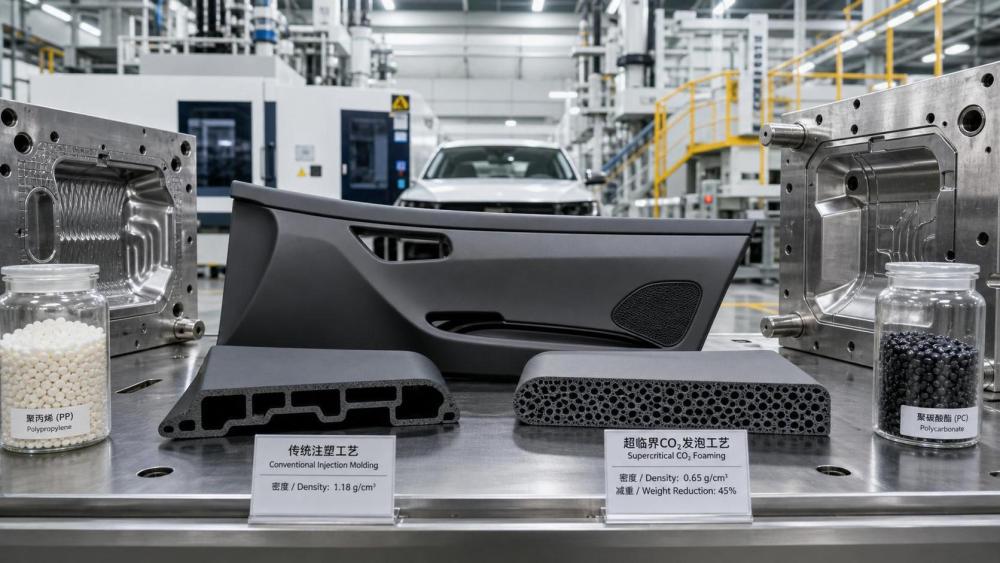
Automotive programs are under pressure from several directions at once. Weight reduction remains important for fuel economy, battery range, and lifecycle carbon performance, but material inflation and supply risk have made resin usage just as sensitive.
Supercritical CO2 foaming for automotive is attractive because it can reduce part density without switching to an entirely new material family. In some cases, that means keeping known polymers, known suppliers, and familiar downstream validation methods.
The method also fits a broader trend covered across APIM’s materials and processing focus. Lightweighting is no longer only about replacing metal with plastic. It is also about getting more function from each kilogram of polymer.
More importantly, project decisions now connect material performance with manufacturing discipline. A lighter part that creates higher scrap, unstable cell morphology, or difficult cosmetic control may weaken the total business case.
What supercritical CO2 foaming changes inside the part
The core change is internal structure. Instead of a fully solid cross-section, the molded part contains fine cells that lower density while changing how the material carries load, transfers heat, and shrinks during cooling.
This matters because automotive parts are rarely judged on weight alone. Door carriers, instrument panel supports, trim backings, ducting, battery-adjacent components, and underbody shields all have different priorities.
Cell size, cell uniformity, skin thickness, and gas distribution influence whether the final part stays dimensionally stable. They also affect surface appearance, local impact response, screw retention, and long-term fatigue behavior.
From a polymer perspective, supercritical CO2 foaming for automotive can be applied to several engineering and commodity resin systems. Results, however, vary sharply with melt strength, crystallization behavior, filler loading, and reinforcement type.
Material behavior does not stay linear
At low foaming levels, density may drop while performance remains acceptable. Push the weight reduction further, and the loss in stiffness or impact resistance can become too steep for structural or semi-structural applications.
That nonlinearity is where many assumptions fail. A ten percent density reduction does not guarantee that twenty percent is commercially sensible, even when the mold can physically produce the part.
Where the weight reduction limits usually appear
The practical ceiling depends on part geometry, resin family, reinforcement, and load case. For many interior and non-cosmetic applications, moderate reduction is realistic. Aggressive targets often expose hidden design or process penalties.
Several limit points appear repeatedly in automotive development:
- Mechanical thresholds, especially flexural stiffness and impact retention.
- Surface demands, including swirl marks, sink control, and paintability.
- Geometry sensitivity around ribs, bosses, thin-to-thick transitions, and insert areas.
- Tolerance windows for assembly interfaces and sealing surfaces.
- Acoustic or thermal requirements that can shift with foam morphology.
A useful way to read those limits is to separate headline weight savings from usable weight savings. The second number is what survives validation, launch timing, and line-rate pressure.
Process trade-offs that shape the business case
The phrase supercritical CO2 foaming for automotive often enters meetings through lightweighting goals, but the real decision sits inside process trade-offs. Those trade-offs affect launch risk as much as they affect grams saved.
Cycle time can improve in some applications because lower packing demand changes filling behavior. Yet this gain is not automatic. Additional tuning, gas management, and quality monitoring may offset part of that advantage.
Tooling is another variable. Existing molds may sometimes be adapted, but stable foaming performance often depends on gate design, venting strategy, pressure profile, and thermal balance. Retrofit assumptions should be tested early.
Then there is material selection. Filled PA, PP compounds, PC blends, and other engineered systems respond differently to dissolved gas. A formulation optimized for solid molding may not be optimized for microcellular processing.
Compounds matter as much as machines
APIM’s broader coverage of modified polymers is relevant here. Reinforcements, impact modifiers, flame retardants, mineral fillers, and recycled content all influence nucleation, melt strength, and final cell structure.
A project can underperform not because the foaming concept is weak, but because the compound was chosen for another process window. That is why resin data should be reviewed together with molding trials, not afterward.
Best-fit automotive applications
The strongest opportunities usually appear where moderate density reduction creates cumulative value across high volumes. Interior substrates, air management parts, covers, housings, semi-structural carriers, and selected EV components are common candidates.
Applications with low cosmetic visibility and manageable load paths tend to move faster. Parts with demanding Class A surfaces or highly concentrated fastening loads need a more cautious approach.
Supercritical CO2 foaming for automotive can also support sustainability strategies when it reduces virgin polymer use without creating new end-of-life complications. That said, lower mass alone does not guarantee a lower overall footprint.
Program teams increasingly compare foamed and solid options using a wider lens:
- Mass saved per vehicle platform, not per isolated part.
- Validation burden for crash, vibration, thermal aging, and chemical exposure.
- Impact on assembly joining, bonding, or fastening methods.
- Supplier capability across regions and launch volumes.
- Consistency of compound quality, dosing, and process documentation.
How to assess a program before scale-up
A disciplined evaluation starts with the part function, not with the foaming technology. If load cases, tolerance zones, and surface expectations are unclear, trial results become difficult to interpret.
The next step is to define acceptable density reduction ranges instead of a single aggressive target. This creates room to compare mechanical retention, warpage, cycle stability, and cost at several process points.
It also helps to align material and equipment suppliers early. In supercritical CO2 foaming for automotive, machine capability, gas delivery control, compound design, and mold behavior are tightly linked variables.
Several questions usually sharpen the decision:
- What is the maximum density reduction that still clears validation margins?
- Does the selected resin maintain enough melt strength across the real production window?
- Can the mold support repeatable cell structure at launch volumes?
- Will appearance, fastening, or sealing requirements force secondary design changes?
- Does the cost model include scrap, tuning time, and qualification effort?
A practical next step
The most useful way to approach supercritical CO2 foaming for automotive is to treat it as a platform decision, not a single-process upgrade. Material data, compounding behavior, tooling limits, and part economics have to be reviewed together.
For teams comparing advanced polymers and lightweight manufacturing routes, the next move is usually a structured candidate screen. Rank parts by density reduction potential, validation risk, surface sensitivity, and regional supply readiness.
From there, focused trials can reveal whether the promised savings remain intact under real production conditions. That is where the value of supercritical CO2 foaming for automotive becomes measurable, and where its limits become commercially visible.
Have questions about this sector analysis, or seeking best practices specific to your niche? Drop us a line below and let the senior consultants at APIM assist you.
We respect your privacy. Your information is strictly confidential.
Related News
- 00
0000-00
Do polyolefin hot melt adhesives bond well to polyethylene? - 00
0000-00
Korean Study Finds PLA Barely Degrades in Landfill After 320 Days - 00
0000-00
How to assess batch consistency from a thermal potting compounds supplier - 00
0000-00
How much weight can carbon fiber reinforced plastics save in cars? - 00
0000-00
Switching from PS to ABS Sheet Extrusion: Equipment Checks