




Why Does Polycarbonate Impact Strength Drop at Low Temperatures?
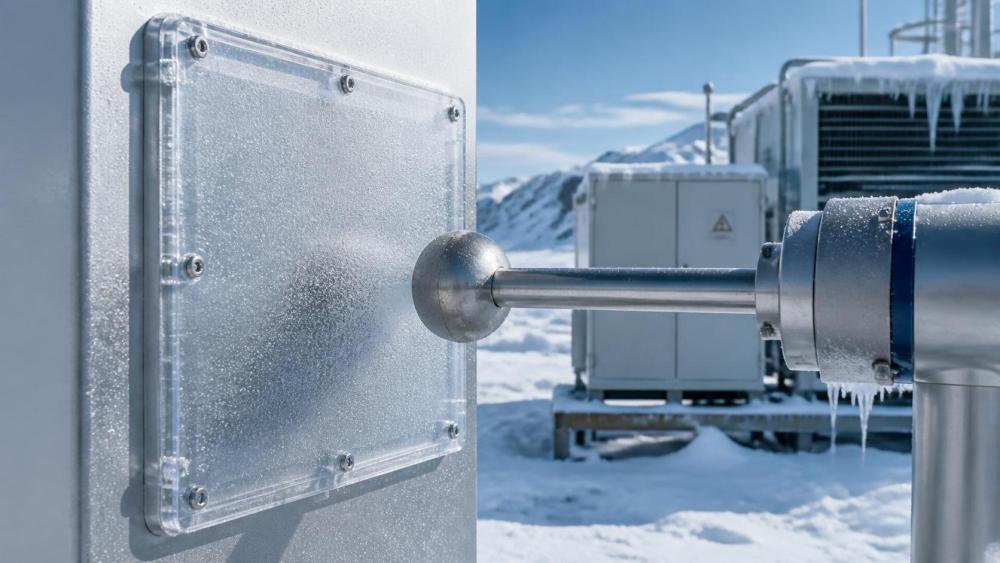
Polycarbonate sheet retains a reputation for high impact resistance because, at ordinary temperatures, it can deform and absorb a large amount of sudden energy before breaking. That behavior becomes less reliable in cold conditions. As temperature falls, the material’s molecular chains have less freedom to move, so an impact that would produce controlled deformation at room temperature is more likely to create a crack, whitening, or brittle fracture.
For an indoor guard, machine enclosure, display cover, or glazing panel used near room temperature, this change may have little practical consequence. For outdoor equipment, cold-room doors, transport housings, protective barriers, snow-region installations, or components exposed to winter handling, it can become a design issue. The question is not whether polycarbonate suddenly loses all toughness below a particular temperature. It is whether the specific grade, sheet structure, part geometry, and loading condition still provide an acceptable margin against impact at the lowest temperature the product will experience.
Why cold makes polycarbonate less able to absorb impact
Polycarbonate is an amorphous engineering thermoplastic. Its impact performance depends heavily on the ability of polymer segments to move locally when the material is struck. Under impact, those segments redistribute stress through yielding and deformation. This delays crack growth and allows the sheet to absorb energy rather than failing immediately.
Lower temperature reduces that local molecular mobility. The material becomes stiffer, and the stress created by a sudden blow is less easily dissipated through plastic deformation. Instead, stress concentrates around small defects, sharp corners, drilled holes, scratches, internal stresses, or restrained mounting points. Once a crack starts, the colder and stiffer sheet may offer less resistance to rapid crack propagation.
This is a gradual material response rather than a simple switch from “tough” to “brittle.” Polycarbonate has a glass-transition temperature well above many normal service temperatures, which is one reason it can remain useful in cold environments. Yet being below the glass-transition temperature does not mean impact behavior is constant. Impact strength is sensitive to temperature because the rate and mode of deformation change as molecular movement becomes more restricted.
The practical result is often a combination of higher apparent stiffness and lower tolerance for local damage. A cold PC sheet may resist a slowly applied load reasonably well while performing less favorably against a sharp, fast impact. That distinction matters because many field failures come from dropped tools, stones, forks, latches, loading equipment, or installation damage rather than from a uniform static load.
A room-temperature impact value is not a cold-service guarantee
One common mistake is to use a room-temperature data-sheet impact value as proof that a sheet is suitable for winter or refrigerated service. Standard impact-test results are useful for comparing materials, but they do not reproduce every application. Test method, specimen thickness, notch condition, impact speed, and conditioning temperature all affect the reported number.
Notched and unnotched tests are particularly different. An unnotched specimen primarily indicates the base resin’s resistance to sudden fracture under relatively favorable conditions. A notched specimen deliberately introduces a stress concentrator and can give a better indication of how sensitive the material may be to scratches, sharp edges, holes, or molded-in stress raisers. A sheet that appears highly impact resistant in an unnotched room-temperature test may show a much less generous safety margin when cold, notched, chemically exposed, or tightly constrained.
For a project that will see low temperatures, teams should request performance information at the intended service temperature or establish an application-specific test. A useful test condition should reflect the actual part as closely as possible: sheet thickness, fabrication method, edge condition, mounting pattern, expected impact location, impact mass, and temperature conditioning time. Testing a small coupon can be a screening step, but it should not replace checking the finished assembly when failure would affect safety, uptime, or compliance.
The grade of polycarbonate can change the answer
“Polycarbonate sheet” is a broad material description, not a complete specification. Different formulations can behave very differently at low temperature. A clear, general-purpose solid sheet, a UV-stabilized outdoor grade, a flame-retardant grade, a filled compound, a recycled-content formulation, and a multilayer sheet should not be assumed to have identical impact performance.
Additives and modifications can improve one required property while affecting another. Flame-retardant packages, pigments, fillers, surface coatings, and recycled feedstock may alter toughness, stress-cracking sensitivity, or batch-to-batch consistency. This does not make those materials unsuitable. It means their cold-impact behavior should be evaluated as a grade-specific property rather than inferred from the behavior of unmodified virgin PC.
Multilayer or coextruded sheet requires similar care. A protective cap layer may improve weathering resistance, while the core provides structural function. The final assembly still needs assessment for adhesion between layers, thermal contraction differences, edge exposure, and fabrication damage. Hollow or multiwall PC sheet introduces another variable: rib geometry can provide efficient stiffness and insulation, but the impact response depends on impact direction, support spacing, and whether a strike lands on a rib, a web, or an unsupported face.
Material documentation should state the exact commercial grade, thickness range, color or transparency option where relevant, and applicable test conditions. A generic statement that a product is “cold resistant” is insufficient for an application that must survive impact below a specified temperature.
Processing and fabrication can create a bigger problem than temperature alone
Cold temperatures often expose weaknesses that were introduced earlier in extrusion, thermoforming, machining, or installation. Residual stress is especially important for polycarbonate. If the sheet has experienced excessive forming stress, aggressive bending, unsuitable heating, sharp punching, or high local clamping force, it may contain regions where cracking can initiate more readily. At room temperature, the part may appear acceptable. In cold use, the reduced ability to redistribute stress can make the defect consequential.
Edges deserve close attention. Saw-cut edges, drilled holes, routed openings, and fastener locations can all become crack initiation sites if they are rough, sharply notched, or placed too close to an edge. A hole designed only around nominal fastener diameter may also become problematic when the sheet contracts in cold conditions but is prevented from moving by rigid hardware.
Good cold-service design generally allows for thermal movement, avoids over-tightened fasteners, uses suitable washers or gaskets where the assembly requires them, and keeps stress concentrations out of high-impact zones. Hole shape, edge finishing, corner radius, support spacing, and mounting sequence can matter as much as a modest difference in nominal resin impact strength.
Chemical exposure can further reduce the margin. Some cleaners, lubricants, sealants, fuels, and installation chemicals can promote environmental stress cracking in polycarbonate, especially where the sheet is already stressed. Cold weather may not be the sole cause of failure in such cases, but it can combine with residual stress, chemical contact, and impact loading to produce a result that a simple material data sheet would not predict.
How sheet geometry changes low-temperature risk
Thicker sheet is often assumed to be automatically safer, but impact performance is more complex. A thicker section can offer greater load-bearing capacity and may distribute an impact over more material. At the same time, thick sections can be less able to flex under a localized strike, depending on support conditions. A large unsupported panel may deflect and absorb energy, while a closely framed panel may transmit more of the impact into a constrained region.
Part geometry also determines whether impact leads to flexing, puncture, cracking, or failure at a mounting point. Consider a transparent machine guard. A centrally struck, unsupported area may behave very differently from the same sheet hit close to a cutout or bolt hole. Likewise, a vehicle-mounted panel may see combined vibration, temperature cycling, road debris impact, and rigid attachment. The relevant question is not simply “What is the impact strength of PC?” but “Where will the energy go in this assembled component at the coldest service condition?”
- Large, unsupported spans should be checked for cold deflection and edge loading, not just material breakage.
- Sharp internal corners and narrow ligaments around cutouts should be minimized where impacts are possible.
- Fastened panels need adequate clearance for thermal movement and should not be locked into a stressed condition.
- Edges exposed to repeated handling, pallet contact, or maintenance tools may need protection or a revised support detail.
- Impact zones should be separated from holes, seams, bonded joints, and abrupt thickness transitions where possible.
When lower-temperature impact performance deserves extra scrutiny
Some applications should trigger a more deliberate review before a PC sheet grade is released. These include outdoor glazing in climates with freezing conditions, covers for equipment transported in winter, guards in refrigerated facilities, agricultural or construction equipment, protective shields exposed to dropped objects, and enclosures that are opened, struck, or serviced while cold.
The risk is also higher when the consequences of breakage are serious. A cosmetic panel can tolerate a different level of uncertainty from a safety shield, electrical enclosure, viewing window around moving equipment, or panel protecting people from projected debris. For those uses, material selection should be tied to the applicable safety requirement and the finished-system test method, rather than to a general expectation that polycarbonate is “unbreakable.”
Repeated temperature cycling deserves consideration as well. A panel may not fail during its first cold exposure, yet repeated expansion and contraction can progressively load fasteners, seals, joints, or constrained edges. If the same part also sees UV exposure, moisture, cleaning agents, vibration, or surface abrasion, the retained impact performance over service life may be more relevant than the initial property of a new sheet.
What to ask before specifying or buying PC sheet for cold conditions
A focused technical discussion with the sheet supplier or fabricator is usually more productive than asking for a single “minimum operating temperature.” Start with the lowest expected material temperature, not merely the regional air temperature. A dark panel in sunlight, an insulated enclosure, a refrigerated interior, and a wind-exposed outdoor surface can reach different temperatures under the same weather conditions.
The final specification should define more than resin family and nominal thickness. It should identify the grade, required optical or surface properties, impact condition, fabrication limits, mounting requirements, and any retention testing needed after environmental exposure. That level of detail prevents a common handoff problem in which engineering assumes a high-toughness sheet while purchasing sources a broadly similar PC product with different formulation or certification boundaries.
Polycarbonate remains a strong option where transparent, lightweight, impact-resistant sheet is needed in demanding service. Low temperature does not automatically rule it out. It does, however, remove some of the forgiveness that makes PC attractive at room temperature. Treat cold impact as an assembly-level requirement, verify the exact grade under relevant conditions, and pay close attention to stress concentrators introduced by fabrication and mounting.
Have questions about this sector analysis, or seeking best practices specific to your niche? Drop us a line below and let the senior consultants at APIM assist you.
We respect your privacy. Your information is strictly confidential.
Related News
- 00
0000-00
How does washing affect contamination in post-consumer recycled PP resins? - 00
0000-00
How does feedstock affect depolymerization equipment selection? - 00
0000-00
US Sets 213.44% Preliminary Antidumping Deposit on Chinese PTMEG - 00
0000-00
When should epoxy be used as a thermal interface material for semiconductors? - 00
0000-00
US Midterm Results Unlikely to Quickly Shift Recycled Plastics Market or Legislation