




When Melt Filtration Equipment for Extrusion Solves Gels, Black Specks, and Downtime
When Melt Filtration Equipment for Extrusion Solves Gels, Black Specks, and Downtime
When gels, black specks, and unplanned stoppages disrupt production, melt filtration equipment for extrusion becomes a critical control point for operators.
The right filtration setup helps stabilize melt quality, protect downstream equipment, and reduce material waste.
Understanding how filtration affects pressure, throughput, and contaminant removal is essential for improving line efficiency and achieving more consistent extrusion results.
Why contamination turns into expensive extrusion problems
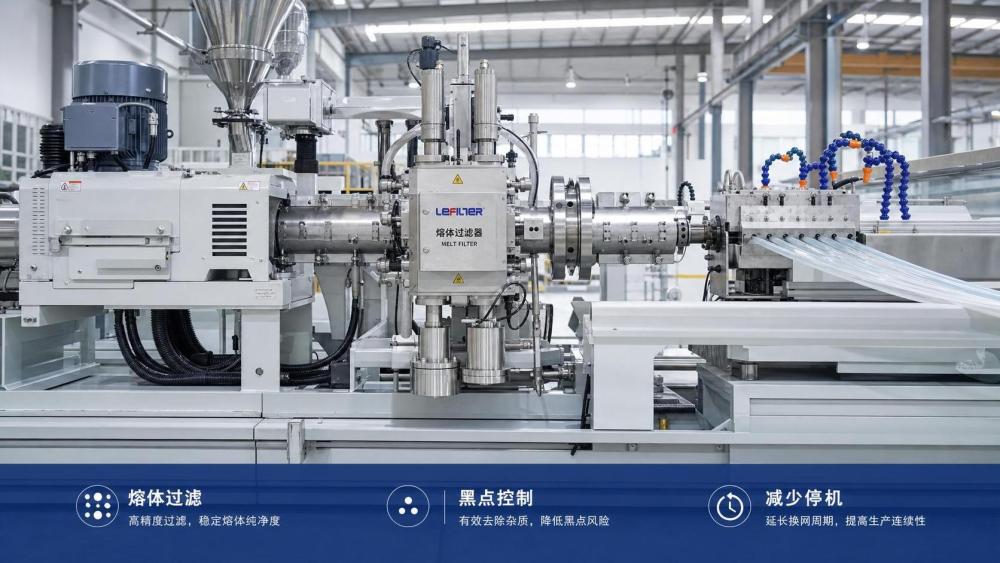
In extrusion, small contamination rarely stays small.
A few unmelted particles, degraded resin, carbonized residue, or foreign solids can quickly show up as visible defects.
That is where melt filtration equipment for extrusion starts to matter most.
Gels often come from crosslinked material, poor thermal history, or contamination carried in recycled feedstock.
Black specks usually point to degraded polymer, dead spots, burnt additives, or poor housekeeping around the line.
Downtime follows when screens plug too fast, pressure rises too far, or downstream quality complaints force stoppages.
In practical terms, operators feel these issues first through unstable pressure, die lines, changing appearance, and frequent screen changes.
The more demanding the product, the less tolerance there is for contamination.
Films, sheets, fibers, and precision profiles are especially sensitive.
This also means melt filtration equipment for extrusion is not just a cleaning tool.
It is a process stability tool, a quality control tool, and often a throughput protection tool.
How melt filtration equipment for extrusion actually solves the root issue
Good filtration removes contamination before it reaches the die, pelletizer, or downstream converting step.
That sounds simple, but the real value is broader.
Well-matched melt filtration equipment for extrusion keeps pressure more stable across the process window.
It reduces random defects that trigger customer complaints or operator intervention.
It also helps extend the life of dies, gear pumps, and other sensitive components.
Most systems work by forcing polymer melt through a screen pack, candle element, or continuous self-cleaning filter medium.
The filter captures solids larger than the selected micron level or mesh rating.
As contamination builds, differential pressure rises.
Once pressure reaches a limit, the screen is changed or the cleaning cycle begins.
The key is balance.
Finer filtration improves cleanliness, but it also increases pressure drop and may reduce output if the system is undersized.
That is why melt filtration equipment for extrusion should always be selected around material behavior, contamination load, and line targets.
What defects filtration can realistically reduce
- Gels caused by crosslinked fragments or poorly dispersed contamination
- Black specks from degraded resin or burnt deposits
- Hard particles that scratch dies or damage pumps
- Visible inclusions that reduce film, sheet, or profile quality
- Pressure spikes that create unstable output or shutdowns
Choosing the right melt filtration setup for the line
Not every line needs the same melt filtration equipment for extrusion.
A virgin engineering resin line has different needs from a recycled PE or filled PP line.
From recent market shifts, higher recycled content is making filtration decisions more important.
More variation in feedstock means contamination can change week to week, even lot to lot.
A good selection process usually starts with five questions.
- What contaminants are present: soft gels, carbon, paper, metal, wood, or degraded polymer?
- How sensitive is the final product to visible defects or pressure fluctuation?
- What throughput must the line hold during normal and peak production?
- How often can the line tolerate manual screen changes?
- How much pressure increase can the extruder and pump safely handle?
Single-plate screen changers are common for simpler operations.
Continuous screen changers help when stoppages are costly.
Backflush and self-cleaning systems are often better for heavily contaminated recycled streams.
For tight tolerance products, finer mesh may be justified, but only if residence time and pressure remain under control.
Quick comparison of common options
Operational signals that the filtration system is not doing its job
A line can keep running while the filtration setup is already underperforming.
That delay is where scrap and downtime quietly build.
Several warning signs usually show up before failure.
- Pressure rises faster than normal after each screen change
- Gels and black specks return soon after cleaning
- Throughput drops to hold pressure within limits
- Melt temperature drifts upward because of extra shear
- Screen life changes sharply between similar production runs
- Die buildup increases even after purge procedures
These signals do not always mean the filter itself is wrong.
Sometimes the real issue is upstream.
Poor drying, resin hang-up, barrel hot spots, additive separation, or screw wear can overload even good melt filtration equipment for extrusion.
That is why troubleshooting should follow the material path, not only the filter assembly.
Practical steps to reduce gels, black specks, and screen-related downtime
The fastest improvements usually come from disciplined operating routines.
Even strong melt filtration equipment for extrusion performs better with consistent process control.
- Track baseline pressure at fixed output, temperature, and resin grade.
- Set screen change limits by differential pressure, not by guesswork.
- Inspect removed screens to identify soft contamination versus hard particles.
- Review barrel temperatures and residence time when black specks increase.
- Check purge effectiveness in dead zones, adapters, and die entries.
- Align mesh selection with product quality needs, not with habit.
- Separate material lots when contamination levels vary significantly.
- Verify that seals, breaker plates, and screen packs are installed correctly.
In real production, these small controls often outperform major line changes.
A stable routine also gives cleaner data for deciding whether upgraded melt filtration equipment for extrusion is justified.
When an upgrade makes financial sense
Not every contamination problem needs a new machine.
But some conditions clearly support an upgrade.
One strong signal is rising recycled content paired with tighter quality demands.
Another is frequent manual intervention on a line that should be continuous.
If screen changes are reducing effective output, the hidden cost is usually larger than expected.
The same applies when scrap, customer claims, or die maintenance remain high.
A better melt filtration equipment for extrusion setup can improve usable throughput, product appearance, and maintenance intervals at the same time.
That broader return is often what makes the investment work.
Questions to ask before upgrading
- What defect rate is directly linked to contamination?
- How much production time is lost during screen changes or cleaning?
- What pressure range is acceptable for the current screw and pump design?
- Will future materials contain more recycled or filled content?
- Is the target product moving toward tighter optical or surface standards?
A smarter filtration strategy starts with line evidence
Melt filtration equipment for extrusion works best when it is treated as part of the full process, not as an isolated accessory.
The most reliable approach is to connect defect patterns, pressure history, material behavior, and maintenance records.
That evidence shows whether the line needs a mesh adjustment, a cleaning routine change, or a different filtration technology.
When the fit is right, melt filtration equipment for extrusion reduces gels, limits black specks, protects output, and makes the whole extrusion line easier to run.
Start with measurable signals, tighten operating discipline, and upgrade only where the data shows clear value.
Have questions about this sector analysis, or seeking best practices specific to your niche? Drop us a line below and let the senior consultants at APIM assist you.
We respect your privacy. Your information is strictly confidential.
Related News
- 00
0000-00
How does washing affect contamination in post-consumer recycled PP resins? - 00
0000-00
How does feedstock affect depolymerization equipment selection? - 00
0000-00
US Sets 213.44% Preliminary Antidumping Deposit on Chinese PTMEG - 00
0000-00
When should epoxy be used as a thermal interface material for semiconductors? - 00
0000-00
US Midterm Results Unlikely to Quickly Shift Recycled Plastics Market or Legislation