




What to Inspect Before Buying Used Plastic Sheet Extrusion Lines
A used sheet extrusion line can look serviceable on the plant floor and still become an expensive problem after installation. For procurement teams, the real question is not whether the line can run, but whether it can run your material, your output range, and your quality targets without turning maintenance and scrap into hidden costs. Inspection before purchase is where most of that risk can be reduced.
Plastic sheet lines are often traded because a factory changed product mix, closed a plant, or upgraded capacity. That creates opportunities, but also a common trap: buyers focus on the headline machine list and overlook wear points, control obsolescence, tooling condition, and the line’s fit with the intended application. A PP sheet line that was acceptable for basic packaging may not be suitable for thermoforming-grade output, tight thickness tolerance, or frequent material changes.
Start with process fit, not machine age
Before inspecting any line, define the production window you actually need. That means resin type, sheet width, thickness range, target output, roll structure if applicable, downstream handling, and quality expectations such as gauge consistency, clarity, surface finish, or flatness. Procurement errors often happen when a line is approved because the asking price is low, while the cost of modification is left vague.
A line designed for PP and PS may not be an efficient fit for PE-heavy production if screw geometry, heating capacity, die design, and cooling layout were optimized for different melt behavior. The same applies to ABS or multilayer structures. When reviewing used plastic sheet extrusion lines, the first filter should be whether the original line architecture matches the materials and end uses planned at your facility. If too many major changes are required, the line may stop being economical even if the base machine is mechanically sound.
Inspect the extruder where wear is most expensive
The extruder is the line’s core asset, and its condition cannot be judged from paint or cosmetic cleaning. Focus on components that directly affect melt quality, output stability, and future overhaul cost.
Screw and barrel condition
Ask for screw drawings if available, along with records of rebuilds, hardfacing, or replacement. Excessive wear on the screw flights or barrel inner wall reduces pumping efficiency and increases melt temperature variation. In practice, that can show up as unstable output, poor mixing, black specks, and difficulty holding thickness.
Visual inspection helps, but dimensional measurement is more useful. If dismantling is possible, check for scoring, corrosion, evidence of abrasive filler use, and nonuniform wear zones. A line that processed regrind, mineral-filled compounds, or flame-retardant materials may have significantly different wear patterns than one that ran clean virgin resin.
Gearbox and drive system
Listen for abnormal noise during operation and review lubrication condition. Oil contamination, overheating marks, or vibration can indicate bearing or gear wear. Replacement lead times for older gearboxes can be long, and retrofitting may affect alignment or motor compatibility. Check motor nameplate data against your site power supply and verify whether variable-frequency drives are current or nearing obsolescence.
Heaters, cooling, and temperature control
Sheet quality depends heavily on thermal stability. Inspect heater bands, thermocouples, cooling fans, and control zones for signs of patch repairs or inactive circuits. If several zones have been bypassed or manually compensated over time, the line may still run, but not predictably enough for demanding applications.
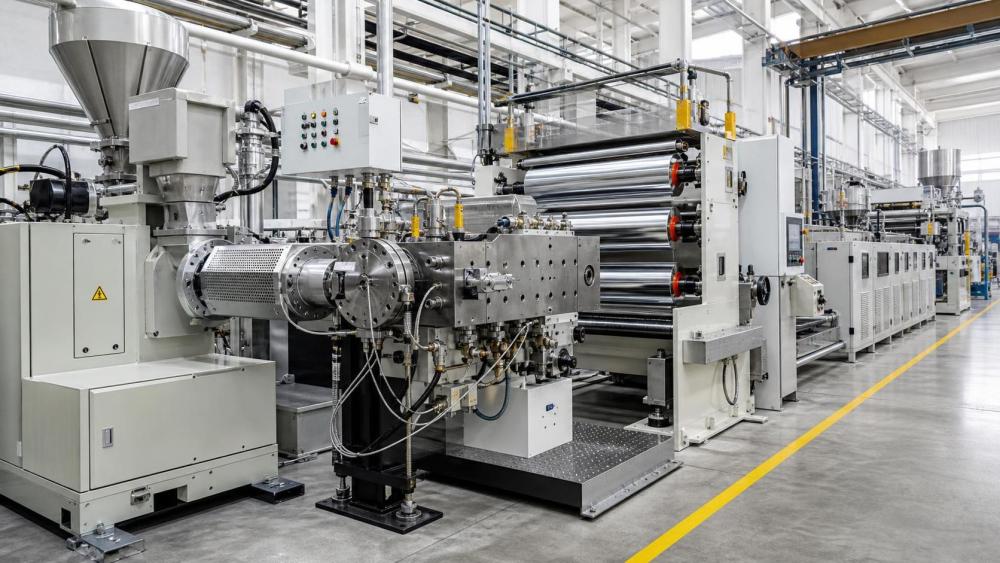
Check the die and screen-changing section with extra care
The die has a direct effect on thickness profile, edge stability, and surface quality. Repairs are possible, but they are not always cheap or fast, especially for wide sheet dies.
Die lips and adjustment system
Inspect the die lip faces for nicks, corrosion, resin buildup damage, and evidence of uneven polishing. Open and close any manual or automatic adjustment mechanism to confirm movement across the width. Frozen bolts, stripped threads, or nonresponsive thermal bolts can make profile tuning slow and inconsistent. If the line is intended for tight gauge tolerance, die condition deserves as much attention as the extruder itself.
Screen changer health
For lines handling regrind or contamination-sensitive applications, the screen changer is not a minor accessory. Check for leakage around the sealing areas, platen wear, hydraulic issues, and heating consistency. A poorly sealing screen changer can cause pressure instability, black specks, or safety concerns under load.
Evaluate the calender or polishing stack for product quality risk
On sheet lines, the roll stack often determines whether the final product is commercially acceptable. A line may produce output volume, yet still fail on gloss, thickness uniformity, flatness, or surface marks if the rolls and support systems are worn.
Roll surface and geometry
Inspect roll surfaces for scratches, pitting, plating damage, and repair marks. Ask whether the rolls have been reground and how many times. Reduced roll diameter after repeated regrinding can affect heat transfer and nip geometry. Also check whether all rolls are parallel and whether the adjustment mechanism moves smoothly without excessive backlash.
Temperature control and circulation
Roll temperature uniformity matters for sheet appearance and dimensional stability. Review the condition of rotary unions, piping, temperature controllers, and seals. Water leakage around the roll ends, unstable flow, or poor temperature response can lead to warpage, inconsistent gloss, or sticking.
Bearings, framing, and vibration
Look for signs of bearing heat, frame cracks, improvised shimming, or vibration during running. On older lines, mechanical looseness in the stack can become visible only under load. That is why a cold inspection should not replace a practical running test.
Do not treat the downstream section as secondary equipment
Many procurement reviews spend most of their time on the extruder and die, then assume the rest of the line is straightforward. In reality, trim handling, haul-off, cutting, winding, or stacking can become the source of frequent stoppages.
Check pull rolls, edge trim systems, guillotines, slitters, sheet stackers, and winders for alignment, guarding, and responsiveness. If your plant needs frequent size changes or batch flexibility, ease of adjustment matters almost as much as mechanical condition. A line that is difficult to set up will consume operator time and create inconsistent production between shifts.
Also confirm whether auxiliary units are included and usable: vacuum loading, dryers, chillers, molds for calibration where applicable, granulators for trim, and spare screens or heaters. Missing auxiliaries often appear manageable during quotation review but become immediate budget additions after the machine arrives.
Controls, electrical documentation, and spare parts exposure
Obsolete controls are one of the biggest hidden costs in older extrusion equipment. A line may run during demonstration, yet still pose long-term risk if drives, PLC hardware, HMI panels, or key sensors are no longer supported.
Ask for complete electrical drawings, software backup where relevant, and a clear list of replaced versus original components. Open the cabinets and inspect wiring condition, labeling discipline, heat damage, dust buildup, and evidence of repeated troubleshooting. Temporary jumpers, undocumented modifications, or mixed generations of components usually signal future service difficulty.
Procurement teams should also check local compliance requirements before shipment. Even when a used line is technically functional, guarding, emergency stops, lockout provisions, and electrical standards may need upgrading to fit the destination plant. That work should be priced before approval, not after commissioning delays begin.
Request a running trial that reflects your real operating window
If a live test is available, do not settle for a short demonstration at an easy output rate. A useful trial should show startup behavior, melt pressure stability, temperature control, output consistency, sheet profile across width, and response to parameter changes. If possible, inspect product samples at different thicknesses within the intended range.
During the trial, watch for:
- motor load that seems too high for the achieved output,
- unstable melt pressure or temperature drift,
- frequent manual correction at the die or roll stack,
- surface defects, gels, edge bead instability, or poor flatness,
- unusual vibration, oil leakage, or hydraulic hesitation,
- slow response when changing line speed or thickness settings.
If the seller cannot run the full line, ask why. Sometimes the reason is harmless, such as disconnected utilities after plant closure. Sometimes it indicates that the line cannot currently demonstrate performance. Those two situations should not be priced the same way.
Review the machine history like a risk document
A procurement decision is stronger when the inspection combines physical condition with operating history. Ask what materials were run, how many shifts the line operated, whether corrosive or abrasive compounds were processed, and which components have been rebuilt. Maintenance logs, spare parts lists, and prior service invoices can reveal whether the line was maintained methodically or repaired only after failure.
Plant environment matters too. Equipment stored indoors after decommissioning is generally less exposed than machinery left in humid or dusty conditions. Corrosion on frames may be superficial, but corrosion in electrical cabinets, hydraulic systems, or precision surfaces is more serious.
Separate purchase price from total acquisition cost
The lowest offer is rarely the lowest-cost project. Procurement teams should build a line-item estimate covering disassembly, loading, shipping, unloading, installation, utilities adaptation, control upgrades, wear-part replacement, tooling refurbishment, trial production, and commissioning support. For used plastic sheet extrusion lines, this full-cost view often changes the ranking of the options.
Build acceptance criteria before negotiation, not after delivery
One practical way to reduce disputes is to define acceptance criteria before the transaction is finalized. That can include the machine list, included auxiliaries, running condition at inspection, visible missing parts, agreed documentation, and the basis for any demonstration sample. If refurbishment or retrofit work is planned, the scope should be explicit. Procurement problems often start when assumptions stay verbal.
It also helps to identify which defects are acceptable and which are deal breakers. Cosmetic wear, old paint, or noncritical cover damage may be manageable. Barrel wear beyond tolerance, unsupported controls, severe die damage, or no verifiable test capacity usually carry much greater operational impact.
What matters most in the final decision
The best used line is not simply the newest one or the cheapest one. It is the one whose original design, current condition, documentation, and upgrade burden align with your plant’s material mix and quality requirements. A disciplined inspection should move from process fit to component condition, then to controls, history, trial performance, and total acquisition cost.
For procurement teams, that sequence makes the decision less about visible machinery and more about predictable production. If the line can be installed, supported, and run within your actual operating window, the used market can offer real value. If those checks are skipped, savings on purchase price can disappear into downtime, scrap, and corrective work very quickly.
Have questions about this sector analysis, or seeking best practices specific to your niche? Drop us a line below and let the senior consultants at APIM assist you.
We respect your privacy. Your information is strictly confidential.
Related News
- 00
0000-00
Do polyolefin hot melt adhesives bond well to polyethylene? - 00
0000-00
Korean Study Finds PLA Barely Degrades in Landfill After 320 Days - 00
0000-00
How to assess batch consistency from a thermal potting compounds supplier - 00
0000-00
How much weight can carbon fiber reinforced plastics save in cars? - 00
0000-00
Switching from PS to ABS Sheet Extrusion: Equipment Checks