




Used Sheet Extruder Inspection: Linking Wear, Output Stability and Cost
Why a Used Sheet Extruder Needs More Than a Visual Check
A used sheet extrusion line can appear well maintained while carrying wear that later shows up as unstable gauge, drifting melt pressure, poor surface finish, or unplanned downtime. For commercial evaluators, the central question is not simply whether the machine can run during a brief demonstration. It is whether its mechanical condition can support the intended resin mix, sheet specification, operating hours, and cost model after installation.
This matters particularly for PP, PE, ABS, and PS sheet operations, where material behavior, screen-pack condition, screw geometry, temperature control, and downstream speed all interact. A line that produces acceptable sheet using one material at reduced output may struggle when asked to process filled resin, regrind-containing blends, thin-gauge sheet, or a product requiring tight thickness consistency. The purchase decision should connect observed wear to likely operating consequences rather than treating component condition and production economics as separate subjects.
Inspection also needs to distinguish between normal age-related condition and defects that change the line’s usable value. Cosmetic deterioration, replacement heaters, and an older control interface may be manageable. A severely worn screw and barrel set, a damaged gearbox, or controls that cannot reliably regulate critical zones can alter output stability enough to affect customer commitments and working capital needs.
Wear Begins in the Plastication System
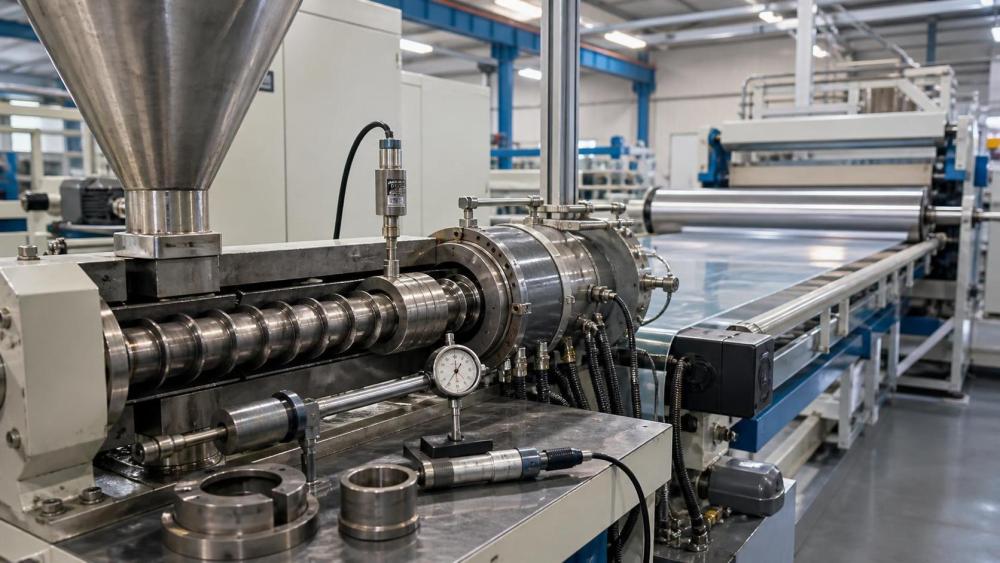
The screw and barrel are the most consequential inspection area because they determine how consistently the extruder conveys, melts, mixes, and pressurizes polymer. Their condition influences not only maximum throughput, but also the range of materials and process settings a buyer can use without creating excessive variation.
Wear commonly develops through continuous friction, abrasive fillers, contaminated regrind, poor material handling, extended operation at unsuitable temperatures, or inadequate lubrication and maintenance. The degree and location of wear matter. A machine may have acceptable flight condition near the feed section but excessive clearance in the metering zone, where pressure development and melt uniformity are especially important. Broad statements that a screw is “in good condition” provide limited decision value without an inspection method and supporting measurements.
What screw condition can reveal
An inspector should look for worn flight lands, reduced flight diameter, corrosion, scoring, pitting, cracking, material buildup, and evidence of past repair. Flight damage can reduce the screw’s ability to develop stable pressure. In practice, this may lead to greater output fluctuation, higher sensitivity to feed changes, and difficulty holding a consistent sheet profile. Local repairs are not automatically disqualifying, but they should be assessed for workmanship, geometry, and compatibility with the intended polymer.
Screw design should also be matched to the intended application. A general-purpose screw may process virgin commodity resin satisfactorily but deliver less predictable melting or mixing when the operation uses higher levels of regrind, color concentrates, additives, or material with variable bulk density. Buyers should request the known screw configuration, its diameter and effective length, and its prior material history where available. The previous production material can offer clues about likely wear, though it cannot replace measurement.
Why barrel clearance changes the cost picture
Barrel wear is often less visible than screw wear. Internal bore wear, especially in high-pressure zones, increases the clearance between screw flight and barrel wall. Polymer can slip backward rather than being conveyed forward efficiently. Operators may compensate by increasing screw speed or changing temperatures, but those adjustments can raise shear, melt temperature, energy use, and the risk of degradation.
For a buyer, the economic issue is rarely limited to the cost of replacing one component. If excessive clearance reduces stable throughput, the line may require more operating time for the same tonnage. If it causes gauge instability, more trim, off-spec sheet, or start-up waste may result. A barrel and screw refurbishment decision should therefore be assessed against the planned production schedule and margin on the target products, not merely against the asking price of a used machine.
Meaningful inspection usually involves measuring screw diameters and barrel internal dimensions at multiple positions, then comparing the resulting clearance with the original design information or a technically appropriate service limit. Exact acceptance criteria depend on machine design, polymer, output target, and product tolerance. A single measurement near the barrel opening does not establish the condition of the full processing length.
Output Stability Is a System-Level Result
Stable output is sometimes discussed as if it were a property of the extruder alone. In sheet production, it is a result of several connected systems: feeding, screw and barrel condition, heating and cooling, drive behavior, melt filtration, die condition, roll-stack control, and haul-off synchronization. A sound inspection sequence follows the material path from hopper to finished sheet.
At the inlet, check the feed hopper, throat cooling arrangement, feeder interface, and any material conveying equipment included with the line. Irregular feeding can resemble screw wear because both may create output variation. If the machine was operated with a gravimetric feeder, determine whether that feeder is included, functional, and compatible with the intended material. Where it is absent, the buyer should understand how material dosing will be controlled after commissioning.
Heating zones deserve more than a check that they turn on. Verify that each zone can reach and hold its setpoint, that thermocouples provide plausible readings, and that controllers respond when settings change. Failed fans, loose wiring, degraded insulation, or incorrectly positioned sensors can create temperature variation that only becomes evident during extended running. On a sheet line, uneven melt temperature can contribute to unstable flow across the die and make downstream adjustment more difficult.
Drive, gearbox, and pressure behavior
The main drive should be evaluated under load, not only at idle speed. Listen for abnormal gearbox noise, observe for vibration, and review lubrication condition where access permits. A drive that hunts or cannot maintain speed under changing load can show up as output inconsistency. Similarly, pressure readings should be interpreted in context. A stable melt pressure trend during a sustained run is generally more informative than a single displayed number.
Where a melt pressure transducer is fitted, verify that its reading changes logically with screw speed and screen-pack condition. A non-functioning sensor is not necessarily a reason to reject a line, but it removes an important process-control input and creates a replacement or integration task. Screen changers, breaker plates, and filtration arrangements should be inspected for leakage, damaged seating surfaces, seized mechanisms, and evidence that the line has been run with inadequate filtration.
A short run trial should include changes that expose control behavior: a moderate increase in screw speed, a hold period at intended operating conditions, and observation of pressure, motor load, melt temperature, and sheet appearance. The goal is not to demand a laboratory-grade qualification at the seller’s site. It is to identify whether the equipment reacts predictably or whether instability is being masked by low speed, a narrow operating window, or unusually favorable material.
Controls Can Determine Whether Mechanical Repairs Deliver Value
Older sheet extruders may have sound mechanical foundations but outdated electrical and control systems. This creates a different category of risk. A machine can be mechanically recoverable while remaining difficult to operate consistently if temperature zones, drive controls, alarms, and safety circuits are unreliable or poorly documented.
Control inspection should include cabinet condition, wiring quality, availability of electrical drawings, component obsolescence, controller operation, emergency-stop function, heater switching, cooling outputs, and communication between extruder and downstream equipment. Commercial evaluators should ask whether spare parts can be sourced without redesigning the panel. If a drive, PLC, or temperature controller is obsolete, the relevant comparison is not simply “old versus new.” It is whether a planned retrofit can be priced, scheduled, tested, and supported within the project timeline.
The practical scope of reconditioning used extruders often depends on this relationship between mechanical and electrical work. Restoring a screw, barrel, or gearbox may improve the core process, but the benefit can be limited if the controls cannot hold temperatures or maintain speed repeatably. Conversely, a control upgrade may provide useful diagnostics and consistency while leaving unresolved mechanical wear. The evaluation should treat these items as a coordinated reliability plan.
Reading Sheet Quality During a Demonstration
Finished sheet provides useful evidence, but it must be interpreted carefully. A clean-looking sample does not by itself prove that a line can meet ongoing production requirements. The sample may have been produced at a low rate, using virgin material selected for the demonstration, with extensive operator adjustment, or after a long stabilization period not reflected in the test.
When a trial is possible, buyers can inspect for visible gels, black specks, surface streaks, edge instability, waviness, and thickness variation across the width. They should also ask how long the line has been at steady state before the sample is taken. For applications where surface appearance or gauge tolerance is commercially sensitive, a sample should be associated with the actual resin grade, screw speed, die setting, line speed, and operating temperatures used during the run.
Build the Cost Model Around Usable Capacity
The lowest acquisition price is not always the lowest-cost route to capacity. A business evaluation should separate purchase price from restoration cost, installation cost, start-up loss, expected maintenance exposure, spare-parts needs, energy demand, and the output level that can realistically be sustained. A line that appears inexpensive may require enough repair work and production derating to lose its initial advantage.
Usable capacity is more informative than nameplate capacity. It reflects the output that can be maintained for the intended material and sheet specification while holding acceptable quality. If a worn extruder must run below its original capability to maintain pressure stability, a buyer should model the capacity at that reduced operating point. If downstream components impose the limit, replacing or upgrading the extruder alone may not solve the production constraint.
There is also a sequencing issue. Some repair work is easiest before shipment and installation, such as screw removal, barrel inspection, electrical cabinet modernization, and replacement of accessible heaters or sensors. Other work may need to wait until the line is installed and connected to site utilities. The proposal and purchase documentation should identify which work is included, who supplies major replacement components, how acceptance will be demonstrated, and what records will transfer with the machine.
A Practical Inspection File for Commercial Approval
A defensible approval process benefits from a structured inspection file rather than informal assurances. The file does not need to eliminate every uncertainty, but it should make uncertainty visible and assign a cost or contingency to it.
- Machine identification, configuration, known operating history, and the materials previously processed.
- Photographs and measurement records for the screw, barrel, gearbox, die, screen changer, and major downstream units.
- A list of missing, non-functional, obsolete, or untested components.
- Electrical drawings, manuals, available maintenance records, and details of any prior modifications.
- Run-test conditions, including material, operating duration, output setting, observed pressure behavior, and sample observations.
- A defined repair scope separating essential work from optional upgrades.
- Freight, installation, utility connection, commissioning, and operator-training assumptions.
- An acceptance plan tied to the buyer’s intended material and product requirements.
The strongest used-equipment decisions are made when mechanical wear, control capability, product quality, and financial exposure are considered together. A sheet extruder does not need to be in new condition to be commercially useful. It does, however, need a verified operating window and a restoration scope that matches the buyer’s actual production plan. Where that link is clear, the cost of wear can be estimated and managed; where it is unclear, apparent savings may rest on assumptions that only become visible after the line reaches the factory floor.
Have questions about this sector analysis, or seeking best practices specific to your niche? Drop us a line below and let the senior consultants at APIM assist you.
We respect your privacy. Your information is strictly confidential.
Related News
- 00
0000-00
Do polyolefin hot melt adhesives bond well to polyethylene? - 00
0000-00
Korean Study Finds PLA Barely Degrades in Landfill After 320 Days - 00
0000-00
How to assess batch consistency from a thermal potting compounds supplier - 00
0000-00
How much weight can carbon fiber reinforced plastics save in cars? - 00
0000-00
Switching from PS to ABS Sheet Extrusion: Equipment Checks