




Used PP Board Extrusion Line Prices: What Drives Equipment Costs
A low asking price for a used PP board extrusion line can disappear into refurbishment, missing auxiliaries and commissioning work. A higher-priced line may cost less to put into production if its tooling matches the intended board, its condition is documented and the sale includes the equipment needed to run it. The useful comparison is therefore the cost of producing acceptable board—not simply the price of acquiring the machinery.
There is no defensible universal price range without knowing the line configuration, condition, location and scope of supply. Buyers should treat advertised prices as starting points and compare offers against the same production specification. The main cost drivers are product compatibility, demonstrated output, component wear, tooling, controls, included equipment and the work required before production can begin.
Define the board before comparing equipment prices
“PP board” can describe products with substantially different production requirements. Solid polypropylene sheet, thick solid board, hollow-profile board and foamed board should not be treated as interchangeable applications. Their dies, calibration or cooling arrangements, downstream handling and process controls can differ. A line that produces acceptable thin sheet is not automatically suitable for thick board or hollow profiles.
Prepare a purchasing specification that identifies the required construction, finished width, thickness range, surface finish, dimensional tolerances and delivery format. Include the intended resin grade and whether production will use virgin material, internal regrind, purchased recycled material or a blend. These details give suppliers a basis for judging compatibility and prevent procurement teams from comparing fundamentally different machines.
Used sheet-extruder listings associated with Machinery Reborn cover a category described as PP, PE, ABS and PS equipment. That category is relevant to an initial equipment search, but the material names alone do not establish suitability for a particular PP board. Buyers still need the actual machine configuration, tooling details and evidence from an appropriate production trial.
Where alternative products are planned, distinguish essential capability from optional flexibility. Paying for multilayer equipment may be reasonable when separate surface and core formulations are required. It may add unnecessary complexity when the production plan calls only for a single-layer board.
Capacity matters only when it produces saleable board
Extruder size and stated output influence asking prices, but neither should be assessed in isolation. A throughput figure has limited purchasing value unless the seller identifies the material, product dimensions, operating conditions and quality achieved during the measurement.
The entire line must support the target output. The extruder supplies melt, while the die distributes it and the downstream equipment cools, shapes and transports the product. A cooling or haul-off limitation can prevent the buyer from using the extruder’s available capacity. Melt temperature, pressure and screw configuration also affect processing behavior; these relationships are discussed in Chris Rauwendaal’s Polymer Extrusion, fifth edition, Hanser, 2014.
Ask for a trial at a representative product specification rather than a demonstration chosen solely for maximum output. Record finished dimensions, acceptable production rate, rejected material, operating stability and the conditions used. If only thin sheet has been demonstrated, do not assume the same output will be available for a much thicker board.
A larger line can be a poor financial fit when orders are small or product changes are frequent. Buyers should compare expected utilization, changeover losses and startup scrap alongside capacity. Paying for output that the business cannot sell or consistently achieve does not improve the purchasing case.
Wear and maintenance history explain price differences
Two lines with similar nameplate specifications can have very different remaining service needs. Age is useful background information, but operating history and measured condition are more relevant to the refurbishment budget. A machine that has been maintained and stored properly may present fewer immediate problems than a newer line with incomplete records.
The screw and barrel deserve particular attention. Wear can change conveying and pressure-generation behavior, although its practical effect depends on the screw design, resin and operating conditions. Inspection should include dimensional measurements against available manufacturer specifications rather than relying on exterior appearance. Rauwendaal’s Polymer Extrusion provides technical background on screw geometry, clearances and extrusion performance.
The gearbox, bearings, lubrication system, heaters, temperature sensors and drives also require assessment. Oil leakage, unusual noise or inconsistent temperature control should trigger further investigation, not an automatic assumption that a minor repair will solve the problem. Ask for repair invoices, replacement dates and the reasons for major interventions.
Tooling and downstream condition can be just as consequential. Inspect die flow surfaces and adjustment mechanisms, roller surfaces and bearings where fitted, haul-off alignment, and cutting equipment. The inspection method should match the line type: a hollow-profile system requires attention to different forming and calibration components than a solid-sheet roller-stack line.
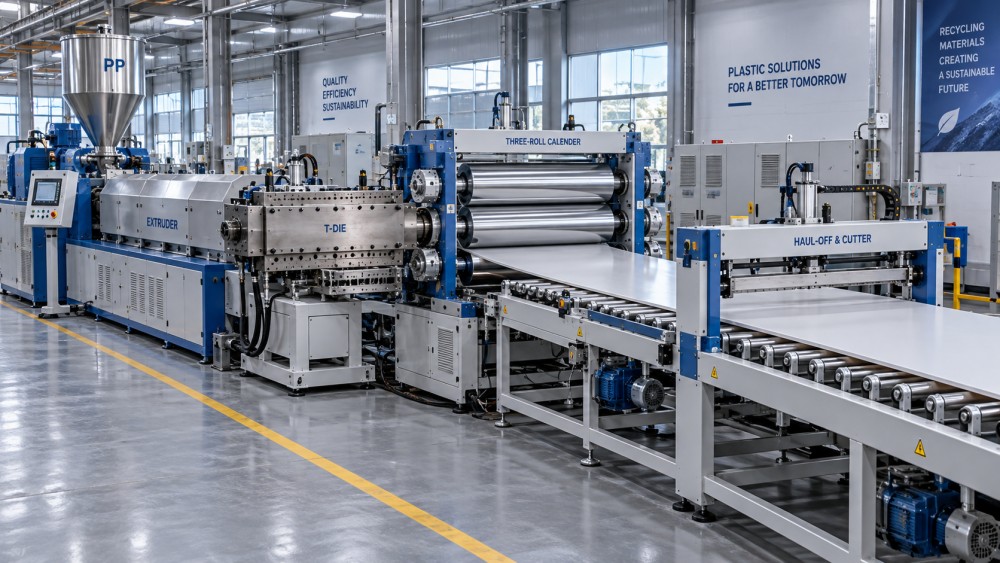
A cold inspection establishes completeness and reveals some mechanical issues. It cannot demonstrate stable processing. If the machine cannot run, price the offer as an unverified asset and obtain repair estimates before committing to a production schedule.
The die and downstream equipment can change the economics
A used extruder may be reasonably priced while the tooling needed for the buyer’s product makes the package expensive. Die width, usable thickness range, flow distribution and edge-trimming requirements all affect whether existing tooling is suitable. A wider die is not automatically more valuable if the business will routinely trim away a large proportion of the output.
For solid sheet and board, cooling and roll arrangements need to suit the intended thickness and finish. Hollow-profile production requires compatible profile tooling and forming equipment. Foamed products bring their own formulation and process requirements. Converting between these applications should be treated as an engineering project, not a routine tooling swap.
Multilayer lines introduce further questions: Are all extruders included? Does the feedblock suit the required layer arrangement? Are individual material feeds and controls complete? Missing components may make an apparently discounted multilayer package more expensive than a complete single-layer line that fits the immediate requirement.
Check downstream product handling as well. A line supplied with winding equipment may require different finishing arrangements for rigid board sold in cut lengths. Cutting, stacking and conveying costs belong in the comparison if they are necessary to deliver the specified product.
Compare the scope of supply, not the headline quotation
“Complete line” is not a sufficiently precise contractual description. Some offers include material handling, cooling equipment and spare tooling; others stop at the main processing machinery. Require an itemized inventory with identification details, quantities and condition, supported by photographs where practical.
Record exclusions explicitly. A missing cooling unit, feeder or control cabinet is not just a purchasing expense: it may also require engineering, installation and integration. The financial comparison should use equivalent scopes, with separately sourced items added to each offer where necessary.
Controls, utilities and safety affect installed cost
An older control system can remain usable, but unavailable replacement parts, locked programs or missing backups can make faults difficult to resolve. Identify the PLC, operator interface, drives and temperature-control hardware. Confirm what documentation and access rights will transfer with the machinery.
Verify electrical supply requirements, cooling-water conditions, compressed-air needs where applicable, and the proposed installation layout. Equipment built for a different supply arrangement may require modification. Available floor space must accommodate operation, maintenance access and material movement, not merely the machine footprint.
Safety-related work should be scoped before purchase. Used machinery may require assessment of guarding, access to moving parts, hot surfaces, electrical equipment and stopping functions. ISO 12100:2010 provides a framework for machinery risk assessment and risk reduction; IEC 60204-1:2016 addresses electrical equipment of machines. These are assessment references, not proof that a particular used line is safe or compliant.
Destination-specific legal requirements still need review by appropriately qualified personnel. A historical certificate or conformity document does not, by itself, establish that the machine’s present condition or a modified installation meets applicable obligations. Budget for any identified corrective work rather than leaving it outside the purchase approval.
Build a total installed-cost comparison
Procurement should separate the equipment price from the cost of making the line production-ready. This exposes a common problem: a cheap machine can carry expensive unresolved assumptions, while a higher quotation may include work that the buyer would otherwise fund separately.
- Acquisition: machinery, included tooling, agreed spares and any documented transaction charges.
- Relocation: dismantling, packing, freight, insurance, import charges where applicable and unloading.
- Installation: foundations where needed, utility connections, cooling provision, electrical work and layout changes.
- Refurbishment: identified mechanical repairs, tooling restoration, control changes and safety-related corrections.
- Production readiness: commissioning, training, trial material, startup losses and finishing equipment.
Keep uncertain items visible. If screw replacement, die repair or a controls upgrade has not been assessed, label it as an unresolved exposure and seek a quotation. A general contingency allowance should not conceal major unknowns.
For operating-cost comparison, use a saleable-output basis. Electricity consumption, labor, maintenance and scrap should be related to accepted board, not merely material passing through the extruder. Where measurements are unavailable, describe the estimate and its assumptions clearly; do not present nameplate motor ratings as measured production energy consumption.
Use acceptance evidence to decide what the price is worth
A useful acceptance plan links payment and approval to the buyer’s actual production requirement. Specify the trial material, representative board dimensions, agreed tolerances, measurement methods and operating conditions. Define how long the line must run to demonstrate sustained performance, allowing for the product and process involved.
During the trial, record throughput alongside product quality and machine behavior. Examine thickness across the usable width, surface defects, flatness after agreed conditioning and cutting accuracy where relevant. Record interruptions and manual interventions. A short video of material emerging from a die demonstrates activity, not sustained production capability.
If an appropriate trial is unavailable, alternatives include an independent inspection, documented component measurements and priced repair scopes. These reduce uncertainty but do not replace operating evidence. The quotation should reflect the remaining risk, especially when the seller cannot substantiate output or equipment completeness.
The strongest purchasing decision is the one that ties price to verified capability and a defined route to installation. Approve the line when its configuration fits the product, its unresolved work has been costed and its acceptance conditions are clear. A discount is valuable only when it survives the cost of bringing the equipment into reliable, saleable production.
Have questions about this sector analysis, or seeking best practices specific to your niche? Drop us a line below and let the senior consultants at APIM assist you.
We respect your privacy. Your information is strictly confidential.
Related News
- 00
0000-00
How does washing affect contamination in post-consumer recycled PP resins? - 00
0000-00
How does feedstock affect depolymerization equipment selection? - 00
0000-00
US Sets 213.44% Preliminary Antidumping Deposit on Chinese PTMEG - 00
0000-00
When should epoxy be used as a thermal interface material for semiconductors? - 00
0000-00
US Midterm Results Unlikely to Quickly Shift Recycled Plastics Market or Legislation