




How to select clear sheet extrusion materials for impact resistance
Start with polycarbonate when resistance to severe impact is the leading requirement. Consider PETG when moderate impact resistance, clear appearance, and straightforward forming must work together. Shortlist impact-modified PMMA when weatherability and surface appearance carry substantial weight, then verify that the selected grade survives the required impact conditions. These are starting positions: sheet thickness, temperature, fabrication, and mounting can change the final choice.
Selecting clear sheet extrusion materials therefore requires evidence from the finished sheet and its intended assembly. Resin datasheets help narrow the field, but a high impact value does not establish that a drilled, bent, cleaned, and installed panel will resist cracking throughout service.
Define the impact event before comparing materials
A dropped tool, a flying fragment, and repeated contact with a moving component impose different loads. Define the likely object, its mass, contact shape, velocity or drop height, and strike location. A rounded object spreads force across the sheet; a sharp corner concentrates it. Edge strikes and impacts beside fasteners require separate attention because the surrounding geometry restricts deformation and introduces stress concentrations.
Specify what constitutes failure. A panel might remain intact while developing whitening, permanent indentation, or optical distortion. Those outcomes could be acceptable for a protective cover but unacceptable for a viewing window. Where containment is required, the relevant endpoint includes penetration, fragment release, and retention within the frame.
Repeated impacts also deserve their own requirement. A sheet that survives one strike may retain damage that reduces resistance to the next. If recurring contact is credible, define the number and spacing of impacts, whether they hit the same location, and the allowable damage after the sequence.
Where PC, PETG, and impact-modified PMMA differ
These comparisons assume suitable clear sheet extrusion grades. A polymer name alone does not identify molecular weight, modifier content, stabilization, or processing suitability. Data from an injection-molding grade should not be treated as evidence for an extruded sheet grade.
Impact modification can also change appearance. Modifier chemistry, dispersion, and refractive-index matching influence haze and light scattering. Evaluate optical properties on sheet of the intended thickness, including after forming where relevant. A flat sample that looks clear against a dark background may still create unacceptable distortion when viewing fine detail through an installed panel.
Read impact data as a test description
An impact value is meaningful only with its test conditions. Notched pendulum, unnotched pendulum, and falling-weight tests impose different stress states. Their results cannot be converted into a universal toughness ranking. Even results reported in similar units may use different specimen dimensions, support arrangements, or calculation methods.
Notched testing indicates sensitivity to a deliberately introduced stress concentration. That information matters around machining marks and damaged edges, but it does not reproduce every panel impact. Unnotched results describe another condition and can conceal vulnerability to local defects. A “no break” result means the specimen did not break under that test configuration; it does not establish unlimited impact resistance.
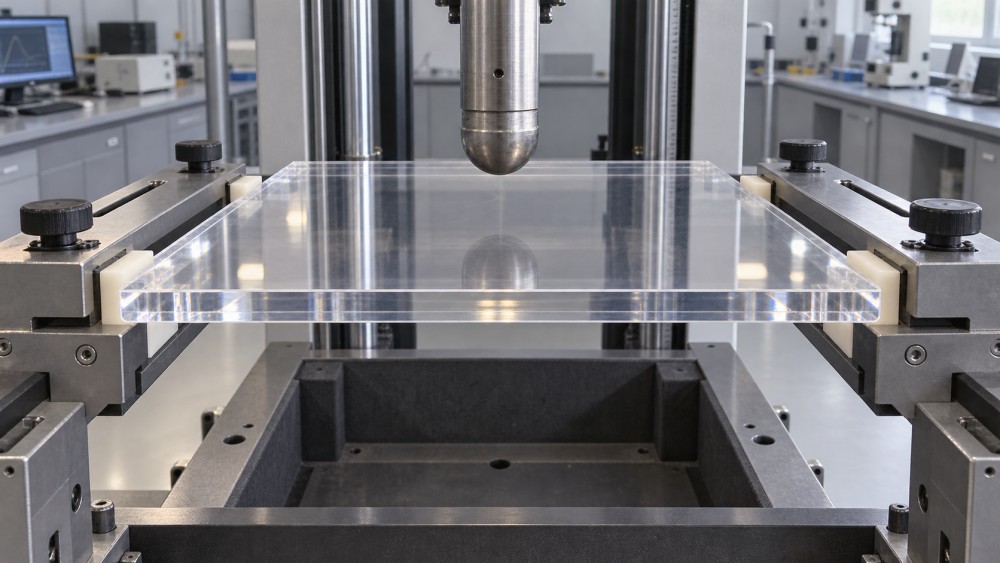
For sheet applications, falling-weight or instrumented puncture testing often provides more relevant information about panel deformation and penetration. Review the striker geometry, opening beneath the specimen, clamping, impact speed, thickness, and temperature. Instrumented traces can distinguish initial damage from continued deformation and final penetration, which a single reported energy value may hide.
Keep supplier comparisons within the same method and conditions. Where that is impossible, use the published data to identify candidates, then test representative sheets together. Record failure appearance as well as numerical results: ductile deformation, brittle cracking, tearing, and fragment release have different implications for the application.
Thickness and mounting can change the outcome
Increasing thickness generally raises panel stiffness and changes the energy required for penetration, but it also changes how the sheet absorbs a strike. A flexible panel can dissipate energy through broad deformation. A more constrained panel transfers greater loads into supports and local contact regions. Impact performance therefore should not be scaled directly from thickness using a simple multiplier.
The unsupported span matters alongside thickness. A small coupon clamped around its perimeter behaves differently from a large panel held along two edges. Compare materials in the intended frame, with representative gasket compression, fastener spacing, and edge engagement. If the panel must protect equipment behind it, include the available deflection clearance in the acceptance criteria.
Drilled holes, tight corners, and rough-cut edges frequently determine where cracks begin. Use fabrication guidance specific to the selected grade, including suitable tooling, edge finishing, hole clearance, and bend radius. Thermal expansion also needs space: an overtightened assembly can place the sheet under sustained stress before an impact occurs.
Cold bending creates a continuing strain that must be included in qualification. A flat sheet that tolerates a cleaner may develop crazing when the same cleaner contacts a bent or tightly fastened region. Test the combination of strain, exposure, and impact whenever those conditions coexist in service.
Qualify temperature, cleaning, and outdoor exposure together
Room-temperature impact performance is insufficient for equipment used in cold storage, outdoor installations, or hot enclosed spaces. Lower temperatures can reduce ductility, with the transition influenced by grade and loading rate. At higher temperatures, a sheet may resist fracture yet deflect excessively or lose retention in its frame. Test at the actual temperature limits after the specimen has reached the required condition.
Chemical resistance deserves equally specific treatment. Record the cleaner or process chemical, concentration, contact duration, application method, and cleaning frequency. A brief wipe differs from liquid trapped under a gasket. Compatibility statements based on unstressed immersion do not fully describe environmental stress cracking in a loaded assembly.
For outdoor exposure, specify a sheet grade or protective layer intended for that environment. Initial clarity does not demonstrate retained impact performance after weathering. Review evidence for changes in yellowing, haze, and toughness, including whether protection is applied to one surface or both. Installation orientation matters when protection is present on only one side.
Surface coatings introduce another variable. A hard coat can improve resistance to abrasion and cleaning damage, but its forming limits, adhesion, and behavior during panel flexing require validation. A coating specified for a flat panel should not automatically be carried into a deeply formed or cold-bent design.
Confirm that extrusion and forming preserve the selected properties
The final sheet reflects both resin formulation and processing history. Moisture control is particularly important for moisture-sensitive polymers processed at elevated temperatures. Inadequate drying can cause visible defects and molecular degradation that reduces mechanical performance. Use the resin supplier’s drying requirements and verify moisture control through storage, conveying, and extrusion.
Excessive melt temperature or residence time can also degrade the polymer. Conversely, poor melt uniformity and unstable cooling create thickness variation, optical defects, and residual stress. A successful trial made under tightly controlled conditions does not establish a repeatable production window. Qualification samples should represent the proposed line conditions and normal thickness tolerances.
Residual stress can be investigated through polarized-light examination where appropriate, but the observed pattern is a screening tool rather than a direct impact rating. Relate it to fabrication behavior, chemical exposure, and mechanical testing. Any stress-relief treatment needs grade-specific guidance because heating can alter dimensions and optical quality.
Thermoforming adds local thinning and a further thermal history. Measure the wall at corners, transitions, and deep-draw regions instead of relying on the incoming sheet gauge. Impact testing should target those thinner or highly strained locations. Protective masking, trimming, and drilling practices also need to match the planned production sequence.
Turn the shortlist into a defensible material specification
A useful qualification program compares a small number of plausible grades under the same application conditions. Include specimens from representative production runs and distinguish material effects from differences in thickness or fabrication. Where extrusion direction could influence behavior, retain sheet orientation in the sample records and examine relevant loading directions.
- Establish a baseline. Measure thickness, haze or transmission as required, and impact behavior on unexposed sheet. Record the failure mode alongside the result.
- Apply the exposures that could change the selection: service-temperature conditioning, repeated cleaning under representative strain, or weathering appropriate to the installation.
- Test the finished configuration, including formed areas, holes, supports, and available deflection clearance. Use both central strikes and credible vulnerable locations.
- Set acceptance limits before reviewing results. These can include no penetration, no released fragments, retained attachment, maximum permanent deformation, and acceptable optical damage.
The resulting specification should identify the exact resin grade or sheet construction, thickness tolerance, surface treatment, permitted material substitutions, and qualified fabrication conditions. If recycled content or production regrind is proposed, qualify that formulation and its controlled limits directly; optical cleanliness alone does not establish equivalent impact behavior.
Retain approved samples and baseline results against which later production can be compared. Changes in resin grade, modifier package, protective layer, or regrind practice should trigger review of the affected properties. This keeps the material decision tied to the sheet construction and service conditions that actually passed validation.
Have questions about this sector analysis, or seeking best practices specific to your niche? Drop us a line below and let the senior consultants at APIM assist you.
We respect your privacy. Your information is strictly confidential.
Related News
- 00
0000-00
How does washing affect contamination in post-consumer recycled PP resins? - 00
0000-00
How does feedstock affect depolymerization equipment selection? - 00
0000-00
US Sets 213.44% Preliminary Antidumping Deposit on Chinese PTMEG - 00
0000-00
When should epoxy be used as a thermal interface material for semiconductors? - 00
0000-00
US Midterm Results Unlikely to Quickly Shift Recycled Plastics Market or Legislation