




How to Evaluate Co Extrusion Machinery for Multi-Layer Sheet Output
Evaluating co extrusion machinery for multi-layer sheet output goes far beyond checking line speed or headline price. In practical production, the real question is whether the line can hold layer structure, melt stability, thickness control, and repeatable quality across changing materials, customer specifications, and operating conditions.
That matters more now because multi-layer sheet is used in packaging, electronics, automotive interiors, protective surfaces, and specialty industrial applications where each layer has a defined job. A sheet may need stiffness, barrier performance, optical quality, impact resistance, recycled content, or a printable surface, all within one structure.
For that reason, co extrusion machinery should be judged as a process system rather than a standalone machine. APIM often frames extrusion equipment this way: screw design, feed accuracy, melt handling, cooling behavior, and downstream control all shape the final material result.
What Multi-Layer Sheet Output Really Demands
A co-extruded sheet is not simply several melts combined into one wide web. It is a controlled structure where resin behavior, layer ratio, interfacial bonding, and thermal history must stay aligned from startup to stable production.
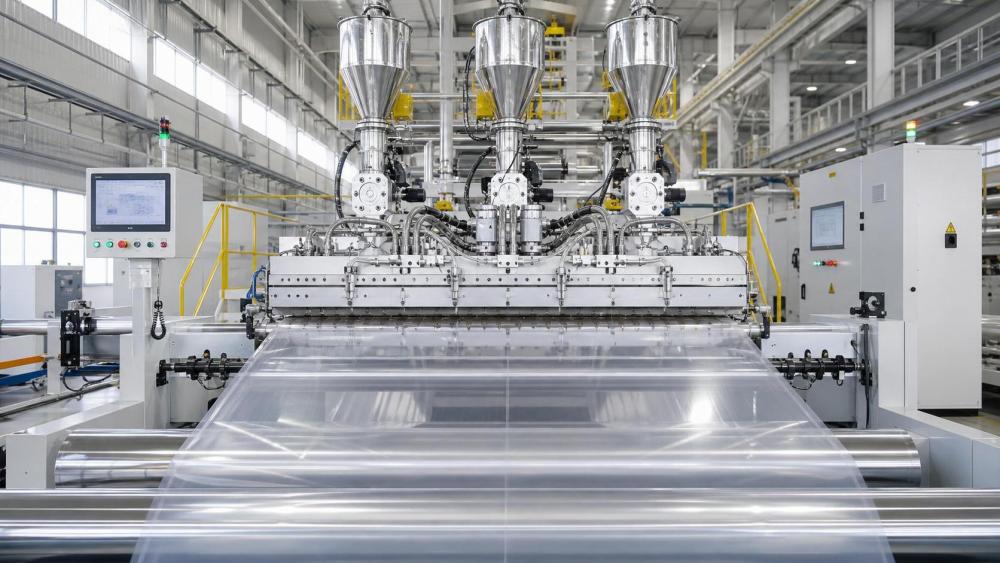
In many cases, the outer layers drive appearance and surface performance, while the core controls cost, stiffness, or recycled content. In barrier structures, a thin functional layer may be the most valuable part of the sheet, even if its thickness is small.
This is why co extrusion machinery must deliver more than output. It must preserve designed layer architecture. A fast line that cannot maintain ratio accuracy or sheet flatness can create more waste than value.
Layer design changes the equipment burden
A simple ABA sheet has different demands from an ABCDE barrier structure. Optical PC or PMMA sheet requires cleaner melt paths than industrial packaging sheet. Recycled content also raises sensitivity to filtration, contamination, and viscosity variation.
So evaluation should always begin with the intended sheet family, not with generic machine specifications.
The Most Important Evaluation Questions
A useful review of co extrusion machinery starts with five technical questions. These questions reveal whether the line can support production targets without hidden instability.
- Can each extruder process its assigned resin within the correct shear and residence time window?
- Can the feedblock or multi-manifold die maintain layer uniformity across the full sheet width?
- Is melt pressure and temperature controlled tightly enough for thin functional layers?
- Can the downstream section stabilize gauge, cooling rate, and sheet geometry?
- How well does the system recover after grade changes, startups, or disturbances?
These points are easy to list, but they should be tested against actual product requirements. A line for PET sheet with reclaim behaves differently from a line for high-gloss PMMA/ABS sheet or EVOH-based barrier structures.
Extruder Configuration Is the Foundation
The performance of co extrusion machinery begins with the individual extruders. Each resin layer may have different melt temperature, viscosity, drying sensitivity, and thermal stability. A mismatch here often appears later as unstable gauge, poor bonding, gels, or degraded appearance.
Extruder sizing should reflect real layer share, not only total line capacity. Oversized extruders can raise residence time risk during low-rate operation. Undersized units may force excessive screw speed and poor melt consistency.
Key checks at the extruder level
- Screw design matched to amorphous, semi-crystalline, filled, or recycled materials
- Stable gravimetric feeding for low-percentage functional layers
- Drying integration for hygroscopic resins such as PET, PC, PA, or PMMA blends
- Melt pumps where pressure stability is critical
- Screen changing and filtration sized for contamination risk and changeover frequency
APIM’s broader materials perspective is useful here. Resin behavior under heat, pressure, and shear is not a side topic. It is central to whether the line can consistently produce the intended structure.
Feedblock, Die, and Layer Distribution Decide Product Integrity
In multi-layer sheet production, the combining section is often where good intentions fail. The feedblock or die must manage different viscosities without distorting layer ratios across width and throughput range.
This is especially important when one layer is very thin, expensive, or performance-critical. Barrier resins, tie layers, conductive skins, UV-protective caps, and optical surfaces all depend on stable distribution.
When reviewing co extrusion machinery, it is worth asking for cross-section samples, gauge maps, and trial data from structures close to the intended application. Marketing diagrams are not enough.
Downstream Stability Is Often Underrated
Even when melt delivery is strong, downstream limitations can undermine the whole line. Chill roll design, roll temperature control, polishing, haul-off tension, trimming, and winding all affect sheet thickness, flatness, gloss, and internal stress.
For optical or appearance-sensitive sheet, small cooling imbalances can show up as haze, warpage, or surface marks. For thermoforming sheet, hidden stress can reduce downstream forming consistency.
What deserves close attention
- Automatic gauge control response time and measurement accuracy
- Chill roll temperature uniformity across width
- Surface finish suitability for gloss, matte, or textured products
- Edge trim handling and regrind integration strategy
- Winding quality for thin or curl-sensitive sheet
In short, co extrusion machinery should be evaluated as a complete line. A strong die cannot compensate for poor cooling control, just as a good extruder cannot solve unstable winding.
Material Compatibility and Market Direction
Current demand is pushing multi-layer sheet in several directions at once. Higher barrier performance, better optical quality, lighter structures, more recycled content, and easier recyclability can all affect equipment selection.
That creates a practical tension. Some product designs require more complex layer combinations. At the same time, sustainability programs often prefer simpler structures or mono-material concepts. The right co extrusion machinery should support today’s product mix without blocking future transitions.
This is where APIM’s cross-sector view becomes relevant. Packaging, automotive, electronics, and industrial sheet applications do not use the same material logic, but they all depend on process stability, traceable performance, and realistic scale-up.
How to Compare Suppliers More Effectively
A strong technical review compares evidence, not only specifications. Supplier proposals for co extrusion machinery should be checked against throughput range, product mix, scrap assumptions, maintenance access, automation depth, and startup support.
Useful comparisons usually include the points below.
- Proven reference lines using similar resins, widths, and layer counts
- Documented gauge tolerance and layer ratio performance
- Energy consumption at realistic operating loads
- Cleaning time, color change time, and restart scrap volume
- Spare parts strategy and control system serviceability
- Operator interface quality and recipe management
The best decision often comes from matching machine behavior to business priorities. For some lines, maximum flexibility matters most. For others, stable high-volume output or demanding surface quality is the real driver.
A Practical Next Step
A disciplined evaluation of co extrusion machinery starts with a structured requirement sheet. That sheet should define resin families, layer structures, target thickness range, annual volume, allowable scrap, downstream converting needs, and future product scenarios.
From there, equipment review becomes more objective. It is easier to judge whether an extruder is oversized, whether a feedblock offers enough flexibility, or whether a trial result reflects real production conditions.
Where the product portfolio includes engineering plastics, specialty films, recycled polymers, or performance-sensitive industrial sheet, the evaluation should connect material science and equipment design from the beginning. That is the most reliable way to turn co extrusion machinery selection into long-term manufacturing value rather than a short-term capital comparison.
Have questions about this sector analysis, or seeking best practices specific to your niche? Drop us a line below and let the senior consultants at APIM assist you.
We respect your privacy. Your information is strictly confidential.
Related News
- 00
0000-00
Do polyolefin hot melt adhesives bond well to polyethylene? - 00
0000-00
Korean Study Finds PLA Barely Degrades in Landfill After 320 Days - 00
0000-00
How to assess batch consistency from a thermal potting compounds supplier - 00
0000-00
How much weight can carbon fiber reinforced plastics save in cars? - 00
0000-00
Switching from PS to ABS Sheet Extrusion: Equipment Checks