




How to Choose a Sheet Extrusion Line for Thermoforming Efficiency
Selecting a sheet extrusion line for thermoforming is rarely a simple capacity decision. Line design affects gauge consistency, heating behavior, scrap rate, energy use, and the stability of downstream forming. In packaging, automotive, medical, and industrial sheet applications, the wrong configuration can lock a project into avoidable waste, narrow material options, and unstable output. The better approach is to evaluate the sheet extrusion line for thermoforming as a process system, where resin behavior, line architecture, and forming targets must work together.
Why line selection matters more than nominal output
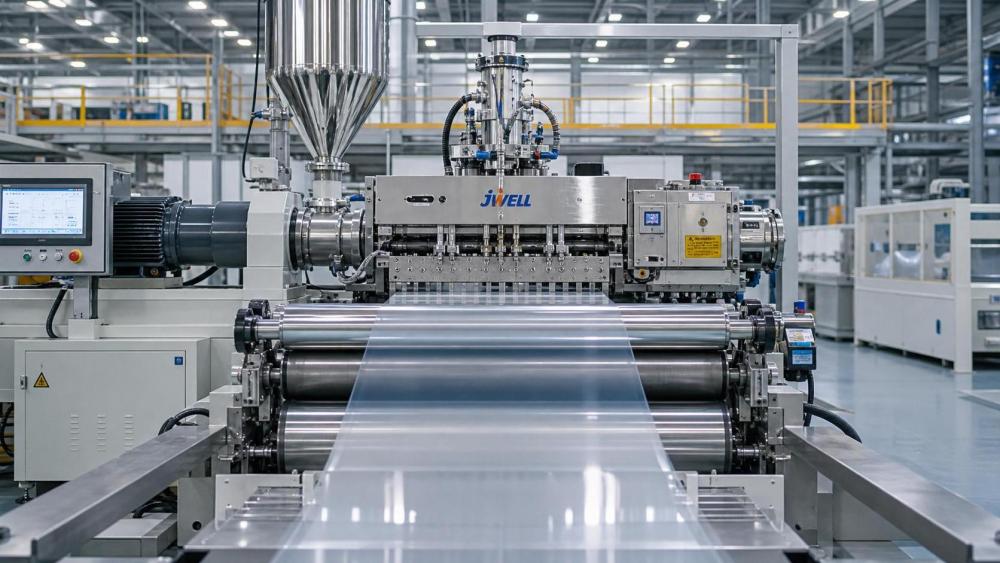
A thermoforming operation does not consume sheet in the same way that a basic sheet sale does. It needs predictable sheet temperature response, stable thickness, clean surfaces, and repeatable trim behavior.
That is why a sheet extrusion line for thermoforming should be judged by effective forming performance, not by throughput alone. A fast line that produces uneven sheet often reduces overall plant efficiency.
This has become more important as processors handle PET, PP, PS, PLA, multilayer barrier structures, recycled content, and engineering-grade sheets with tighter customer requirements.
APIM’s coverage of advanced polymers and extrusion technologies reflects this reality. Material performance and equipment configuration now influence each other more directly than many investment models assume.
What a sheet extrusion line for thermoforming must actually deliver
At a practical level, the line must convert polymer into sheet that forms consistently under heat and pressure. That sounds obvious, but several technical requirements sit behind it.
Thickness profile control
Cross-direction and machine-direction variation directly affect part wall distribution. If sheet gauge drifts, formed parts become difficult to control, especially in deep-draw or thin-wall applications.
Melt quality and cleanliness
Poor melt homogeneity creates gels, surface defects, and optical inconsistency. In food packaging, medical trays, and display-related sheet, these issues quickly become commercial problems.
Thermal stability
The sheet should absorb heat evenly in the thermoformer. A line that causes internal stress, moisture defects, or unstable crystallization makes heating windows narrower and cycle time less reliable.
Process repeatability
A good sheet extrusion line for thermoforming supports repeatable startup, stable recipes, and manageable operator control. These factors matter when product changeovers are frequent.
Start with material behavior, not machine preference
The first filter is resin behavior. PET, PP, PS, PC, PMMA, ABS, and bio-based materials do not respond the same way in extrusion or thermoforming.
PET often requires careful drying, venting, melt filtration, and temperature control. PP may demand attention to melt strength and sag behavior during forming. Recycled content can increase variability in viscosity and contamination risk.
Modified compounds add another layer. Mineral-filled, impact-modified, flame-retardant, conductive, or reinforced formulations can change screw loading, die behavior, and cooling response.
This is where line selection becomes a broader materials question. APIM often frames equipment decisions through polymer performance because screw design, filtration, degassing, and cooling all depend on the resin system.
- Check melt temperature sensitivity and residence time tolerance.
- Review moisture control needs, especially for PET, PLA, and hygroscopic polymers.
- Match filtration level to contamination risk and surface quality targets.
- Confirm whether future material plans include recycled or multilayer structures.
Core equipment choices that shape thermoforming efficiency
Several components have an outsized effect on line performance. They should be assessed as a connected system rather than isolated options.
For many projects, the melt pump and die control package deserve more attention than headline motor size. They often influence usable sheet quality more than nominal installed power.
Production goals change the right answer
There is no universal best sheet extrusion line for thermoforming. A line for disposable food packaging is not optimized the same way as one for durable refrigerator liners or medical trays.
High-volume commodity sheet
This usually favors stable output, fast screen changes, lower energy per kilogram, and predictable operation over broad formulation complexity.
Premium appearance or optical sheet
Surface finish, filtration, roll quality, and contamination control become critical. Small defects can erase margin quickly.
Multilayer or barrier structures
Co-extrusion capability, layer ratio stability, and material compatibility need early review. Barrier performance depends on both structure and process control.
Recycled or sustainable sheet programs
The line should tolerate broader feedstock variation. Degassing, filtration, and recipe adaptability matter more when circular material strategies are part of the roadmap.
Where efficiency is often won or lost
In real operations, efficiency losses usually come from instability, not from average speed. A line may look productive on paper while underperforming on total converted output.
The following checkpoints are usually more useful than a simple output claim:
- Startup scrap volume before on-spec sheet is reached.
- Gauge variation at full operating speed.
- Thermoformer heating window across product changes.
- Downtime linked to filtration, die cleaning, or control drift.
- Energy consumption per usable kilogram, not per extruded kilogram.
- Ability to maintain quality during recycled content trials.
These indicators are especially relevant when comparing capital proposals that look similar in broad specification sheets.
Questions worth asking before final selection
A disciplined review process helps avoid buying a line that fits current volume but misses future process needs.
- Which materials will run in the first year, and which are likely within three years?
- What thickness range must the sheet extrusion line for thermoforming cover without sacrificing profile control?
- How much of the business case depends on regrind or recycled feedstock?
- What downstream defects are least acceptable: haze, gels, gauge bands, curl, or poor formability?
- Can the supplier show stable production data on comparable materials and structures?
- How strong are spare parts support, controls service, and process training?
The last point is easy to underrate. For complex extrusion assets, supplier process support can influence ramp-up speed as much as the equipment itself.
A practical way to move the evaluation forward
A useful next step is to build a decision matrix around material family, target sheet structure, formed part requirements, and acceptable operating window.
Then compare each sheet extrusion line for thermoforming against that matrix, using trial data, not just catalog values. Include gauge tolerance, usable output, scrap rate, changeover time, and support capability.
APIM’s broader view of polymers, compounds, specialty films, recycling, and extrusion systems is useful here because line decisions increasingly connect material strategy with equipment flexibility.
When the evaluation stays grounded in forming performance, not headline speed, the investment decision becomes clearer. The right line is the one that produces stable sheet, supports future material shifts, and keeps downstream thermoforming efficient under real operating conditions.
Have questions about this sector analysis, or seeking best practices specific to your niche? Drop us a line below and let the senior consultants at APIM assist you.
We respect your privacy. Your information is strictly confidential.
Related News
- 00
0000-00
How to assess batch consistency from a thermal potting compounds supplier - 00
0000-00
How much weight can carbon fiber reinforced plastics save in cars? - 00
0000-00
Switching from PS to ABS Sheet Extrusion: Equipment Checks - 00
0000-00
Are flame retardant industrial materials subject to RoHS restrictions? - 00
0000-00
How to choose speciality films for high-barrier food packaging