




Can Polycarbonate Sheets Be Thermoformed into Complex Shapes?
Can Polycarbonate Sheets Be Thermoformed into Complex Shapes?
Can polycarbonate sheets be thermoformed into complex shapes? Yes—but the answer is more qualified than it may first appear. Polycarbonate is one of the more capable transparent engineering thermoplastics for demanding formed parts, yet a successful result depends on much more than heating a flat sheet and pulling it over a tool. Sheet grade, thickness distribution, oven control, mold geometry, draw ratio, plug-assist design, cooling, trimming, and downstream use all influence whether a part looks precise and performs reliably.
That matters in applications such as vehicle interior panels, machine guards, equipment housings, protective glazing, medical-device covers, electronic enclosures, display bezels, and formed industrial windows. In these projects, the part is often expected to retain impact resistance, visual quality, dimensional consistency, and sometimes flame-retardant or UV-resistance properties after forming. Thermoforming can produce shapes that would be difficult or costly to fabricate from flat material, but it is not a shortcut around sound engineering.
Why polycarbonate responds well to thermoforming
Polycarbonate, commonly abbreviated as PC, is an amorphous engineering plastic. When heated into its forming range, it softens gradually rather than transitioning abruptly between rigid and fluid states. This gives processors a workable forming window and helps the material reproduce broad contours, radii, domes, recessed features, and three-dimensional profiles. Its well-known toughness also makes it attractive where a formed panel must resist impact better than many conventional clear plastics.
However, “formable” does not mean every PC sheet is interchangeable. A sheet intended for general-purpose glazing may not be the best option for a deep-draw housing. An optical-grade sheet may require more careful handling to protect surface appearance. A flame-retardant formulation, a UV-stabilized grade, a textured sheet, or a multilayer sheet with a hard coat can each behave differently in the oven and against the mold surface. Material selection should start with the finished part’s functional requirements, not only its initial transparency or price.
For B2B teams, this distinction is especially relevant because the same formed part can sit at the intersection of several requirements: visual clarity for an operator window, chemical resistance for cleaning, dimensional fit around a metal frame, resistance to vibration, and compliance documentation for its end market. The forming process cannot be separated from that wider design brief.
What “complex shape” really means in a forming project
Complexity is not defined simply by the number of curves. A smooth, shallow automotive interior trim panel may be relatively manageable, while a clear enclosure with deep sidewalls, sharp corners, a tight radius, uniform wall-thickness requirements, and a cosmetic front surface can be difficult. Complex parts commonly combine several risks: uneven stretching, local thinning, trapped air, stress concentration, poor detail reproduction, and distortion during cooling.
The key issue is how far the sheet must stretch and where that stretch occurs. During vacuum forming or pressure forming, material tends to thin in areas that travel furthest into the cavity. Deep boxes, tall domes, narrow channels, and abrupt transitions place more demand on thickness control than gently contoured parts. A design that appears uncomplicated in CAD can still create difficult material flow when converted into a real forming tool.
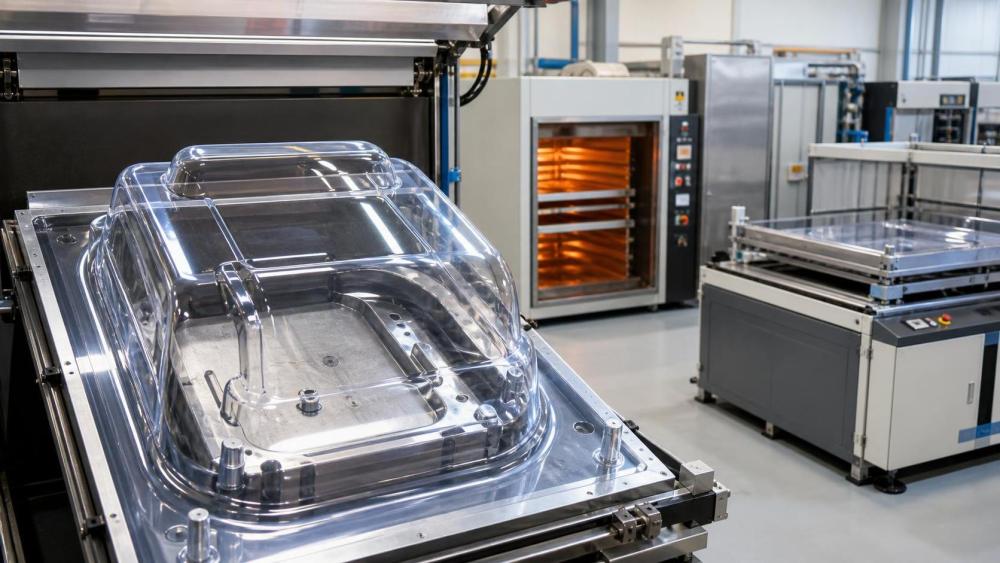
A useful early question is not merely, “Can this shape be formed?” It is, “Can this shape be formed while preserving the minimum wall thickness, surface quality, tolerance, and performance required in service?” That reframing prevents teams from approving an attractive prototype that later proves difficult to manufacture consistently.
The process variables that determine the outcome
Heating control is central. Polycarbonate must be heated evenly through the sheet thickness and across its surface. Uneven heating can lead to uneven sag, localized overstretching, waviness, optical distortion, or incomplete mold definition. Heating too aggressively may increase the risk of surface defects or degradation; insufficient heating makes the sheet resist forming, which can create stress and poor detail capture. The suitable oven profile depends on the specific grade, sheet thickness, coating system, and equipment configuration, so supplier guidance and production trials are more useful than relying on a generic temperature setting.
Moisture management also deserves attention. Polycarbonate can absorb moisture from its environment. When moisture-containing sheet is exposed to forming heat, defects such as bubbles, splay-like appearance, or surface blemishes may occur. Storage conditions, packaging integrity, elapsed warehouse time, and any necessary pre-drying procedure should therefore be defined before production—not investigated only after rejects appear.
Tooling must guide material flow rather than simply impose shape. Draft angles support part release. Generous radii usually reduce localized stress and thinning. Vacuum ports need enough capacity and a layout that evacuates air without leaving unacceptable witness marks. Where deeper draws are unavoidable, pressure forming or plug assistance may improve definition and thickness distribution. A plug-assist approach is particularly valuable when material needs to be pushed toward locations that would otherwise become too thin.
Vacuum forming, pressure forming, and matched tooling are not equivalent
Vacuum forming is widely used because it is practical for many medium-to-large covers, guards, trays, and housings. It can be highly effective when the geometry is moderate and one visible surface is the primary concern. Yet vacuum alone may not deliver the same detail level or thickness control demanded by more aggressive geometry.
Pressure forming applies positive air pressure in addition to vacuum. This can improve definition on textured surfaces, logos, ribs, and finer geometric features, while helping the heated sheet conform more closely to the mold. It is often considered when appearance matters as much as structural performance. The process still requires thoughtful mold venting, controlled heating, and realistic expectations about material movement.
For the most tightly controlled geometries, matched-mold forming or other more specialized approaches may be evaluated. These options can support better control in some applications, but tooling cost, cycle time, material thickness, annual volume, and the part’s tolerance requirements all need to be weighed. The right process is rarely chosen by material alone. It is a production decision involving design, quality, capital equipment, and expected demand.
Performance after forming: where projects can go wrong
A formed PC part may look acceptable immediately after demolding and still create problems later. Residual stress can make a component more sensitive to certain cleaning agents, adhesives, paints, or environmental exposures. Drilling, routing, fastening, ultrasonic operations, printing, and bonding can introduce additional stress around critical areas. If the part will be assembled into a rigid frame, the coefficient of thermal expansion and operating temperature range also need consideration.
Chemical compatibility is regularly underestimated. Polycarbonate is valued for toughness, but some solvents and aggressive cleaners can contribute to environmental stress cracking, particularly where the formed part already contains residual stress. A material decision should therefore include the actual cleaning protocol, exposure to oils or lubricants, adhesive chemistry, and any coatings applied after forming. A laboratory compatibility result for an unformed plaque may not fully represent the behavior of a deeply formed, trimmed component.
Clear parts need a separate discussion about optics. Heating and stretching can affect perceived flatness, haze, reflected appearance, and light transmission. Minor distortion may be acceptable in a machine guard but unacceptable in a viewing panel, retail display component, sensor cover, or illuminated interface. The acceptance standard should be defined in functional terms: Is the part viewed head-on? Is there a backlight? Does it need to transmit an image without visible distortion? Are mold-contact marks allowed on a non-display surface? These questions influence both sheet selection and tooling finish.
How to assess feasibility before committing to production tooling
The most efficient projects put feasibility work ahead of final tooling release. Start with the intended geometry, nominal sheet thickness, minimum thickness required in service, visible surfaces, functional loads, environmental exposure, joining method, and target production volume. Then review the part with the sheet supplier and thermoformer together. Separating those conversations often creates avoidable gaps: the material supplier may understand resin behavior, while the converter sees how the sheet behaves on a specific oven and tool.
Prototype forming is useful, but it should be treated as a decision tool rather than a visual demonstration. Measure thickness at the base, corners, sidewalls, and feature transitions. Check trim accuracy after the part has cooled and stabilized. Evaluate the surface under the lighting conditions relevant to its end use. Where the component will be bonded, painted, printed, or exposed to cleaners, include those operations in validation samples. The right prototype questions are often more valuable than simply asking whether the mold filled.
Procurement teams should also ask about sheet consistency, protective-film options, color control, lead-time resilience, and documentation needs. A technically suitable grade can still become a poor production choice if its supply route is unstable or if batch variation complicates visual matching. For regulated or safety-sensitive sectors, the applicable test methods and documentation requirements should be clarified for the finished part, not assumed from the resin family name.
When a different material or process may be more sensible
Polycarbonate is not automatically the answer to every formed transparent component. PMMA may be considered where optical appearance and scratch resistance are priorities, although its impact behavior differs. PET-based sheets may fit some applications that demand another balance of cost, processability, and clarity. ABS or PC/ABS sheets can be practical for opaque housings where toughness and appearance are needed but full transparency is not. In high-heat, chemically severe, or unusually precise applications, other engineering polymers or a different manufacturing route may be justified.
The decision should be based on the failure mode that matters most. If the product is likely to receive impact, PC’s toughness may carry substantial weight. If the critical concern is a highly polished optical surface, abrasion resistance may lead the discussion toward coatings or alternative substrates. If the geometry requires exceptionally sharp detail and tight tolerances, injection molding or a hybrid assembly may deserve comparison. No sheet material can compensate indefinitely for an unsuitable part design.
A practical material-and-process decision
Complex thermoformed polycarbonate parts are entirely achievable, and they are already embedded in many industrial, transportation, electronics, and protective-equipment applications. The reliable path is to treat the sheet, the forming method, and the end-use environment as one system. Deep geometry requires attention to thickness distribution. Cosmetic surfaces require disciplined handling and tool quality. Stress-sensitive downstream operations need early compatibility testing. Dimensional requirements must reflect the realities of heating, cooling, and trimming.
For teams comparing PC sheets, coated substrates, modified compounds, and forming technologies, APIM organizes these questions around material behavior and manufacturing conditions rather than isolated product claims. Before specifying a grade, confirm the intended shape, visible-surface standard, minimum retained thickness, operating environment, secondary processes, and supply requirements. Those details will determine whether thermoformed polycarbonate is simply possible—or genuinely production-ready.
Have questions about this sector analysis, or seeking best practices specific to your niche? Drop us a line below and let the senior consultants at APIM assist you.
We respect your privacy. Your information is strictly confidential.
Related News
- 00
0000-00
Do polyolefin hot melt adhesives bond well to polyethylene? - 00
0000-00
Korean Study Finds PLA Barely Degrades in Landfill After 320 Days - 00
0000-00
How to assess batch consistency from a thermal potting compounds supplier - 00
0000-00
How much weight can carbon fiber reinforced plastics save in cars? - 00
0000-00
Switching from PS to ABS Sheet Extrusion: Equipment Checks