




Which polymers withstand hot water in plumbing fittings?
Which Polymers Withstand Hot Water in Plumbing Fittings?
Selecting polymers for high heat plumbing fittings is not a matter of finding the resin with the highest temperature figure on a datasheet. A fitting may survive a brief hot-water exposure yet fail years earlier than expected when that heat is combined with internal pressure, chlorinated water, residual installation stress, disinfectants, or repeated thermal cycling. For project leaders, the real question is not simply “Can this polymer handle hot water?” It is whether the complete fitting system can hold its geometry, sealing load, joint integrity, and safety margin throughout its intended service life.
This distinction matters in domestic hot-water networks, hydronic heating loops, commercial washroom systems, circulation lines, heat-pump installations, and industrial utility piping. In each case, water temperature is only one part of the duty cycle. Pressure may be steady or intermittent. The water chemistry may be controlled, variable, or poorly documented. A fitting may be concealed behind walls, exposed to sunlight, installed in a cold plant room, or repeatedly subjected to start-stop temperature changes. The polymer choice must reflect that actual operating picture.
Among the polymers for high heat plumbing fittings, crosslinked polyethylene, polypropylene random copolymer, polyphenylene sulfide, polyvinylidene fluoride, chlorinated polyvinyl chloride, and selected polyamide systems are the materials most often evaluated. They do not compete on temperature alone. Their processing routes, joining methods, stiffness, chemical behavior, cost, and failure modes are different enough that treating them as interchangeable can create expensive design errors.
Start with the operating envelope, not the resin name
A material review should begin with a service map. Record normal water temperature, anticipated peak temperature, operating pressure, pressure excursions, expected lifetime, water-treatment chemicals, and whether the system will see continuous circulation. A fitting used on a short domestic hot-water branch is not exposed in the same way as a compact fitting near a recirculation pump or boiler outlet.
Thermal cycling deserves particular attention. When hot water flows, the fitting body, pipe, insert, O-ring, and any metal reinforcement expand at different rates. In a well-designed system, those movements are accommodated. In a marginal one, repeated movement can relax an interference fit, increase stress around a thread, or reduce gasket compression. A resin with respectable heat resistance may still be the wrong choice if its creep behavior, stiffness, or joining process does not suit the connection geometry.
Project teams also need to separate the pipe material from the fitting material. A piping system may use one polymer in the tube but a different, tougher or more dimensionally stable compound in elbows, tees, manifolds, valve housings, and transition components. The fitting is often the more demanding component because it contains weld interfaces, sharp geometry changes, molded stress, seals, and threaded or metallic inserts.
The practical material options
Crosslinked polyethylene, usually referred to as PEX, is widely used in hot- and cold-water distribution because it combines flexibility, practical installation, and useful resistance to long-term hot-water service when the system is designed and qualified for the intended application. Its flexibility is a clear advantage in routed plumbing runs, where fewer joints can reduce leak opportunities. However, PEX is not a universal fitting solution. Complex rigid fittings, threaded connections, and components requiring high dimensional stability often rely on other polymers or metal inserts. The specific crosslinking route, formulation, pipe-wall design, connection style, and stated system approval all matter.
Polypropylene random copolymer, commonly called PP-R, is another established choice for hot-water plumbing and heating distribution. It is valued for corrosion resistance and for fusion joining, which can create a continuous polymer-to-polymer joint when performed correctly. PP-R is often a sensible option where installers have the correct fusion equipment and disciplined process control. Its trade-off is that it is more rigid than PEX and can show greater thermal expansion in long straight runs. Supports, expansion allowances, alignment, and fusion temperature discipline are therefore part of the material decision rather than separate installation details.
For fittings exposed to higher temperature, more aggressive water chemistry, or demanding industrial utility conditions, polyphenylene sulfide (PPS) and polyvinylidene fluoride (PVDF) may enter the discussion. PPS offers high heat resistance, stiffness, and generally strong chemical performance. It is often considered for engineered components where dimensional stability under heat is important. But it is not a drop-in replacement for commodity plumbing polymers: its processing window, cost, weld-line behavior, reinforcement selection, and impact performance must be reviewed for the exact part geometry.
PVDF has a strong reputation in chemical process piping and high-purity fluid systems because of its chemical resistance and cleanability. It can be attractive where hot water is accompanied by process chemicals or where contamination control matters. For ordinary building plumbing, though, PVDF may be more material capability than the application needs. Higher material and fabrication costs can be justified, but usually only after the water chemistry, temperature profile, uptime consequences, and maintenance access have been assessed.
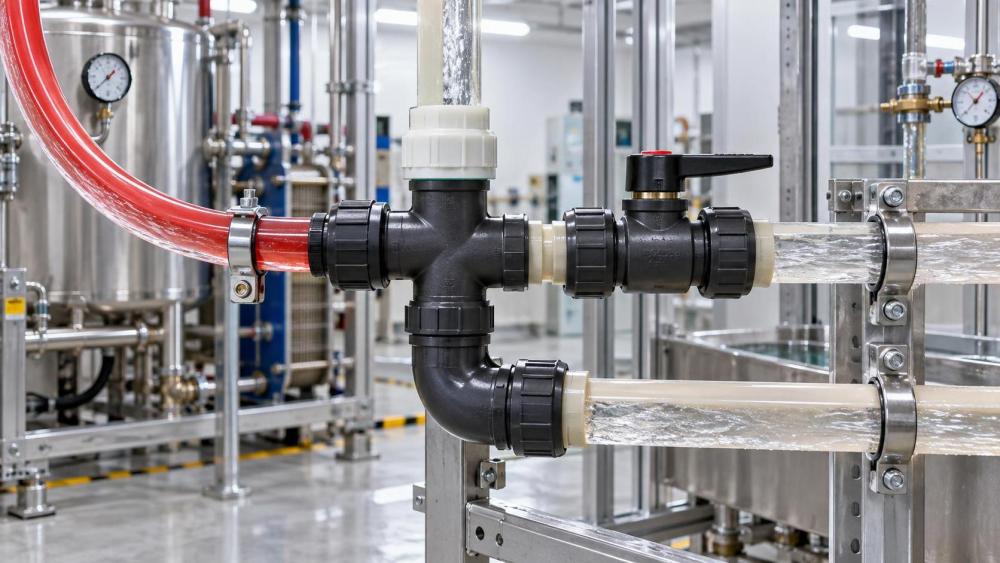
Chlorinated polyvinyl chloride (CPVC) is commonly considered for hot-water distribution because chlorination improves the thermal capability of PVC. It is rigid, familiar to many installers, and compatible with solvent-cement joining systems designed for the material. Yet CPVC needs careful attention to chemical compatibility beyond water itself. Certain lubricants, sealants, thread compounds, insulation materials, cleaning agents, and construction chemicals can be incompatible with CPVC formulations. The fitting may look sound at commissioning and later develop stress-related cracking after an incompatible substance has migrated into a stressed area. This is a frequent reason to review the whole installation bill of materials, not just the pipe and fitting.
Polyamide, especially reinforced grades, can be highly capable in compact plumbing fittings, valve bodies, manifolds, and components with metal inserts. Its strength and moldability make it useful where a thin but mechanically robust part is needed. The caution is moisture absorption. Polyamides can change dimension and mechanical behavior as they condition in humid or aqueous environments. This does not make them unsuitable; it means design dimensions, reinforcement choice, molding quality, weld lines, and long-term water exposure need more disciplined evaluation than a simple short-term temperature comparison provides.
Why a temperature rating alone can mislead a project
Published temperature values are useful screening tools, but they do not automatically represent allowable long-term operating conditions at pressure. Polymer performance is time-dependent. Under stress and elevated temperature, most thermoplastics gradually deform; this is creep. A compact fitting with a press-fit insert or a threaded section may be much more sensitive to creep than a straight section of pipe. It is also why a short high-temperature test cannot replace system-level validation.
Water chemistry can add another layer of uncertainty. Oxidizing disinfectants, high chlorine levels, dissolved minerals, cleaning chemicals, and unusual pH conditions can alter long-term performance in ways that are grade-specific. A project manager should ask the resin supplier or fitting manufacturer for compatibility information relevant to the local water conditions, not merely a generic statement that the polymer is “chemical resistant.” For recirculating hot-water systems, where exposure is continuous, this question becomes more pressing.
Then there is the interface problem. A polymer body may be fully suitable, while the seal elastomer, brass insert, adhesive, thread sealant, or solvent cement is not. In mixed-material fittings, differential thermal expansion can change seal compression. In reinforced compounds, glass fiber improves stiffness but can introduce anisotropic shrinkage or affect surface finish around sealing areas. Materials engineering is rarely about choosing a winning resin in isolation; it is about managing the interfaces that determine actual failure risk.
A more reliable selection process for plumbing fittings
A useful first filter is to divide the project into service classes rather than apply one material across every location. Standard domestic distribution, high-temperature recirculation, near-boiler connections, chemical dosing areas, and concealed critical joints may each deserve different levels of material capability. Over-specifying every component can inflate procurement cost and complicate installation. Under-specifying the highest-risk zones can produce failures that are difficult to locate and repair.
Before finalizing a material, request the specific documents applicable to the proposed product system: pressure-temperature performance information, joining instructions, chemical compatibility guidance, dimensional tolerances, and evidence of compliance with the standards or plumbing code required in the installation market. Requirements vary by region and application, so a material accepted in one market should not be assumed acceptable in another. The relevant authority, customer specification, and system supplier documentation should govern the decision.
It is also worth reviewing manufacturing consistency. For injection-molded fittings, resin drying, melt temperature, mold cooling, gate location, fiber orientation, and residence time can all affect warpage, weld-line strength, and residual stress. For compounded materials, additive dispersion and batch stability influence results just as much as the base polymer family. This is where structured material intelligence becomes useful: it helps procurement and engineering teams ask whether the compound, process, and final part have been evaluated as one chain.
Teams using resources such as the Global Advanced Polymers & Industrial Materials Intelligence Network can compare polymer behavior through that broader lens: heat, pressure, chemical exposure, processing method, supply stability, and part design. The aim is not to make every plumbing decision more complicated. It is to avoid the common shortcut of comparing only resin names and nominal temperature limits while overlooking the fitting’s actual duty.
The sensible answer is usually system-specific
PEX and PP-R are often practical starting points for mainstream hot-water distribution, each with different installation and expansion-management implications. CPVC can suit rigid hot-water systems when chemical compatibility across the installation is controlled. PPS, PVDF, and engineered polyamide compounds are more likely to be considered when the fitting faces elevated heat, difficult chemistry, compact geometry, or industrial service conditions that justify their added complexity and cost.
The strongest material choice is the one backed by the complete pressure-temperature duty, water-quality assumptions, joining method, fitting geometry, approval requirements, and installation plan. If any of those inputs are unknown, the right response is not to select the most impressive polymer on paper. It is to close the information gap before the fitting becomes the weakest point in an otherwise sound plumbing system.
Have questions about this sector analysis, or seeking best practices specific to your niche? Drop us a line below and let the senior consultants at APIM assist you.
We respect your privacy. Your information is strictly confidential.
Related News
- 00
0000-00
Do polyolefin hot melt adhesives bond well to polyethylene? - 00
0000-00
Korean Study Finds PLA Barely Degrades in Landfill After 320 Days - 00
0000-00
How to assess batch consistency from a thermal potting compounds supplier - 00
0000-00
How much weight can carbon fiber reinforced plastics save in cars? - 00
0000-00
Switching from PS to ABS Sheet Extrusion: Equipment Checks