




Polymer Rheology Compounding Basics for Stable Torque and Melt Flow
Why does polymer rheology compounding matter so much in daily production?
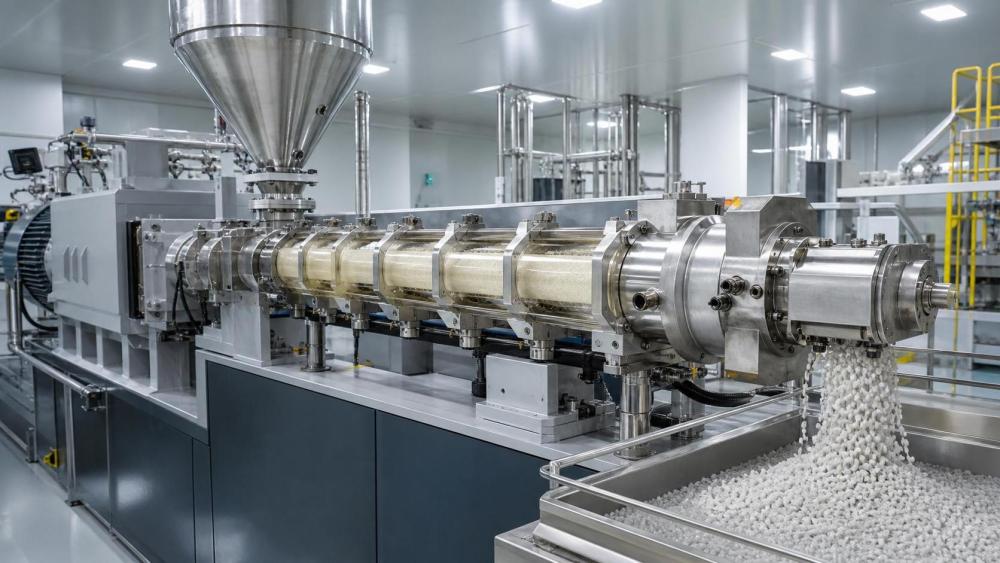
Stable torque and predictable melt flow are often the first signals of a healthy compounding process.
When polymer rheology compounding is poorly understood, small shifts in viscosity can create larger problems downstream.
These problems may appear as feeder fluctuation, pressure swings, poor pellet shape, uneven filler distribution, or unstable extrusion output.
In practical terms, rheology describes how a polymer melt moves under heat and shear.
Compounding adds another layer because resins, fillers, fibers, modifiers, and additives all change that melt behavior together.
That is why polymer rheology compounding is not only a lab topic.
It directly affects equipment load, residence time, venting efficiency, dispersion quality, and final application consistency.
Across engineering plastics, specialty films, recycled polymers, and adhesive compounds, the same rule usually applies.
If the melt behaves differently than expected, quality variation follows.
APIM often frames this issue through process logic rather than isolated data points.
That approach is useful because torque stability only makes sense when linked to formulation design and line conditions.
What should you actually look at when assessing melt behavior?
A common mistake is to rely on one number, usually melt flow index, as the whole story.
MFI is useful, but polymer rheology compounding needs a wider view.
Two compounds can show similar MFI values and still behave very differently inside a twin-screw extruder.
The better starting point is to check a group of linked indicators.
In actual review work, it helps to compare these values over time, not only at one sampling point.
That is especially true for PA, PET, TPU, flame-retardant PC, and recycled blends.
These systems can react quickly to moisture, heat history, or additive imbalance.
Why can a small formulation change upset stable torque?
Because polymer rheology compounding is sensitive to interactions, not just ingredient percentages.
A small increase in glass fiber, mineral filler, recycled content, or flame retardant package can raise apparent viscosity fast.
Even a lubricant change may alter wall slip, feeder behavior, and mixing efficiency.
More importantly, additives do not act independently once shear starts building in the barrel.
For example, a compound may flow well at hopper entry but thicken after partial filler wet-out.
Another formulation may show the opposite pattern because chain scission lowers viscosity as residence time increases.
This is one reason torque stability and final melt flow are not always aligned.
A smooth torque trace can still hide polymer degradation, especially in moisture-sensitive or heat-sensitive resins.
A practical evaluation usually checks four points together.
- Base resin molecular weight and moisture condition before feeding.
- Filler loading, particle shape, and surface treatment.
- Lubricant, impact modifier, or compatibilizer effect on mixing.
- Actual screw configuration and venting capacity.
Without that full picture, formulation approval can look safe on paper but become unstable on the line.
Is melt flow index enough, or do you need real rheology data?
For quick screening, MFI is convenient.
For decision-making in polymer rheology compounding, it is rarely enough by itself.
MFI measures flow under one defined load and temperature.
Compounding lines operate across changing shear rates, local temperatures, and residence time zones.
That gap matters when dealing with reinforced compounds, conductive plastics, recycled blends, or multilayer extrusion materials.
A better comparison uses capillary rheology or rotational rheology when available.
Those methods show how viscosity falls with shear, how elastic response changes, and whether the melt is likely to surge.
If full rheology data is unavailable, process-side evidence becomes more important.
Look at die pressure variation, amperage trend, pellet consistency, vent deposits, and filter loading rate.
Those signals often reveal more than a single lab value.
APIM’s material coverage is useful here because it links polymer properties with equipment behavior and downstream conversion needs.
Where do stable torque and melt flow create the biggest business impact?
The impact is strongest when compounds must meet tight performance windows across multiple process stages.
Automotive under-hood compounds are a clear example.
If rheology drifts, fiber length retention, warpage control, and surface quality can all move out of target.
In electronics materials, unstable polymer rheology compounding may disturb flame-retardant dispersion and dimensional precision.
For film and sheet, melt flow consistency affects thickness tolerance, haze, die lines, and lamination behavior.
Recycled polymers deserve special attention.
Feedstock variability can widen viscosity spread, making process windows narrower than expected.
The same issue appears in adhesive and hot-melt formulations, where rheology influences coating weight, wetting, and cure consistency.
When evaluating risk, it helps to ask where melt instability will be felt first.
- At the extruder, through torque spikes or vent fouling.
- At pelletizing, through strand breakage or poor cut quality.
- At conversion, through molding variation or film gauge drift.
- In the final part, through mechanical inconsistency or appearance defects.
What are the most common mistakes in polymer rheology compounding reviews?
One frequent mistake is separating material review from process review.
A compound may look acceptable in specification format but still be poorly matched to screw design or vent location.
Another mistake is ignoring shear history.
Material tested after one thermal cycle may not match the behavior of reprocessed or heavily sheared material.
There is also a tendency to overfocus on average values.
In polymer rheology compounding, variation often matters more than the mean.
A narrow operating window can cause unacceptable line interruptions even when nominal properties are within range.
The checklist below helps keep the review grounded.
How should the next evaluation step be structured?
The most reliable approach is to combine formulation data, rheology data, and process evidence in one review path.
Start by defining which output really matters.
That may be stable torque, fixed pellet quality, constant die pressure, or downstream molding consistency.
Then map the variables that can shift that output.
In many cases, polymer rheology compounding decisions become clearer after three simple comparisons.
- Compare virgin and production-return material behavior under the same drying and shear conditions.
- Compare lab viscosity curves with actual torque and pressure records from stable runs.
- Compare formulation options by dispersion quality, not only by flow number.
That process creates a more useful technical basis than isolated property sheets.
It also aligns with how APIM presents advanced polymer and compounding knowledge.
The goal is not to make rheology look academic.
The goal is to judge whether a material system can run consistently, convert cleanly, and hold performance through real manufacturing conditions.
If the next review focuses on those connections, polymer rheology compounding becomes far easier to evaluate with confidence.
Have questions about this sector analysis, or seeking best practices specific to your niche? Drop us a line below and let the senior consultants at APIM assist you.
We respect your privacy. Your information is strictly confidential.
Related News
- 00
0000-00
Do polyolefin hot melt adhesives bond well to polyethylene? - 00
0000-00
Korean Study Finds PLA Barely Degrades in Landfill After 320 Days - 00
0000-00
How to assess batch consistency from a thermal potting compounds supplier - 00
0000-00
How much weight can carbon fiber reinforced plastics save in cars? - 00
0000-00
Switching from PS to ABS Sheet Extrusion: Equipment Checks