




Polymer Rheology Basics: How Shear Changes Melt Flow
Why does polymer rheology matter so much in melt processing?
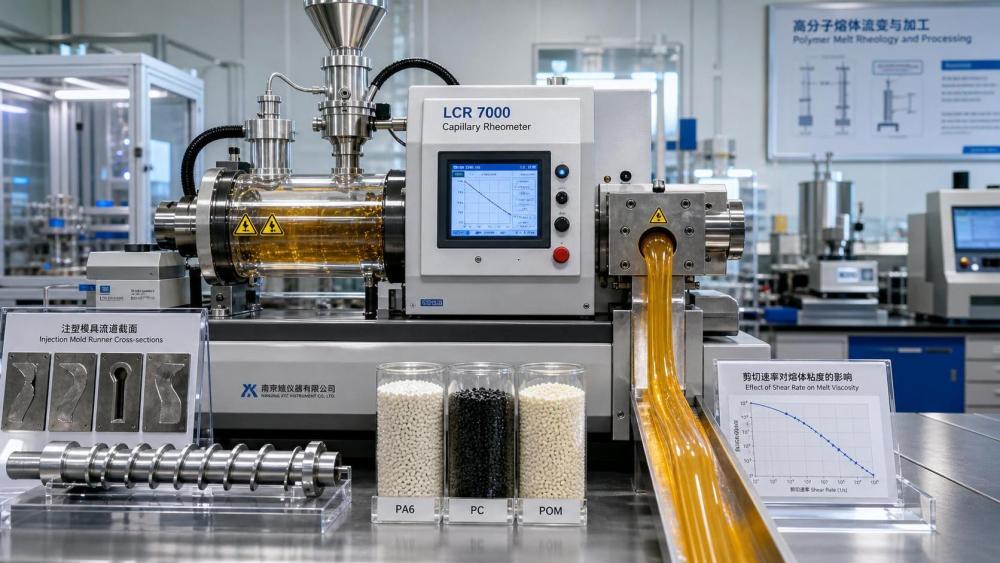
Polymer rheology explains how a polymer melt moves when force is applied. In practical terms, it links material structure to real processing behavior.
That matters because extrusion, injection molding, film production, and compounding all depend on controlled melt flow, not just resin data sheet values.
A polymer can look stable on paper, yet behave very differently once shear rate rises inside a screw, die, runner, or narrow gate.
This is where polymer rheology becomes useful for early technical screening. It helps interpret viscosity shifts, pressure demand, heat build-up, and flow uniformity.
For advanced polymers, these effects are rarely minor. Materials such as PA, PEEK, PET, TPU, PC, and reinforced compounds often respond strongly to processing conditions.
APIM frequently frames materials through this kind of processing logic. That approach is valuable because melt behavior affects both part performance and production stability.
A simple question usually starts the investigation: when shear changes, does the melt become easier to move, or does it become unstable?
When people ask how shear changes melt flow, what are they really asking?
Most searches about polymer rheology are really about viscosity under motion. Shear rate describes how fast adjacent melt layers slide past each other.
As shear rate increases, many polymer melts show shear thinning. That means viscosity drops, so the material flows more easily.
This behavior is common because polymer chains begin to align in the flow direction. Entanglements still exist, but resistance to flow decreases.
In actual equipment, this can reduce required pressure and improve cavity filling. It can also support faster line speeds in extrusion.
Still, the answer is not always “more shear is better.” Excessive shear may increase melt temperature, trigger degradation, or disturb filler distribution.
That is why polymer rheology is not only about one viscosity number. It is about the full viscosity response across a useful processing range.
A low-shear test may describe storage behavior. A high-shear condition often tells more about molding, coating, or die flow performance.
A quick comparison helps clarify the point
This kind of table is often more useful than a single flow index. It turns polymer rheology into a decision tool rather than a lab-only topic.
Is shear thinning always a benefit, or can it create new problems?
Shear thinning is usually helpful, but only within a controlled range. Easier flow can shorten cycles and improve shape filling in thin sections.
The trouble begins when lower viscosity is mistaken for universal process freedom. A fast-flowing melt can still produce defects.
In film and sheet extrusion, unstable rheology may contribute to die lines, edge variation, gauge fluctuation, or surface inconsistency.
In injection molding, high shear near gates may cause burn marks, jetting, orientation effects, or excessive internal stress.
Filled and reinforced materials add another layer. Glass fiber, mineral filler, flame retardants, and conductive additives can alter flow response significantly.
The more common judgment is to ask whether the rheology supports the full route: feeding, melting, pumping, shaping, cooling, and final property retention.
That is especially relevant in APIM-covered sectors where compounds are expected to deliver mechanical strength, electrical safety, optical clarity, or barrier performance.
Warning signs worth watching
- Sharp pressure increase despite higher temperature
- Melt fracture or rough extrudate surface
- Unexpected color shift after higher screw speed
- Unstable output in recycled or moisture-sensitive polymers
- Loss of impact strength after aggressive processing
These symptoms often point back to polymer rheology, even when they first appear as machine, mold, or quality issues.
Which applications are most sensitive to polymer rheology?
Not every product sees rheology in the same way. Thin-wall, multilayer, reinforced, and appearance-critical applications are usually more sensitive.
Take specialty films. Barrier layers, optical films, and release films need steady melt flow to maintain thickness control and surface quality.
For engineering plastics, rheology influences how parts fill complex geometries, how fibers orient, and how dimensions hold after cooling.
Adhesives and hot-melt systems also depend on controlled flow. Application temperature, wetting behavior, and bond line consistency all connect to rheology.
Recycled polymers deserve extra attention. Their molecular weight distribution can vary, which means melt flow can shift from batch to batch.
In compounding lines, polymer rheology affects dispersion, degassing, torque load, and filtration efficiency. Those are direct cost and quality drivers.
That is one reason structured technical interpretation matters. Materials that seem equivalent by grade name may behave differently once processed under real shear.
How should polymer rheology be compared when selecting a material?
A common mistake is comparing only melt flow rate. MFR is useful, but it is a simplified indicator, not a full rheological profile.
A better comparison starts with the intended process. Extrusion, injection molding, coating, and compounding each stress the melt differently.
Then look at three variables together: shear rate sensitivity, temperature sensitivity, and stability over residence time.
For example, two PET grades may show similar nominal flow. Under higher shear, one may thin smoothly while the other becomes less predictable.
The same logic applies to PC, ABS, PA, PBT, TPU, and high-temperature polymers. Rheology often separates a workable grade from a troublesome one.
When additives are involved, the comparison should include filler level, fiber length retention, moisture control, and lot consistency.
Useful selection questions include the following:
- Does the melt stay stable at the required throughput?
- Can the material fill narrow channels without overheating?
- Will rheology changes affect optical, mechanical, or bonding performance?
- How wide is the safe process window across normal production variation?
In practice, this is where industry information platforms become useful. They help connect rheology data with application context instead of treating numbers in isolation.
What are the most common misunderstandings around shear and melt flow?
One misunderstanding is that lower viscosity always means better processing. It can also mean reduced melt strength or higher sensitivity to deformation.
Another is assuming that one test condition represents the whole process. Polymer rheology changes across temperature, shear, and time.
Some teams also treat rheology as a machine-side issue only. In reality, molecular architecture, additives, and recycled content strongly influence it.
There is also a tendency to overlook interaction effects. Moisture, residence time, screw design, and filtration can reshape the apparent flow behavior.
For biomaterials or sustainable compounds, this point becomes even more important. Processing stability may be narrower than with conventional virgin polymers.
A balanced reading of polymer rheology asks two things at once: how easily does the melt flow, and what does that flow do to final quality?
Where should the next evaluation start?
Start with the process, not with the catalog number. Define whether the material must be pumped, filled, stretched, laminated, or compounded.
Then match polymer rheology data to actual operating conditions. A lab curve becomes useful only when linked to shear range, temperature, and residence time.
Next, screen for application-specific risks. Thin-wall molding, optical surfaces, barrier films, structural compounds, and recycled content each need different checks.
It also helps to compare rheology alongside downstream targets such as strength, clarity, adhesion, dimensional control, and long-term stability.
This is the practical value of understanding polymer rheology basics. It turns melt flow from an abstract material property into a usable decision framework.
For the next step, build a short comparison sheet with shear response, thermal sensitivity, process window, and likely defect risks for each candidate material.
That kind of structured review supports clearer technical discussions and better material choices across modern industrial applications.
Have questions about this sector analysis, or seeking best practices specific to your niche? Drop us a line below and let the senior consultants at APIM assist you.
We respect your privacy. Your information is strictly confidential.
Related News
- 00
0000-00
Do polyolefin hot melt adhesives bond well to polyethylene? - 00
0000-00
Korean Study Finds PLA Barely Degrades in Landfill After 320 Days - 00
0000-00
How to assess batch consistency from a thermal potting compounds supplier - 00
0000-00
How much weight can carbon fiber reinforced plastics save in cars? - 00
0000-00
Switching from PS to ABS Sheet Extrusion: Equipment Checks