




Plastic Dimensional Stability Under Moisture Exposure: Common Failure Causes
Why does plastic dimensional stability change under moisture exposure?
Plastic dimensional stability under moisture exposure is often underestimated until parts start drifting out of tolerance. A resin may look fine in dry storage, yet swell, soften, or distort after shipping, washing, or outdoor use. For quality and safety checks, the real issue is not just water uptake, but how that moisture changes shape, fit, and stress over time.
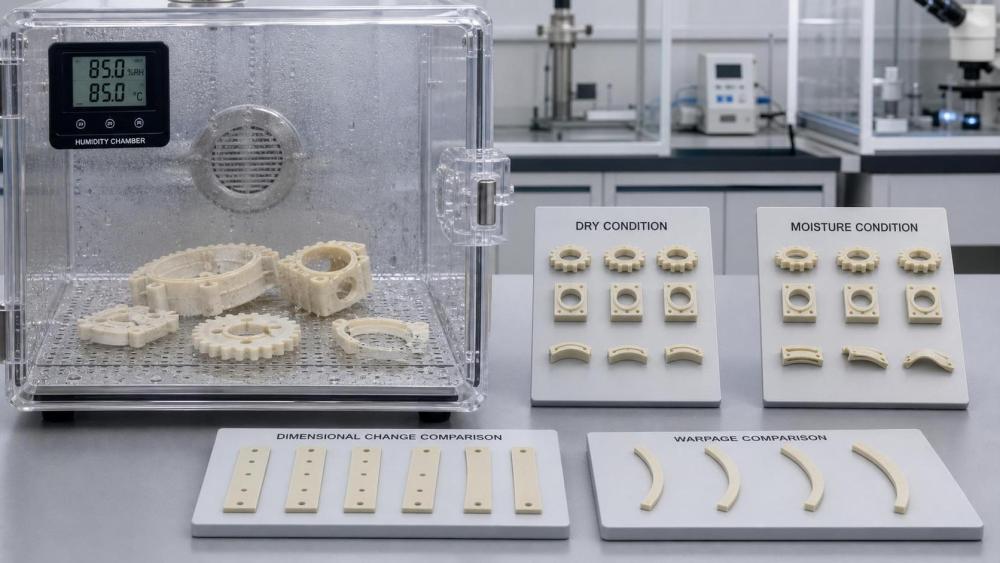
In APIM’s material selection logic, this problem sits at the intersection of polymer chemistry, processing history, and application environment. Engineering plastics, modified compounds, and films do not fail in the same way. Some absorb water and expand. Others hold size but lose stiffness. A few crack only after repeated humidity cycles.
That is why moisture exposure should be treated as a performance condition, not a storage detail. If the part has sealing surfaces, mating features, or precision geometry, even small movement can become a functional failure.
What are the most common failure causes?
The most common cause is simple water absorption. Materials such as PA are more sensitive than low-absorption resins like POM or some filled PP grades. Once moisture enters the polymer matrix, dimensions can shift and internal stress can redistribute.
Processing conditions matter just as much. Overheating, uneven cooling, poor drying, or high residual stress can leave a part vulnerable. When moisture arrives later, the hidden stress turns into warpage or stress cracking faster than expected.
Another common trigger is formulation mismatch. Glass fiber, mineral fillers, flame retardants, and impact modifiers all change how moisture moves through the material. A compound may look stable in lab testing, but edge sections, ribs, or thin walls can still drift in real use.
Quick failure map
Which materials are more at risk in humid environments?
The answer depends on the application, but hygroscopic polymers usually demand more attention. PA grades are a classic example because they can absorb enough moisture to change size and mechanical behavior. In contrast, PC, PET, PBT, and POM often behave better in dimensional terms, though they are not immune to stress-related issues.
Filled compounds can go either way. Glass fiber reinforcement may improve stiffness, yet it can also create directional movement if orientation is uneven. Thin-walled parts, precision housings, connectors, and optical components tend to expose these differences quickly.
For film and sheet products, moisture may not cause obvious swelling, but it can affect flatness, curl, haze, and seal consistency. That is why APIM often separates material choice from processing route. The same resin can behave differently in extrusion, molding, or multilayer structures.
How can processing and storage make the problem worse?
Poor drying is a frequent starting point. If pellets enter the machine with excess moisture, hydrolysis, bubbles, and uneven melt behavior may follow. That is especially sensitive for PET, PA, and some TPU formulations.
Molding conditions also shape the final risk. High packing pressure, fast cooling, or unbalanced gates can lock stress into the part. Later, when humidity rises, the part relaxes unevenly and dimensional stability drops.
Storage is often ignored until damage appears. Open bags, damp warehouses, and long exposure before assembly can all change the starting condition. For safety-related parts, that can be enough to create a failed inspection or a field complaint.
A practical check before release
- Confirm dry-state and conditioned-state dimensions.
- Review drying temperature, time, and dew point.
- Inspect weld lines, ribs, bosses, and thin sections.
- Check packaging and warehouse humidity control.
How should a material be selected when moisture is part of the use case?
The best choice is rarely the lowest-absorption resin alone. It should match geometry, load, tolerance, and environment. A slightly more moisture-sensitive material may still be suitable if the design allows expansion. A stable resin may still fail if assembly stress is too high.
A useful approach is to compare three things together: dimensional change, mechanical retention, and processing consistency. APIM-style material comparison works well here because it links resin behavior with compounding quality, extrusion control, and end-use conditions.
For projects with sealing, safety, or precision demands, ask whether the part must remain stable in dry air, high humidity, or repeated wet-dry cycles. Those are not the same requirement, and they should not use the same acceptance limit.
What is the fastest way to reduce moisture-related failures?
Start with measurement, not assumptions. Track dimension before and after conditioning, then compare the results against service limits. If drift is already visible in testing, the problem is usually in material choice, part design, or processing setup.
Next, tighten the control points that matter most: drying, storage, mold balance, and post-mold conditioning. In many cases, a small change in process discipline gives a bigger improvement than switching grades too early.
For complex applications, use the table below as a quick decision aid.
In practice, plastic dimensional stability moisture exposure issues are easier to manage when the full chain is visible: resin, compounding, extrusion or molding, storage, and service environment. That is the logic behind APIM’s technical coverage, because selection decisions are rarely about one number alone.
The safest next step is to define the real humidity condition, not just the nominal material grade. Then compare absorption, stress behavior, and dimensional drift against the part’s tolerance and life cycle. When those three match, moisture-related failures become much easier to prevent.
Have questions about this sector analysis, or seeking best practices specific to your niche? Drop us a line below and let the senior consultants at APIM assist you.
We respect your privacy. Your information is strictly confidential.
Related News
- 00
0000-00
How does washing affect contamination in post-consumer recycled PP resins? - 00
0000-00
How does feedstock affect depolymerization equipment selection? - 00
0000-00
US Sets 213.44% Preliminary Antidumping Deposit on Chinese PTMEG - 00
0000-00
When should epoxy be used as a thermal interface material for semiconductors? - 00
0000-00
US Midterm Results Unlikely to Quickly Shift Recycled Plastics Market or Legislation