




How to select polymers for high-pressure applications without cracking
High-pressure polymer components rarely fail because the resin’s published tensile strength was too low. Cracking is more often the result of a mismatch between the material, the pressure profile, the fluid environment, and the part’s local geometry. A grade that survives a short hydrostatic test can still split after months of pressure cycling, chemical exposure, or elevated-temperature service.
For technical evaluators selecting polymers for high pressure applications, the first decision is therefore not “Which polymer is strongest?” It is whether the application demands resistance to sustained stress, repeated pressure pulses, rapid decompression, aggressive media, or a combination of these conditions. Those demands lead to different material choices and different validation plans.
A sensible selection starts by treating the polymer, reinforcement, molding process, and part design as one system. High-pressure performance cannot be established from a datasheet alone, particularly for fittings, valves, pump parts, manifolds, seals, pressure housings, filter bodies, and fluid-handling connectors.
Define the pressure duty before comparing resin families
“High pressure” is not a complete operating condition. The same nominal pressure can produce very different failure risks depending on how long it is applied, how frequently it changes, and what happens at the pressure boundaries.
A component under steady internal pressure may gradually deform through creep. A component exposed to cyclic pressure may initiate fatigue cracks at weld lines, threads, sharp corners, inserts, or molded-in details. A part operating with compressed gas can face rapid gas decompression, where absorbed gas expands inside the polymer faster than it can diffuse out. In fluid systems, the medium may plasticize, swell, hydrolyze, oxidize, or chemically attack the material while pressure keeps local stresses high.
Before requesting samples or comparing grades, establish the actual duty envelope:
- Maximum operating pressure, proof pressure, and expected pressure spikes
- Continuous versus intermittent loading, including pressure-cycle frequency and dwell time
- Minimum and maximum service temperature, including start-up and cleaning cycles
- Pressure medium: water, oil, fuel, gas, refrigerant, solvent, hydraulic fluid, cleaning chemistry, or mixed media
- Expected service life and consequence of leakage, deformation, or rupture
- Part geometry, wall thickness, threaded interfaces, metal inserts, weld lines, and assembly loads
This information changes the material shortlist quickly. A polymer that performs well in a room-temperature water fitting may be unsuitable for hot glycol, compressed gas, or a hydraulic component exposed to thousands of pressure cycles. Leaving the medium and temperature undefined is one of the most common reasons a promising material evaluation produces misleading results.
Use long-term behavior, not short-term strength, as the first filter
Tensile strength and flexural modulus remain useful screening values, but they describe only part of the problem. Internal pressure produces hoop stress and often multi-axial loading. Local stresses near gates, threads, transitions, or inserts can be substantially higher than the nominal stress calculated from wall thickness. Over time, polymers relax and deform under load in ways that metals do not.
For pressurized components, prioritize data that reflects the intended service condition: creep at temperature, stress relaxation, fatigue behavior, pressure cycling, fracture toughness, and crack-growth resistance. If the supplier only provides dry, short-term room-temperature tensile results, the data may be insufficient to qualify the grade for a safety- or uptime-critical pressure part.
Polyamide illustrates why this distinction matters. Reinforced PA grades can offer attractive strength and stiffness, especially for molded structural parts. However, their moisture uptake and temperature sensitivity can alter dimensions and mechanical behavior. In a pressurized water or glycol application, the relevant question is not whether the dry grade has high tensile strength. It is whether the conditioned material retains sufficient stiffness, crack resistance, and dimensional control throughout the expected temperature and fluid exposure.
Similarly, POM can be a practical choice for certain precision fluid components because of its low friction and dimensional stability, but its suitability depends on the fluid, temperature, geometry, and joining method. It should not be assumed to be a universal answer for high-pressure fittings simply because it performs well in many mechanical applications.
Higher-performance materials such as PEEK and PPS are often considered when temperature, chemical exposure, and sustained stress make commodity or standard engineering plastics inadequate. PEEK can provide strong long-term mechanical and chemical performance in demanding environments, while PPS offers good chemical resistance and thermal stability. Yet both require disciplined design and processing. A high-performance resin cannot compensate for a sharp internal corner, inadequate knit-line strength, poorly controlled fiber orientation, or a geometry that creates excessive hoop stress.
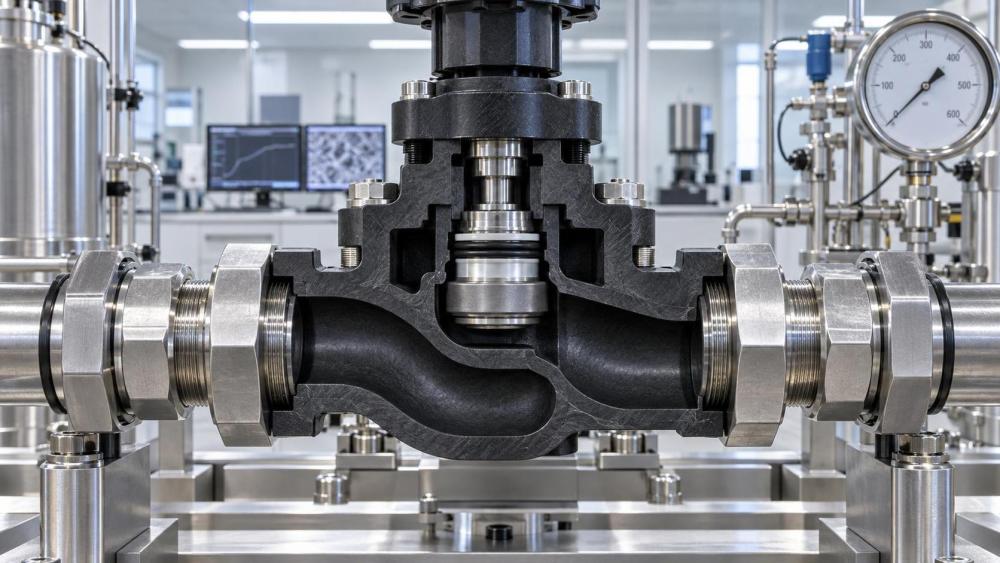
Match the polymer family to the dominant failure mechanism
The most efficient selection method is to identify the likely failure mechanism first, then compare candidate materials against that mechanism. This prevents teams from overvaluing a familiar grade that solves the wrong problem.
A useful early distinction is between stiffness and toughness. Increasing stiffness may reduce deformation under pressure, but an overly brittle formulation can become more sensitive to stress concentrators, low-temperature impact, molding defects, and fiber-rich regions. This tradeoff is especially important with glass-fiber reinforced compounds. Reinforcement can improve strength, creep resistance, and dimensional stability, but it can also increase anisotropy and reduce resistance to crack propagation in unfavorable directions.
Carbon-fiber reinforcement may provide even greater stiffness where weight and deformation control are central concerns. It also introduces process and design considerations: fiber orientation becomes more consequential, flow paths require attention, and local weld-line performance may not track the headline modulus. Reinforcement should be selected to address a defined structural need, rather than added automatically to make a pressure part “stronger.”
Do not separate material selection from geometry
Cracks usually begin where the part concentrates stress. Thick walls alone do not guarantee a durable pressure vessel or fitting. Sudden changes in section, sharp internal radii, unsupported ports, aggressive threads, gate vestiges, and rigid metal inserts can all create local loading conditions that are more severe than bulk property data suggests.
For injection-molded components, the location of weld lines deserves early review. Where separate melt fronts meet, the resulting bond may be weaker than the surrounding material, particularly if the flow fronts are cool, contaminated, poorly vented, or highly filled. A weld line located in a low-stress area may be acceptable; the same weld line crossing a highly stressed pressure boundary can define the part’s failure limit.
Metal inserts deserve equal caution. They are often necessary for threads, fastening, or connection strength, but their thermal expansion differs from the surrounding polymer. At elevated temperature, cooling, or pressure cycling, the interface can create hoop stress and microcracks. Insert geometry, installation method, surrounding wall thickness, and molding conditions should be evaluated together. A material change alone may not solve an insert-driven crack problem.
Threaded polymer connections also need realistic testing. Installation torque, mating-part tolerance, lubricant or sealant compatibility, and repeated assembly can damage a thread root before the part is ever pressurized. A pressure test performed on an unassembled coupon does not replicate that condition.
Environmental compatibility often decides the final grade
Many polymers retain impressive properties in air but change significantly after exposure to the actual medium. Fluids can extract additives, cause swelling, reduce modulus, promote hydrolysis, or create environmental stress cracking. The risk rises when chemical exposure and tensile stress occur together, which is exactly the condition around ports, threads, and pressure-loaded walls.
Technical evaluations should include the full fluid package rather than only the primary substance. Hydraulic systems may contain additives. Cleaning processes may introduce oxidizers or alkaline agents. Fuels and lubricants may include blends whose interaction with a polymer differs from that of a pure laboratory chemical. If the component sees multiple fluids over its life, each relevant exposure should be represented in the test plan.
Temperature must accompany chemical testing. A material that appears compatible during room-temperature immersion can lose performance at a higher service temperature or after prolonged exposure. In some applications, a short immersion test followed by burst pressure testing provides more useful information than a visual inspection alone, because loss of toughness may not be visible before failure.
Processing quality is part of pressure performance
For molded or extruded pressure components, a suitable resin can fail because of poor conversion conditions. Moisture control, melt temperature, residence time, contamination, fiber dispersion, mold temperature, packing profile, gate design, and cooling all influence the finished part. Overheating can degrade sensitive polymers; inadequate drying can create hydrolytic damage or voids; poor venting can weaken knit lines; uncontrolled cooling can leave residual stresses that appear later as cracking.
This is particularly relevant when switching suppliers, changing compound formulations, adding recycled content, or moving a part between molding sites. Nominally equivalent grades may differ in viscosity, reinforcement characteristics, stabilizer package, pigment system, moisture sensitivity, and lot-to-lot consistency. Qualification should therefore cover the molded part made under production-representative conditions, not only resin pellets or standard test bars.
Material traceability also matters when a component has a long service expectation. A controlled specification should identify the approved resin grade, reinforcement level, colorant or additive constraints where relevant, drying requirements, and critical process windows. Without that discipline, later substitutions can introduce changes that are invisible at incoming inspection but significant under pressure cycling.
Build a validation sequence that exposes real cracking risk
Testing should be staged so that lower-cost screening identifies poor candidates before full component validation. Begin with the stress state and material exposure likely to govern service life. Then test finished parts under conditions that include temperature, fluid contact, assembly, and pressure history.
A practical sequence may include dimensional checks after conditioning, proof pressure, burst pressure, extended pressure hold, cyclic pressure testing, and post-test inspection of threads, weld lines, gates, and insert interfaces. For chemically exposed systems, age the parts in the relevant medium before or during testing. For parts that experience thermal changes, include temperature cycling because residual stress and differential expansion often reveal weaknesses that static testing misses.
Failure analysis should distinguish between overload, fatigue, chemical attack, void-driven fracture, weld-line failure, and insert-related cracking. Each points to a different correction. Increasing wall thickness may help an overload failure but do little for a chemically induced crack at a threaded port. Changing to a tougher compound may improve fatigue life while creating processing or dimensional issues that require a mold adjustment.
The final selection should be documented as a set of operating assumptions, not a simple statement that a material is “pressure resistant.” Specify the approved temperature range, pressure profile, permitted media, assembly conditions, part geometry, and manufacturing controls. That record gives engineering, quality, and procurement teams a clear basis for evaluating substitutions and prevents a qualified design from being weakened by an apparently minor grade or process change.
For high-pressure polymer parts, cracking prevention comes from aligning those conditions early. The strongest candidate on paper is not always the most reliable component in service. The better choice is the material-and-design combination that retains adequate stiffness, toughness, chemical stability, and process consistency across the actual pressure duty.
Have questions about this sector analysis, or seeking best practices specific to your niche? Drop us a line below and let the senior consultants at APIM assist you.
We respect your privacy. Your information is strictly confidential.
Related News
- 00
0000-00
Do polyolefin hot melt adhesives bond well to polyethylene? - 00
0000-00
Korean Study Finds PLA Barely Degrades in Landfill After 320 Days - 00
0000-00
How to assess batch consistency from a thermal potting compounds supplier - 00
0000-00
How much weight can carbon fiber reinforced plastics save in cars? - 00
0000-00
Switching from PS to ABS Sheet Extrusion: Equipment Checks